In the world of ornamental koi, few topics are more important — or more fascinating — than the appreciation of Gosanke, the “Big Three” koi varieties that form the foundation of high-level koi keeping. Whether you are visiting a Japanese koi farm, attending a koi show, browsing breeder auctions, or building your first serious pond collection, understanding these three core bloodlines is essential for developing a trained eye.
The three major Gosanke varieties are:
-
Kohaku
-
Taisho Sanke
-
Showa Sanshoku
At first glance, beginners often think the differences between them are simple:
-
Kohaku = red and white
-
Sanke = red, white, and black
-
Showa = black, red, and white
But experienced hobbyists know the reality is far more complex.
True koi appreciation involves evaluating:
-
Skin quality
-
Body conformation
-
Color depth
-
Pattern balance
-
Sumi placement
-
Future development potential
-
Bloodline characteristics
-
Overall harmony
In fact, two koi with similar colors may differ enormously in quality, value, growth potential, and show competitiveness.
This comprehensive guide explains how to distinguish Kohaku, Sanke, and Showa properly while teaching the most important judging principles, pattern terminology, skin evaluation standards, and advanced appreciation techniques that serious koi enthusiasts use around the world.
Why Gosanke Are Considered the Foundation of Koi Appreciation
The term “Gosanke” refers to the three most historically important and prestigious koi varieties in the hobby.
These varieties dominate:
-
Major koi competitions
-
Breeder development programs
-
Collector preferences
-
High-end auctions
Although hundreds of koi varieties exist today, Gosanke remain the benchmark for serious koi quality evaluation.
Understanding the Historical Origins of Gosanke
Modern ornamental koi originated in Japan, especially in Niigata Prefecture.
Over generations, Japanese breeders selectively refined:
-
Color purity
-
Skin quality
-
Pattern elegance
-
Body shape
The result was the development of the three iconic bloodlines that define modern koi culture.
The Philosophy Behind Koi Appreciation
Before analyzing individual varieties, it is important to understand one key principle:
Great koi are judged as living works of art.
Evaluation is not based on color alone.
Judges and experienced hobbyists consider:
-
Balance
-
Presence
-
Movement
-
Harmony
-
Growth potential
-
Overall elegance
A koi with flashy colors but poor structure may still be considered low quality.
Kohaku: The King of Koi
Most experienced hobbyists consider Kohaku the foundation of koi appreciation.
Many even say:
“If you understand Kohaku, you understand koi.”
What Is a Kohaku?
Kohaku are koi with:
-
Pure white skin
-
Red patterning
No black markings should appear on true Kohaku.
Despite this apparent simplicity, Kohaku evaluation is highly sophisticated.
Why Kohaku Are So Difficult to Judge Properly
Because Kohaku only contain two colors, flaws become highly visible.
There is nowhere for imperfections to hide.
Every detail matters:
-
Skin quality
-
Pattern balance
-
Edge sharpness
-
Color consistency
The Importance of Shiroji in Kohaku
“Shiroji” refers to the white skin base.
High-quality shiroji should appear:
-
Snow-white
-
Bright
-
Clean
-
Glossy
-
Luminous
Poor white quality immediately lowers overall value.
Understanding Beni Quality
“Beni” refers to the red pigmentation.
Excellent beni should display:
-
Even coloration
-
Thick appearance
-
Deep saturation
-
Stable future development
Weak beni may:
-
Fade unevenly
-
Break apart with age
-
Become patchy
Kiwa: The Sharpness of Pattern Edges
“Kiwa” describes the trailing edge of a color pattern.
Ideal kiwa should appear:
-
Sharp
-
Clean
-
Well-defined
Blurry kiwa often suggests weaker quality.
Sashi: The Leading Edge of Beni
“Sashi” refers to the softer front edge of a red pattern.
Young koi often display slightly blurry sashi that sharpens with maturity.
Proper sashi development is an important indicator of future quality.
Classic Kohaku Pattern Types
Pattern balance is critical in Kohaku appreciation.
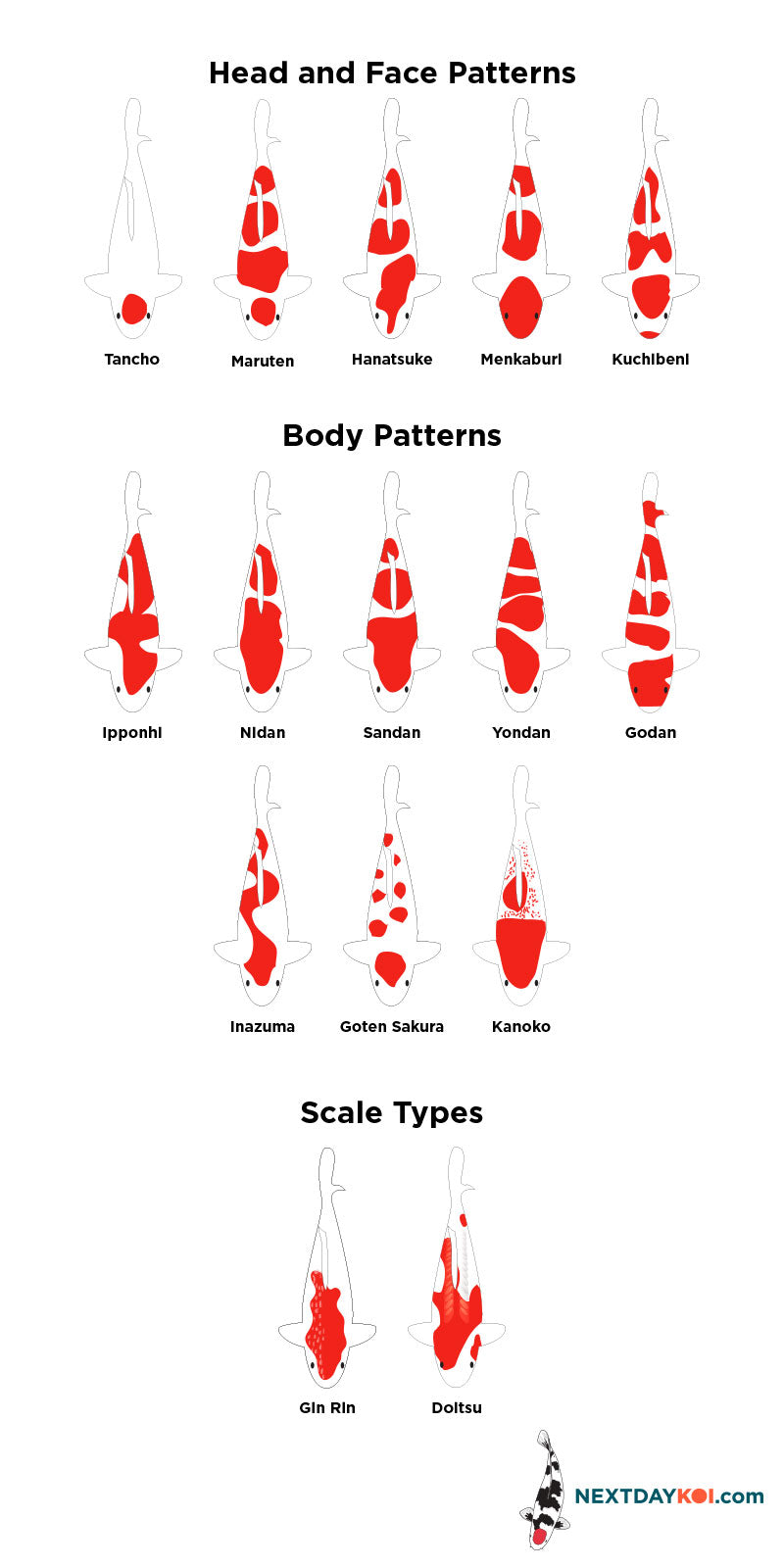
Nidan
A two-step red pattern.
Sandan
A three-step pattern.
One of the most popular traditional layouts.
Yondan
A four-step pattern.
Inazuma
A lightning-shaped pattern running through the body.
Highly prized when balanced correctly.
Maruten Kohaku
Features a separate head marking in addition to body patterning.
Strong maruten placement is highly valued.
Why Body Conformation Matters More Than Pattern
Beginners often focus excessively on patterns.
Experienced hobbyists prioritize body structure first.
A top-quality body should show:
-
Broad shoulders
-
Thick tail tube
-
Smooth taper
-
Strong bone structure
-
Balanced proportions
Excellent body conformation supports future jumbo growth.
Understanding Taisho Sanke
Sanke are often described as an extension of Kohaku with black accents.
What Defines a Sanke?
Sanke display:
-
White base
-
Red patterning
-
Black markings
Unlike Showa, black should not dominate the body.
The Key Difference Between Sanke and Showa
This is where many beginners become confused.
Sanke
-
White-based koi
-
Black appears as accent markings
Showa
-
Black-based koi
-
Black forms part of the underlying structure
This distinction is fundamental.
Sumi in Sanke Appreciation
“Sumi” refers to black pigmentation.
In Sanke, sumi should appear:
-
Balanced
-
Refined
-
Elegant
-
Secondary to the red pattern
Heavy aggressive sumi is usually less desirable in traditional Sanke.
Modern vs Traditional Sanke
Modern bloodlines often feature:
-
Larger sumi blocks
-
More dramatic contrast
-
Cleaner white skin
Traditional Sanke tended to display lighter black placement.
Ideal Sanke Sumi Placement
Good Sanke sumi typically:
-
Avoids overcrowding
-
Balances the body visually
-
Enhances movement through the pattern
Why Head Sumi Is Controversial in Sanke
Traditional Sanke standards generally avoid heavy black on the head.
Small sumi accents may appear acceptable, but excessive head black often shifts the fish visually toward Showa characteristics.
Tejima and Fine Sumi Details
“Tejima” refers to striped black markings in the fins.
Light tejima may add elegance to Sanke.
Heavy fin black often becomes less desirable.
Appreciating Showa Sanshoku
Showa are among the most dramatic and visually powerful koi varieties.
What Defines a Showa?
Showa contain:
-
Black base coloration
-
Red markings
-
White patterning
Unlike Sanke, the black structure forms the foundation of the fish.
Why Showa Appreciation Is More Complex
Showa undergo enormous transformation as they mature.
Young Showa may look completely different years later.
This makes future potential evaluation extremely important.
Understanding the Power of Sumi in Showa
Strong sumi is central to Showa identity.
Good Showa sumi should appear:
-
Deep
-
Lacquer-like
-
Thick
-
Powerful
Weak gray sumi lowers overall impact.
Menware: One of the Most Iconic Showa Traits
“Menware” refers to a lightning-like black division on the face.
Strong menware often enhances:
-
Drama
-
Symmetry
-
Visual power
Motoguro and Fin Balance
“Motoguro” refers to black coloration at the base of pectoral fins.
Balanced motoguro helps anchor the fish visually.
Uneven motoguro may reduce harmony.
Why Modern Showa Look Different Than Older Bloodlines
Modern breeders have dramatically refined Showa genetics.
Contemporary Showa often display:
-
Cleaner white
-
Brighter beni
-
More refined sumi
-
Improved body structure
Older Showa bloodlines were often darker and heavier.
The Role of Skin Quality Across All Gosanke
Skin quality may be the single most important factor separating average koi from elite koi.
High-Quality Skin Should Appear:
-
Glossy
-
Thick
-
Bright
-
Healthy
-
Luminous
Top-level koi almost seem to glow underwater.
Why Water Quality Affects Appearance
Even elite koi cannot display full potential in poor water conditions.
Water quality affects:
-
Color intensity
-
Skin brightness
-
Growth
-
Stress levels
This is why advanced hobbyists invest heavily in filtration systems.
Understanding Future Potential vs Current Appearance
One of the hardest lessons for beginners is understanding that young koi are often purchased for future development rather than current beauty.
Tategoi: Future Potential Koi
“Tategoi” refers to koi expected to improve dramatically over time.
These fish may:
-
Have unfinished sumi
-
Immature body structure
-
Developing patterns
Experienced hobbyists learn to predict long-term development.
Why Young Koi Change So Much
Koi coloration evolves continuously.
Changes may include:
-
Sumi emergence
-
Beni thickening
-
Pattern refinement
-
Body expansion
This dynamic development is part of the hobby’s appeal.
Common Beginner Mistakes When Evaluating Gosanke
Mistake #1: Focusing Only on Bright Colors
Brightness alone does not indicate quality.
Mistake #2: Ignoring Body Shape
Poor structure limits future development.
Mistake #3: Preferring Overcrowded Patterns
Too much pattern often reduces elegance.
Mistake #4: Judging Young Showa Too Early
Showa transformations take years.
How Koi Shows Judge Gosanke
Koi competitions evaluate many categories simultaneously.
Judges assess:
-
Body conformation
-
Skin quality
-
Pattern balance
-
Presence
-
Condition
-
Variety characteristics
Large mature koi with exceptional balance usually dominate major awards.
Why Simplicity Often Wins
Many beginners prefer flashy chaotic patterns.
Experienced judges often favor:
-
Clean layouts
-
Elegant spacing
-
Balanced contrast
Simplicity can create greater visual impact.
The Importance of Odome
“Odome” refers to the white space before the tail.
Good odome creates:
-
Visual balance
-
Pattern completion
-
Elegant finishing
Poor odome may make patterns feel cramped.
Bloodlines Matter More Than Beginners Realize
Different breeders specialize in different strengths.
Some bloodlines emphasize:
-
Jumbo growth
-
Thick beni
-
Powerful sumi
-
Refined skin
Understanding breeder reputation becomes increasingly important at advanced levels.
Japanese Breeders and Their Influence
Famous breeders helped shape modern Gosanke standards.
Well-known breeder names often include:
-
Dainichi
-
Sakai
-
Momotaro
-
Isa
-
Omosako
Each breeder has recognizable stylistic tendencies.
Why Pond Environment Influences Koi Beauty
Even genetically elite koi require proper conditions.
Important factors include:
-
Stable water parameters
-
High oxygen levels
-
Low stress
-
Balanced nutrition
-
Adequate pond size
Environment strongly affects long-term development.
Feeding and Color Development
Nutrition plays a major role in:
-
Beni quality
-
Skin luster
-
Growth rate
However, excessive color-enhancing foods may create unnatural appearance if overused.
The Role of Sunlight in Koi Appearance
Moderate natural sunlight often improves:
-
Skin brightness
-
Color richness
-
Overall vitality
But excessive UV exposure may create stress in shallow ponds.
Why Serious Koi Appreciation Takes Years
Koi judging is highly nuanced.
Developing an advanced eye requires:
-
Observation
-
Experience
-
Comparing bloodlines
-
Watching koi mature
-
Studying show winners
Over time, hobbyists begin seeing subtle qualities invisible to beginners.
The Emotional Side of Gosanke Appreciation
Beyond technical judging, Gosanke also carry emotional and artistic value.
Each variety creates a different feeling:
Kohaku
Elegant simplicity.
Sanke
Refined sophistication.
Showa
Dynamic power and drama.
This emotional resonance is part of why koi keeping becomes so addictive.
Why Gosanke Remain the Center of the Koi World
Despite the development of countless modern varieties, Gosanke still represent the highest level of koi appreciation because they combine:
-
Technical breeding difficulty
-
Artistic balance
-
Historical prestige
-
Dynamic development
-
Competitive excellence
Mastering Gosanke evaluation builds the foundation for understanding all other koi varieties.
Final Thoughts
Learning to distinguish and appreciate Kohaku, Sanke, and Showa is one of the most important milestones in becoming a serious koi enthusiast. While beginners may initially focus on simple color differences, true appreciation requires understanding body conformation, skin quality, pattern balance, sumi development, bloodline characteristics, and long-term growth potential.
Kohaku teaches the elegance of simplicity and refinement. Sanke introduces balance and subtle sophistication. Showa demonstrates dramatic contrast and evolving power. Together, these three core bloodlines form the artistic and technical heart of the entire koi hobby.
As hobbyists gain experience, they begin to realize that great koi are not judged by a single feature, but by the harmony of all elements working together. That balance — between color, structure, movement, and future potential — is what transforms ordinary fish into living masterpieces admired by collectors around the world.