Introduction: Why UV Wavelength Matters More Than You Think
In modern manufacturing, ultraviolet (UV) curing technology has become an essential process for improving production speed, product quality, and material performance. From electronic assembly and optical bonding to printing, coating, medical device manufacturing, and industrial adhesive applications, UV lamps provide a fast and efficient way to transform liquid materials into durable solid structures.
However, choosing the right industrial UV lamp is not simply about selecting a device with higher power output. One of the most important factors that directly influences curing results is wavelength.
Among the most commonly used UV curing wavelengths, 365nm and 395nm are two popular choices. Although they may appear similar, the difference between them can significantly affect curing depth, reaction speed, adhesive performance, surface quality, and long-term reliability.
Many manufacturers make the mistake of focusing only on UV intensity while ignoring wavelength compatibility. A powerful UV lamp with the wrong wavelength may produce incomplete curing, weak bonding strength, surface defects, or inconsistent production results.
Understanding the relationship between UV wavelength and curing chemistry allows engineers and manufacturers to select the right UV equipment for their specific applications.
This article explores the key differences between 365nm and 395nm UV lamps, explains how wavelength affects curing performance, and provides practical guidance for industrial UV lamp selection.
Understanding UV Curing Technology
UV curing is a photochemical process that uses ultraviolet light energy to initiate a chemical reaction. Unlike traditional heat curing methods, UV curing does not rely primarily on temperature. Instead, it uses specific wavelengths of light to activate photoinitiators inside UV-sensitive materials.
A typical UV curing system includes:
-
A UV light source
-
A UV-sensitive resin, adhesive, coating, or ink
-
Photoinitiators within the material
-
A controlled exposure environment
When UV light reaches the material surface, photoinitiators absorb the energy and generate reactive species, such as free radicals or cations. These reactive particles trigger polymerization, transforming liquid molecules into a solid polymer structure.
The efficiency of this process depends on several factors:
-
UV wavelength compatibility
-
Light intensity
-
Exposure time
-
Material thickness
-
Photoinitiator type
-
Distance between lamp and material
-
Surface conditions
Among these factors, wavelength determines whether the UV energy can effectively activate the chemical components inside the material.
A mismatch between UV lamp wavelength and photoinitiator absorption range can lead to poor curing performance, even when the lamp provides sufficient power.
What Does UV Wavelength Mean?
UV wavelength refers to the distance between repeating waves of ultraviolet light. It is measured in nanometers (nm).
Different UV wavelengths have different energy levels and penetration characteristics.
Generally:
-
Shorter wavelengths provide higher photon energy but lower penetration depth.
-
Longer wavelengths provide lower photon energy but better material penetration.
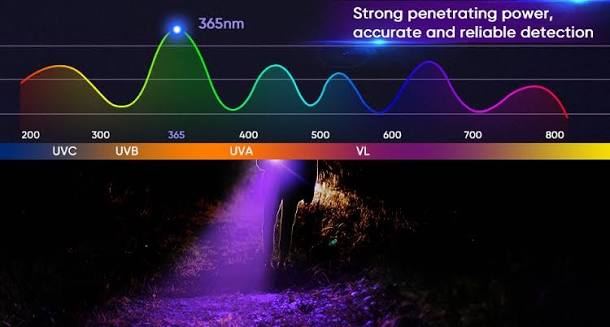
Industrial UV curing typically uses wavelengths ranging from approximately 320nm to 450nm, depending on application requirements.
Common UV curing ranges include:
UV-A Range (320nm–400nm)
UV-A wavelengths are widely used for industrial curing because they provide effective polymerization while offering better penetration compared with shorter UV wavelengths.
Both 365nm and 395nm belong to the UV-A category.
Near Visible Violet Range (400nm–450nm)
These wavelengths provide even deeper penetration and are often used in applications where visibility and reduced material absorption are important.
Although 365nm and 395nm are close in numerical value, their interaction with curing materials can be very different.
365nm UV Lamps: High Energy and Precise Surface Curing
A 365nm UV lamp is one of the most widely used wavelengths in industrial curing applications.
It is commonly selected for applications requiring:
-
Strong chemical activation
-
High bonding strength
-
Precise curing control
-
Excellent surface performance
The reason is that many traditional UV photoinitiators have strong absorption around the 365nm range.
Advantages of 365nm UV Curing
1. Strong Photoinitiator Activation
Many UV adhesives and coatings are specifically formulated to respond efficiently to 365nm light.
When the photoinitiator absorbs 365nm energy, it can quickly generate reactive particles, accelerating polymerization.
This results in:
-
Faster curing reactions
-
Higher conversion rates
-
Stronger final material properties
For precision applications such as optical bonding or electronic assembly, this characteristic is extremely valuable.
2. Excellent Surface Curing Quality
365nm UV light is particularly effective for achieving a hard and durable surface finish.
Applications that benefit from this include:
-
Protective coatings
-
Optical components
-
Display manufacturing
-
Decorative finishes
-
Precision electronics
A properly matched 365nm system can reduce common curing problems such as:
-
Sticky surfaces
-
Incomplete polymerization
-
Poor chemical resistance
3. Better Compatibility With Specialized UV Materials
Many high-performance industrial materials are designed around 365nm curing technology.
Examples include:
-
Optical adhesives
-
Medical-grade UV adhesives
-
Electronic encapsulation materials
-
High-strength bonding agents
Manufacturers often choose 365nm systems when material specifications require maximum reliability.
Limitations of 365nm UV Lamps
Although 365nm offers excellent curing performance, it is not always the best choice.
1. Limited Penetration Depth
Because 365nm has higher energy absorption characteristics, some materials may absorb the light near the surface.
This can create challenges when curing:
-
Thick adhesive layers
-
Filled polymers
-
Dark-colored coatings
-
Highly pigmented materials
In these cases, the surface may cure properly while deeper areas remain partially uncured.
2. Higher Material Sensitivity
Some materials require very specific wavelength matching.
If the photoinitiator is not optimized for 365nm exposure, curing efficiency may decrease.
Manufacturers must always consider the chemical formulation of the material before selecting a lamp.
395nm UV Lamps: Deeper Penetration and Versatile Performance
395nm UV lamps have become increasingly popular due to their versatility, affordability, and ability to cure a wide range of materials.
They are commonly found in:
-
Industrial inspection systems
-
UV printing
-
General adhesive curing
-
Resin curing
-
Manufacturing equipment
Compared with 365nm, 395nm provides longer wavelength UV-A energy with slightly lower photon energy but improved penetration characteristics.
Advantages of 395nm UV Curing
1. Better Light Penetration
One of the biggest advantages of 395nm is improved penetration into materials.
Longer wavelengths generally travel deeper through certain polymers and coatings.
This makes 395nm suitable for:
-
Thicker resin layers
-
Larger adhesive areas
-
3D printing materials
-
Transparent plastics
When curing depth is a priority, 395nm can provide better overall results.
2. Wider Material Compatibility
Many modern UV-sensitive materials are designed to respond to wavelengths around 395nm.
These include:
-
Acrylic-based resins
-
Industrial coatings
-
Printing inks
-
General-purpose UV adhesives
For manufacturers handling multiple product types, 395nm equipment offers greater flexibility.
3. Lower Equipment Cost and Longer LED Lifespan
Many industrial UV LED curing systems use 395nm LEDs because they are widely available and cost-effective.
Compared with some specialized UV wavelengths, 395nm systems often provide:
-
Lower initial investment
-
Easier maintenance
-
Reliable long-term operation
This makes them attractive for general industrial production environments.
Comparing 365nm and 395nm UV Lamps: Key Performance Differences
Although both 365nm and 395nm UV lamps belong to the UV-A spectrum, their differences in energy distribution and material interaction create noticeable performance variations.
Selecting between these two wavelengths requires understanding how they influence curing speed, depth, bonding strength, and production efficiency.
The following comparison highlights the major differences:
| Performance Factor | 365nm UV Lamp | 395nm UV Lamp |
|---|---|---|
| Photon Energy | Higher | Lower |
| Surface Curing | Excellent | Good |
| Deep Curing Ability | Moderate | Better |
| Photoinitiator Activation | Strong for many traditional formulas | Strong for modern UV materials |
| Precision Applications | Excellent | Good |
| Thick Material Curing | Limited | Better |
| General Industrial Use | Moderate | Excellent |
| Equipment Cost | Usually higher | Usually lower |
Neither wavelength is universally better. The correct choice depends on the material chemistry and production requirements.
How Wavelength Affects UV Curing Depth
One of the most important differences between 365nm and 395nm UV lamps is curing depth.
Curing depth refers to how far UV energy can effectively penetrate into a material and complete polymerization.
For thin layers, wavelength differences may not be obvious. However, when working with thicker materials, the difference becomes significant.
365nm: Excellent for Thin and Precision Layers
Because 365nm UV energy is strongly absorbed by many photoinitiators, it creates a powerful reaction near the surface.
This makes it ideal for:
- Thin adhesive layers
- Electronic components
- Optical assembly
- Micro-precision manufacturing
For example, when bonding a small camera lens module, manufacturers often require precise surface activation and strong adhesion without excessive exposure time. A 365nm system can provide the controlled curing performance needed for such applications.
However, if the adhesive layer becomes too thick, surface absorption may prevent sufficient energy from reaching deeper areas.
395nm: Better for Thick and Transparent Materials
395nm wavelengths generally penetrate deeper into many transparent polymers.
This makes them useful for:
- Thick resin parts
- Industrial coatings
- 3D printed components
- Large-area adhesive curing
For example, in resin-based 3D printing, deeper penetration helps cure larger volumes of material more evenly.
The trade-off is that some highly specialized materials may not achieve the same surface hardness as they would under a properly matched 365nm system.
The Relationship Between Photoinitiators and UV Wavelength
Choosing a UV lamp without considering photoinitiators is one of the most common mistakes in industrial curing.
Photoinitiators are chemical compounds added to UV-sensitive materials. Their job is to absorb UV energy and start the curing reaction.
Different photoinitiators respond to different wavelengths.
Some are optimized for:
- 365nm
- 385nm
- 395nm
- 405nm
A UV lamp can only work effectively when its wavelength matches the absorption range of the photoinitiator.
For example:
A coating designed for 365nm exposure may cure poorly under a 395nm lamp, even if the lamp has higher optical power.
Likewise, a modern resin designed for 395nm LED curing may not achieve maximum efficiency under a traditional 365nm system.
Therefore, before selecting equipment, manufacturers should check:
- Material technical specifications
- Recommended curing wavelength
- Required energy dosage
- Maximum curing thickness
The lamp and material must work as a complete system.
Industrial Applications: Which Wavelength Should You Choose?
Different industries have different curing requirements. The best wavelength depends on the specific production process.
1. Electronics Manufacturing
Electronic manufacturing often requires extremely reliable bonding and protection.
Applications include:
- Circuit board assembly
- Sensor packaging
- Component fixing
- Display bonding
- Semiconductor-related processes
Recommended wavelength: 365nm
Why?
Electronic components usually require:
- Strong adhesion
- Low curing defects
- Precise positioning
- Excellent reliability
365nm UV lamps provide excellent control and are widely used with high-performance electronic adhesives.
They are especially suitable when:
- Adhesive layers are thin
- Components are sensitive
- Surface quality is critical
2. Optical Bonding Applications
Optical manufacturing has some of the highest curing requirements.
Examples include:
- Camera lenses
- Fiber optic components
- Optical sensors
- Touch panels
Recommended wavelength: 365nm
Optical adhesives often require:
- High transparency
- Low shrinkage
- Strong bonding
- Minimal stress
365nm systems are commonly selected because they provide controlled polymerization and excellent material compatibility.
Improper wavelength selection may cause:
- Optical distortion
- Adhesive weakness
- Internal stress
- Reduced product lifespan
3. UV Printing and Ink Curing
UV printing involves fast curing of inks and coatings.
Applications include:
- Packaging printing
- Labels
- Industrial marking
- Decorative printing
Recommended wavelength: 395nm
Many modern UV inks are formulated for longer UV-A wavelengths.
395nm lamps offer:
- Efficient ink drying
- Large-area coverage
- Good production speed
For high-speed printing lines, 395nm LED systems are often preferred because of their efficiency and durability.
4. Industrial Coatings
UV coatings are widely used for:
- Wood finishing
- Plastic protection
- Metal coating
- Automotive parts
The choice depends on coating thickness.
Thin coatings:
365nm may provide better surface performance.
Thick coatings:
395nm may provide better penetration.
Manufacturers should consider:
- Coating composition
- Pigment concentration
- Required hardness
- Production speed
5. UV Resin and 3D Printing
The popularity of UV resin manufacturing has increased demand for longer wavelength curing systems.
Applications include:
- Rapid prototyping
- Jewelry models
- Engineering parts
- Customized components
Recommended wavelength: 395nm
Reasons include:
- Better resin penetration
- More uniform curing
- Wider resin compatibility
Many consumer and industrial resin systems are specifically designed around 395nm or similar wavelengths.
6. Medical Device Manufacturing
Medical applications require strict quality control.
Products include:
- Disposable medical components
- Diagnostic equipment
- Surgical instruments
- Sensor assemblies
Recommended wavelength: Depends on material
For medical-grade adhesives requiring maximum bonding reliability:
365nm is often preferred.
For larger transparent resin structures:
395nm may be more suitable.
Manufacturers must follow material supplier recommendations and validate curing performance through testing.
How UV Intensity and Exposure Time Interact With Wavelength
Many people assume that increasing UV intensity can solve all curing problems. However, intensity cannot completely compensate for an incorrect wavelength.
UV curing depends on energy dosage:
Energy dosage = UV intensity × exposure time
A higher intensity lamp can deliver more energy, but if the material does not absorb that wavelength effectively, the curing reaction will remain inefficient.
For example:
A 395nm lamp with very high output may still fail to properly cure a material designed specifically for 365nm.
Similarly, a lower-power 365nm lamp may outperform a stronger 395nm lamp when curing a compatible adhesive.
The correct approach is:
- Match wavelength first.
- Confirm intensity requirements.
- Adjust exposure time.
- Validate final material performance.
Common Mistakes When Selecting Industrial UV Lamps
Mistake 1: Choosing the Highest Power Available
More power does not always mean better curing.
Excessive UV intensity can cause:
- Overheating
- Material discoloration
- Surface stress
- Reduced component lifespan
The goal is not maximum power but optimized curing conditions.
Mistake 2: Ignoring Material Specifications
Every UV-sensitive material has recommended curing conditions.
Manufacturers should review:
- Recommended wavelength
- Required energy dose
- Maximum curing thickness
- Exposure limitations
Selecting equipment before understanding the material often leads to production problems.
Mistake 3: Using One UV Lamp for Every Application
Different production processes have different requirements.
A factory producing:
- Optical components
- Printed products
- Industrial coatings
may require different UV wavelengths for different production lines.
A universal solution rarely provides optimal results.
How to Test Whether a UV Lamp Matches Your Material
Before purchasing industrial UV equipment, manufacturers should perform testing.
A practical evaluation process includes:
Step 1: Check Material Documentation
Review technical information from the adhesive, coating, or resin manufacturer.
Look for:
- Recommended wavelength range
- Minimum energy requirements
- Curing time recommendations
Step 2: Perform Small-Scale Testing
Test different conditions:
- Different wavelengths
- Different exposure times
- Different lamp distances
Measure:
- Adhesion strength
- Hardness
- Surface quality
- Chemical resistance
Step 3: Evaluate Long-Term Performance
Immediate curing results are not enough.
A properly cured product should maintain performance after:
- Temperature changes
- Mechanical stress
- Environmental exposure
Long-term reliability is especially important in industrial applications.
Future Trends in Industrial UV LED Curing Technology
UV curing technology continues to evolve rapidly.
Modern manufacturers are moving from traditional mercury lamps toward UV LED systems because of advantages such as:
- Lower energy consumption
- Longer operating life
- Reduced maintenance
- Better process control
- Less heat generation
UV LED technology is also expanding available wavelengths.
Future systems may combine multiple wavelengths, such as:
- 365nm for surface activation
- 385nm for balanced curing
- 395nm for deeper penetration
Multi-wavelength curing systems can provide better performance for complex materials.
Final Guide: Choosing Between 365nm and 395nm UV Lamps
The decision between 365nm and 395nm should be based on application requirements rather than wavelength popularity.
Choose 365nm UV lamps when you need:
- Precision curing
- Strong surface bonding
- Optical-grade performance
- High reliability
- Thin-layer curing
Choose 395nm UV lamps when you need:
- Greater penetration depth
- General industrial versatility
- Thick resin curing
- Large-area applications
- Cost-effective operation
The most important factor is compatibility between the UV lamp wavelength and the material photochemistry.
A correctly selected UV lamp can improve production efficiency, reduce defects, and increase product reliability. A poorly matched wavelength can lead to incomplete curing, wasted materials, and unnecessary production costs.
For industrial manufacturers, understanding the difference between 365nm and 395nm UV curing technology is not just a technical decision—it is a key factor in achieving stable and efficient manufacturing performance.