In today’s highly competitive manufacturing environment, companies are constantly searching for technologies that can improve production speed, product quality, energy efficiency, and reliability. Among the many advanced manufacturing solutions available, ultraviolet (UV) curing technology has become one of the most important tools across a wide range of industries.
UV lamps, once considered a specialized technology used only in limited applications, are now widely adopted in industries ranging from automotive production and electronics assembly to medical devices, printing, and advanced microelectronics.
The reason behind this rapid adoption is simple: UV curing provides manufacturers with a fast and efficient way to solidify coatings, adhesives, inks, and protective materials through controlled ultraviolet exposure.
Unlike traditional thermal curing methods, which often require long heating periods, UV curing can complete chemical reactions within seconds or minutes. This allows manufacturers to increase production efficiency while reducing energy consumption and improving process consistency.
Modern UV lamp systems offer several advantages, including:
- Fast curing speeds
- Precise process control
- Reduced heat generation
- Lower energy consumption
- Improved production automation
- Enhanced product quality
As industries continue to demand smaller components, stronger materials, and faster manufacturing cycles, UV lamp technology has become an essential part of advanced production processes.
This article explores five major industrial fields where UV lamps are widely used and explains how this technology helps manufacturers achieve better performance.
1. Automotive Manufacturing: Improving Durability and Production Efficiency
The automotive industry is one of the largest users of industrial UV curing technology. Modern vehicles contain thousands of components that require strong bonding, protective coatings, and high-quality surface finishes.
From interior parts to electronic systems, UV lamps play an important role in improving manufacturing efficiency and product reliability.
UV Curing Applications in Automotive Production
1. Automotive Adhesive Bonding
Modern vehicles increasingly use lightweight materials such as:
- Plastic composites
- Carbon fiber materials
- Aluminum components
- Advanced polymers
Traditional mechanical fastening methods are often replaced or supported by adhesive bonding.
UV-curable adhesives provide several benefits:
- Fast assembly speeds
- Strong bonding performance
- Reduced mechanical stress
- Improved design flexibility
Applications include:
- Interior panels
- Dashboard components
- Lighting assemblies
- Sensors
- Display modules
Because UV adhesives can cure rapidly after exposure to ultraviolet light, manufacturers can reduce waiting time and improve automated production efficiency.
2. Automotive Coatings and Surface Protection
Vehicle components require durable coatings to withstand:
- Temperature changes
- Moisture
- Chemicals
- Mechanical wear
- UV exposure from sunlight
UV curing technology is commonly used for:
- Protective coatings
- Decorative finishes
- Scratch-resistant layers
- Plastic surface treatments
The fast curing process allows manufacturers to achieve high-quality finishes while reducing production space requirements.
3. Automotive Electronics Manufacturing
Modern vehicles contain increasingly complex electronic systems, including:
- Cameras
- Sensors
- Control modules
- Touch displays
- LED lighting systems
These components require precise protection against environmental damage.
UV-curable materials are used for:
- Electronic encapsulation
- Component fixation
- Protective coatings
The accuracy of UV curing helps protect sensitive electronic components without exposing them to excessive heat.
Why UV Lamps Are Valuable in Automotive Manufacturing
The automotive industry benefits from UV lamp technology because it supports:
Faster Production Lines
Automotive manufacturing depends on high-speed assembly. UV curing reduces waiting periods and improves workflow efficiency.
Better Quality Control
Controlled UV exposure provides consistent curing results, reducing defects caused by uneven processing.
Lightweight Vehicle Design
Adhesive bonding supported by UV technology allows engineers to combine different materials while reducing vehicle weight.
Lower Manufacturing Costs
Faster curing cycles and reduced energy consumption contribute to improved production economics.
2. Electronics Manufacturing: Precision Curing for Advanced Components
The electronics industry is another major field where UV lamps are widely used.
As electronic devices become smaller and more powerful, manufacturers require extremely precise bonding and protection technologies.
Smartphones, computers, wearable devices, and industrial electronics all depend on advanced assembly processes where UV curing plays an important role.
UV Applications in Electronic Assembly
Micro Component Bonding
Electronic manufacturing often involves extremely small components that require precise positioning.
UV-curable adhesives are used for:
- Component fixation
- Lens assembly
- Display bonding
- Sensor attachment
Because UV curing can be completed quickly, manufacturers can maintain high production speeds while achieving accurate assembly.
PCB Protection and Conformal Coating
Printed circuit boards (PCBs) are sensitive to:
- Moisture
- Dust
- Chemicals
- Temperature changes
UV-curable coatings provide protective layers that extend product lifespan.
Applications include:
- Consumer electronics
- Industrial controllers
- Automotive circuit boards
- Communication equipment
UV lamps allow these coatings to cure rapidly and evenly.
Display Manufacturing
Modern displays require highly accurate assembly.
UV technology is used in:
- LCD production
- OLED assembly
- Touchscreen bonding
- Optical component installation
The advantages include:
- Minimal thermal impact
- High positioning accuracy
- Fast processing
This makes UV curing particularly suitable for delicate electronic components.
The Importance of UV LED Technology in Electronics
Traditional UV lamps have been widely used for decades, but UV LED curing systems are becoming increasingly popular in electronics manufacturing.
UV LEDs provide:
- More precise wavelengths
- Longer operating life
- Lower heat output
- Better energy efficiency
These advantages are especially important for miniaturized electronic components that cannot tolerate excessive heat.
3. Medical Device Manufacturing: Ensuring Safety and Reliability
The medical device industry requires some of the highest standards in manufacturing. Products must meet strict requirements for safety, durability, cleanliness, and performance.
UV curing technology has become an important solution for medical manufacturers because it provides fast, controlled, and reliable bonding and coating processes without exposing sensitive components to excessive heat.
Medical products often contain complex materials, including:
- Medical-grade plastics
- Glass components
- Silicone materials
- Metal parts
- Optical elements
These materials require specialized bonding methods that can maintain performance under demanding conditions.
UV Lamp Applications in Medical Device Production
Medical Adhesive Bonding
One of the most common applications of UV lamps in medical manufacturing is adhesive curing.
UV-curable adhesives are widely used for assembling:
- Catheters
- Syringes
- Diagnostic devices
- Blood analysis equipment
- Medical sensors
- Optical medical instruments
The advantages of UV adhesive bonding include:
Fast Processing Speed
Medical device manufacturers often operate high-volume production lines. UV curing allows adhesive joints to solidify quickly, improving production efficiency.
Clean Manufacturing Process
Unlike some traditional bonding methods, UV curing does not require high-temperature processing or long drying periods.
Precise Bond Control
Medical components often require extremely accurate assembly. UV curing allows manufacturers to control exactly where and when bonding occurs.
Optical Medical Equipment and UV Technology
Many medical instruments depend on optical components, including:
- Endoscopes
- Imaging systems
- Diagnostic equipment
- Laboratory instruments
These products require clear optical performance and reliable assembly.
UV-curable optical adhesives help maintain:
- Transparency
- Alignment accuracy
- Long-term stability
Because UV curing creates strong bonds without significant thermal stress, it is suitable for sensitive optical applications.
Protective Coatings for Medical Components
Medical devices frequently require protective coatings to improve resistance against:
- Chemicals
- Moisture
- Cleaning processes
- Environmental exposure
UV-cured coatings provide:
- Strong surface protection
- Fast production cycles
- Consistent coating quality
This technology helps manufacturers produce safer and more durable medical products.
4. Printing and Packaging Industry: Enhancing Quality and Production Speed
The printing and packaging industry is one of the earliest and most widespread users of UV curing technology.
As customers demand higher-quality packaging, sharper graphics, and faster production, UV lamps have become an essential part of modern printing systems.
UV Printing Applications
UV lamps are commonly used to cure:
- Printing inks
- Coatings
- Varnishes
- Adhesive layers
During the printing process, UV light instantly hardens liquid ink after application.
This creates several advantages.
Faster Drying and Higher Production Efficiency
Traditional printing methods often require waiting periods for ink to dry.
UV curing eliminates much of this waiting time because the ink solidifies immediately after exposure.
Benefits include:
- Faster printing speeds
- Reduced production delays
- Higher manufacturing capacity
Improved Print Quality
UV curing helps maintain sharp and accurate images.
Advantages include:
- Reduced ink spreading
- Better color stability
- Enhanced surface appearance
- Improved detail reproduction
This is especially important for:
- Luxury packaging
- Product labels
- Advertising materials
- High-end publications
Printing on More Types of Materials
Traditional printing methods are often limited by material compatibility.
UV printing technology allows printing on a wider range of surfaces, including:
- Plastic
- Glass
- Metal
- Wood
- Specialty films
This flexibility makes UV lamps valuable in packaging, decoration, and industrial printing applications.
UV Coating Applications in Packaging
Packaging manufacturers use UV-curable coatings to create:
- Glossy finishes
- Protective surfaces
- Scratch resistance
- Premium visual effects
Examples include:
- Cosmetic packaging
- Beverage containers
- Electronics packaging
- High-end product boxes
UV coatings improve both appearance and durability.
5. Microelectronics and Semiconductor Manufacturing: Supporting Next-Generation Technology
Among all industrial applications, microelectronics manufacturing represents one of the most demanding environments for UV curing technology.
As electronic devices become smaller and more powerful, manufacturers require extremely precise processes.
UV lamps are widely used in:
- Semiconductor packaging
- Sensor manufacturing
- Optical devices
- Microelectronic assembly
- Advanced component production
UV Applications in Microelectronics
Wafer-Level Processes
Semiconductor manufacturing involves highly precise processes where contamination, heat, and dimensional changes must be carefully controlled.
UV technology supports applications such as:
- Photoresist processing
- Surface treatment
- Material modification
- Precision bonding
The controlled energy output of UV systems makes them suitable for advanced semiconductor environments.
Semiconductor Packaging
Modern chips require reliable packaging solutions to protect internal structures.
UV-curable materials are used for:
- Die bonding
- Encapsulation
- Component fixation
- Protective coatings
Benefits include:
- Rapid curing
- High accuracy
- Reduced thermal stress
These advantages are critical for advanced electronic devices.
Optical and Photonic Components
The growth of technologies such as:
- Fiber optics
- Laser systems
- Imaging sensors
- Communication devices
has increased demand for precision UV curing.
UV adhesives help assemble optical components while maintaining alignment accuracy and long-term stability.
Why UV Lamps Are Essential Across These Industries
Although automotive, electronics, medical, printing, and microelectronics industries have different requirements, they all benefit from the same core advantages of UV technology.
1. Rapid Manufacturing Processes
Speed is one of the biggest advantages of UV curing.
Traditional curing methods may require:
- Hours of drying
- High-temperature ovens
- Large production spaces
UV curing can complete many processes within seconds.
This allows manufacturers to:
- Increase output
- Reduce production space
- Improve workflow efficiency
2. Lower Energy Consumption
Compared with thermal curing systems, UV lamps can significantly reduce energy usage.
Traditional ovens must heat large areas and maintain high temperatures for extended periods.
UV curing focuses energy directly on the material requiring treatment.
This improves energy efficiency and reduces operating costs.
3. Better Process Accuracy
Modern manufacturing requires precise control.
UV systems allow manufacturers to adjust:
- Wavelength
- Light intensity
- Exposure time
- Curing position
This precision improves product consistency.
4. Reduced Heat Damage
Many modern products contain heat-sensitive materials.
UV curing provides a low-temperature alternative that protects:
- Electronic components
- Plastic parts
- Optical materials
- Medical devices
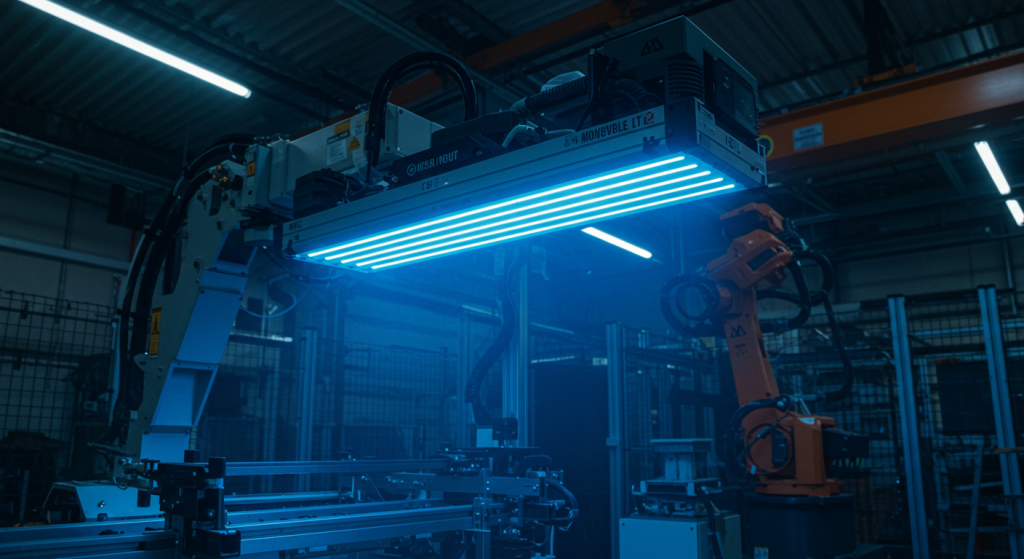
5. Easy Integration With Automation Systems
Modern factories increasingly rely on automation.
UV curing equipment can be integrated into:
- Robotic assembly lines
- Conveyor systems
- Automated inspection systems
- Smart manufacturing platforms
This improves production efficiency and reduces human error.
How to Choose the Right UV Lamp System for Industrial Applications
Different industries require different UV solutions.
Before selecting UV equipment, manufacturers should consider several factors.
1. Wavelength Requirements
The UV wavelength must match the material being cured.
Common industrial wavelengths include:
- 365 nm
- 385 nm
- 395 nm
- 405 nm
The correct wavelength ensures effective curing.
2. Light Intensity
Higher intensity is not always better.
The ideal intensity depends on:
- Material type
- Adhesive thickness
- Production speed
- Required curing depth
Proper testing is essential.
3. Operating Environment
Industrial conditions vary greatly.
Manufacturers should consider:
- Temperature control
- Dust protection
- Continuous operation requirements
- Equipment maintenance needs
4. Production Volume
High-volume factories may require:
- Automated UV systems
- Multiple curing stations
- Real-time monitoring
Smaller applications may benefit from compact UV curing solutions.
Future Trends in Industrial UV Lamp Technology
As manufacturing continues to evolve, UV technology will continue improving.
Several trends are shaping the future.
Growth of UV LED Systems
UV LEDs are becoming increasingly popular due to:
- Longer lifespan
- Lower energy consumption
- More precise wavelengths
- Reduced maintenance requirements
They are expected to replace many traditional UV lamp applications.
Intelligent UV Monitoring
Future UV systems will include more intelligent control features.
Advanced equipment may monitor:
- UV output
- Temperature
- Curing quality
- Equipment condition
Real-time data will help manufacturers maintain stable production.
More Environmentally Friendly Manufacturing
Sustainability is becoming increasingly important.
UV curing supports greener production by reducing:
- Energy consumption
- Solvent usage
- Production waste
This makes UV technology an attractive option for environmentally responsible manufacturing.
Conclusion: UV Lamps Are Powering the Future of Industrial Manufacturing
From automotive production lines to advanced microelectronics factories, UV lamps have become a critical technology supporting modern manufacturing.
Their ability to provide fast curing, precise processing, energy efficiency, and reliable performance makes them valuable across many industries.
The five major application fields discussed in this article include:
- Automotive manufacturing
- Electronics production
- Medical device manufacturing
- Printing and packaging
- Microelectronics and semiconductor industries
Each industry uses UV technology in different ways, but the goal remains the same: improving product quality, increasing manufacturing efficiency, and creating more reliable production processes.
As industries continue moving toward smarter, faster, and more sustainable manufacturing, UV lamp technology will play an increasingly important role.
For companies looking to improve bonding, coating, printing, or precision manufacturing processes, choosing the right UV curing solution can create significant advantages in productivity and product performance.