Imagine printing a full-color graphic and having the ink completely cured before the substrate leaves the printer. Picture a freshly coated automotive component that can move directly to the next production stage without waiting hours—or even days—for the finish to dry. Consider a manufacturing environment where productivity increases, floor space requirements shrink, and product quality improves simultaneously.
This is the power of UV curing technology.
For decades, manufacturers have searched for faster, cleaner, and more efficient ways to cure inks, coatings, adhesives, and finishes. Traditional drying methods often rely on heat, evaporation, or chemical reactions that require significant time and energy. UV curing fundamentally changes this process by using ultraviolet light to initiate an almost instantaneous chemical reaction.
Today, UV curing systems are used in countless industries, including inkjet printing, packaging, electronics manufacturing, medical devices, woodworking, aerospace, automotive production, and industrial coatings. What once seemed like a technological marvel has become a cornerstone of modern manufacturing.
But how exactly does UV curing work? Why can it transform a liquid coating into a durable solid surface within seconds? And why are so many industries replacing conventional drying technologies with UV-based systems?
This article explores the science, advantages, applications, and future of UV curing technology—and explains how it delivers the “instant dry” miracle that has revolutionized industrial production.
What Is UV Curing?
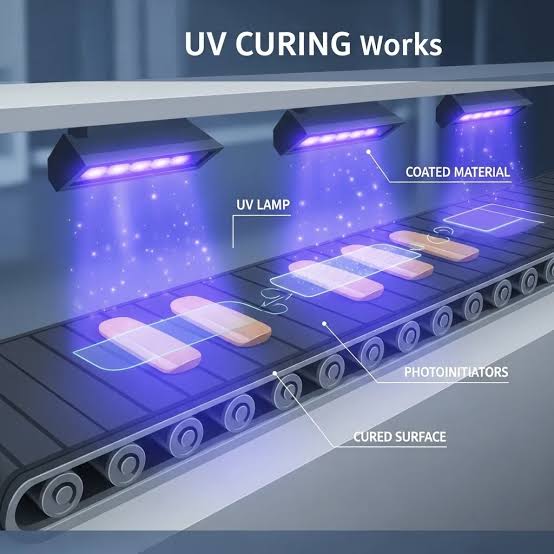
UV curing is a photochemical process that uses ultraviolet light to instantly cure specially formulated materials.
Unlike conventional drying, UV curing does not depend on solvent evaporation.
Instead, ultraviolet energy triggers a chemical reaction that rapidly converts liquid materials into solid polymers.
Materials commonly cured with UV light include:
-
UV inks
-
UV coatings
-
UV adhesives
-
UV varnishes
-
UV resins
-
Protective finishes
The process can occur in fractions of a second when exposed to the proper wavelength and intensity of ultraviolet radiation.
This speed is one of the primary reasons UV curing has become so popular across manufacturing industries.
Understanding the Science Behind UV Curing
To understand why UV curing is so fast, it helps to examine the chemistry involved.
A typical UV-curable formulation contains:
Monomers
Monomers are small molecules that serve as building blocks.
During curing, they link together to form larger molecular structures.
Oligomers
Oligomers provide the primary performance characteristics of the final coating or ink.
They influence:
-
Hardness
-
Flexibility
-
Chemical resistance
-
Durability
-
Adhesion
Photoinitiators
Photoinitiators are the secret ingredient.
When exposed to ultraviolet light, photoinitiators absorb UV energy and generate reactive species known as free radicals or cations.
These reactive molecules initiate polymerization.
Additives
Additional ingredients may enhance:
-
Color
-
Gloss
-
Scratch resistance
-
Weather resistance
-
Flow characteristics
When UV light activates the photoinitiators, a rapid chain reaction begins.
Within milliseconds, countless molecular bonds form, transforming the liquid into a solid material.
Unlike traditional drying methods, nothing needs to evaporate.
The coating simply changes state through polymerization.
Why Traditional Drying Takes So Long
Before UV curing became widespread, manufacturers relied on several conventional drying methods.
These include:
Air Drying
Air drying depends on natural solvent evaporation.
The process can require:
-
Minutes
-
Hours
-
Days
depending on coating thickness and environmental conditions.
Heat Drying
Ovens accelerate solvent evaporation through elevated temperatures.
While faster than air drying, heat drying still consumes considerable time and energy.
Chemical Curing
Certain coatings cure through chemical reactions triggered by mixing two components.
These systems often require extended curing periods.
Moisture-Curing Systems
Some materials react with atmospheric moisture.
Cure speed depends heavily on humidity and temperature.
All of these methods share a common limitation:
They require time.
UV curing eliminates this bottleneck by initiating an immediate chemical reaction.
The “Instant Dry” Advantage
The phrase “instant dry” is often used to describe UV curing.
Technically, the process is curing rather than drying.
However, from a production perspective, the effect appears nearly instantaneous.
Benefits include:
-
Immediate handling
-
Faster production speeds
-
Reduced work-in-process inventory
-
Increased throughput
-
Improved product consistency
In many manufacturing environments, parts can move directly to packaging, assembly, or shipment immediately after curing.
This dramatically improves operational efficiency.
UV Curing in Inkjet Printing
One of the most visible applications of UV curing technology is digital inkjet printing.
Traditional printing inks often require drying time before further processing.
This can slow production and increase the risk of smudging.
UV inkjet systems solve these challenges.
How UV Inkjet Printing Works
UV-curable ink is deposited onto a substrate.
Immediately afterward, UV lamps or UV LED systems expose the ink to ultraviolet light.
The ink cures almost instantly.
As a result:
-
Images remain sharp
-
Colors stay vibrant
-
Smearing is minimized
-
Production speed increases
Expanded Substrate Compatibility
Because UV inks do not depend on absorption, they can print on materials such as:
-
Glass
-
Metal
-
Plastic
-
Acrylic
-
Wood
-
Ceramic
-
Packaging films
This versatility has expanded opportunities in industrial printing and custom graphics.
Improved Print Quality
UV-cured inks offer:
-
High color density
-
Excellent durability
-
Strong adhesion
-
Enhanced scratch resistance
These characteristics make UV printing ideal for demanding applications.
UV Curing in Packaging and Label Production
The packaging industry has embraced UV curing technology for several reasons.
Manufacturers require:
-
Fast turnaround times
-
High-quality graphics
-
Consistent results
UV curing helps achieve all three.
Benefits include:
-
Immediate finishing
-
Faster converting processes
-
Reduced waste
-
Improved print durability
Food packaging, beverage labels, cosmetic containers, and pharmaceutical products frequently utilize UV-cured printing technologies.
UV Curing in Electronics Manufacturing
Modern electronics require precise assembly and protection.
UV curing plays a critical role in:
-
Component bonding
-
Encapsulation
-
Conformal coatings
-
Display manufacturing
Because UV curing is highly controllable, manufacturers can cure specific areas without affecting surrounding components.
This precision supports the production of increasingly compact electronic devices.
UV Adhesives and Precision Bonding
UV-curable adhesives offer several advantages over traditional adhesives.
Manufacturers can:
-
Position components accurately
-
Verify alignment
-
Activate curing only when ready
This level of control is especially valuable in:
-
Medical devices
-
Optical assemblies
-
Electronic sensors
-
Consumer electronics
The result is improved accuracy and reduced assembly errors.
UV Curing in Wood Finishing
Furniture manufacturers increasingly use UV curing systems.
Traditional wood finishes often require multiple drying stages.
UV-curable coatings provide:
-
Faster production
-
Higher gloss levels
-
Enhanced durability
-
Reduced floor space requirements
Cabinets, flooring, furniture panels, and decorative surfaces frequently utilize UV-cured finishes.
Automotive Manufacturing and UV Curing
One of the most impressive applications of UV technology is found in automotive production.
Automobile manufacturers constantly seek methods to improve productivity while maintaining exceptional finish quality.
UV curing has become an important solution.
Why Automotive Coatings Matter
Automotive coatings serve multiple purposes.
They provide:
-
Aesthetic appeal
-
Corrosion resistance
-
Chemical protection
-
UV resistance
-
Scratch resistance
Modern vehicles contain numerous coated components requiring reliable finishing processes.
UV-Cured Automotive Parts
UV curing is commonly used for:
-
Headlamp assemblies
-
Interior trim
-
Dashboard components
-
Plastic panels
-
Electronic displays
-
Decorative accents
These components benefit from rapid processing and durable finishes.
Faster Production Lines
Automotive manufacturing depends on speed.
Every second saved on the production line translates into significant cost reductions.
UV curing allows coated components to proceed immediately to subsequent manufacturing stages.
Benefits include:
-
Higher throughput
-
Reduced bottlenecks
-
Increased factory efficiency
Enhanced Surface Quality
UV-cured automotive coatings often deliver:
-
Excellent gloss retention
-
Uniform appearance
-
Improved scratch resistance
-
Strong chemical resistance
These properties contribute to long-term vehicle durability.
UV LED Technology: The Next Evolution
While traditional mercury UV lamps remain widely used, UV LED technology has emerged as a major advancement.
UV LED systems provide several advantages.
Lower Energy Consumption
UV LEDs convert electrical energy into ultraviolet light more efficiently.
This can reduce operating costs significantly.
Instant On/Off Capability
Traditional lamps require warm-up periods.
UV LEDs reach full output immediately.
This improves process control and reduces wasted energy.
Longer Lifespan
Many UV LED systems operate for tens of thousands of hours.
Longer service life reduces maintenance requirements.
Reduced Heat Generation
Lower heat output makes UV LEDs suitable for heat-sensitive materials.
Applications include:
-
Thin films
-
Flexible packaging
-
Sensitive plastics
Environmental Benefits of UV Curing
Environmental considerations increasingly influence manufacturing decisions.
UV curing offers several sustainability advantages.
Reduced VOC Emissions
Many conventional coatings contain solvents that evaporate during drying.
These emissions contribute to volatile organic compounds (VOCs).
UV-curable formulations often contain little or no solvent.
This significantly reduces emissions.
Lower Energy Usage
Because UV curing occurs rapidly, energy consumption is often lower than conventional thermal drying methods.
Reduced Waste
Instant curing minimizes:
-
Smearing
-
Rework
-
Product defects
Less waste means greater manufacturing efficiency.
Common Industries Using UV Curing Technology
Today, UV curing technology supports numerous sectors.
These include:
-
Commercial printing
-
Digital printing
-
Packaging
-
Automotive manufacturing
-
Aerospace
-
Medical devices
-
Electronics
-
Woodworking
-
Industrial coatings
-
Glass decoration
-
Plastic fabrication
The versatility of UV curing continues to drive adoption worldwide.
Challenges and Considerations
Although UV curing offers many benefits, successful implementation requires careful planning.
Factors to consider include:
Material Compatibility
Not all formulations respond to UV exposure.
Specially designed UV-curable materials are required.
Lamp Selection
Choosing the correct UV wavelength is critical.
Different photoinitiators respond to different spectral ranges.
Process Optimization
Variables include:
-
Exposure time
-
Light intensity
-
Distance from the lamp
-
Production speed
Proper optimization ensures consistent curing quality.
The Future of UV Curing Technology
The future of UV curing looks exceptionally promising.
Several trends are shaping the industry.
Advanced UV LED Systems
Efficiency and output continue to improve.
Smart Manufacturing Integration
UV systems increasingly connect with Industry 4.0 platforms.
Sustainable Coating Development
Researchers are creating environmentally friendly UV formulations.
Expanded Automotive Applications
More vehicle components are expected to adopt UV-curable coatings.
High-Speed Digital Printing
UV curing will continue driving advances in industrial inkjet technologies.
As these innovations mature, UV curing will become even more integral to modern manufacturing.
Conclusion
From high-speed inkjet printing and packaging production to precision electronics assembly and automotive coatings, UV curing technology has transformed the way industries manufacture products. By harnessing ultraviolet light to trigger instant polymerization, UV curing eliminates lengthy drying times and enables coatings, inks, and adhesives to achieve full performance within seconds.
The result is a true manufacturing revolution: faster production, higher quality, lower energy consumption, reduced emissions, and greater operational efficiency. What once required hours of drying can now be accomplished almost instantly.
As UV LED technology advances and new UV-curable materials enter the market, the capabilities of UV curing systems will continue expanding. For manufacturers seeking speed, consistency, durability, and sustainability, UV curing is no longer just an alternative—it is rapidly becoming the standard.
The “instant dry” miracle is not magic. It is the result of decades of innovation in photochemistry, materials science, and industrial engineering. And its impact on modern manufacturing is only beginning to unfold.