Introduction: Why Fast and Accurate Adhesive Curing Matters in Electronics Manufacturing
In modern electronics manufacturing, adhesive dispensing has become an essential process for improving product reliability, structural protection, and assembly efficiency. From smartphones and automotive electronics to medical devices, LED modules, sensors, and industrial control systems, adhesives are widely used to secure components, protect sensitive areas, provide insulation, and improve mechanical stability.
However, dispensing adhesive is only the first step. The real challenge begins after the adhesive application process: achieving fast, complete, and reliable curing.
If the adhesive does not cure properly, electronic products may experience serious quality problems, including:
- Component movement
- Reduced bonding strength
- Moisture penetration
- Electrical failures
- Thermal reliability issues
- Product returns and warranty costs
Traditional curing methods, such as natural air curing or thermal curing, may not always meet the speed and precision requirements of modern electronics production. This is why industrial UV curing technology has become increasingly important.
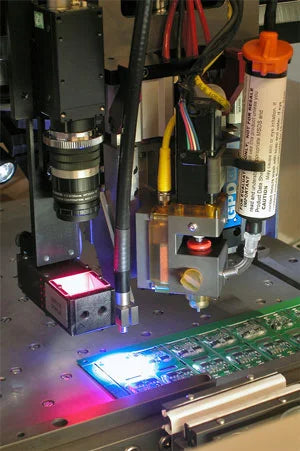
Using high-performance UV lamps and precisely controlled curing systems, manufacturers can rapidly solidify UV-sensitive adhesives within seconds while maintaining excellent bonding performance and production consistency.
A professional UV curing solution is not simply about choosing a powerful light source. It requires a complete understanding of adhesive chemistry, wavelength matching, energy density, curing distance, heat management, and production requirements.
This article provides a detailed analysis of how electronic component adhesives can be quickly cured after dispensing and how industrial UV curing systems can achieve precise, efficient, and stable results.
Understanding the Role of Adhesive Dispensing in Electronic Component Assembly
Adhesive dispensing is a precision process where liquid or semi-liquid materials are accurately applied to specific areas of electronic components.
Common adhesive materials include:
- UV-curable adhesives
- Epoxy adhesives
- Acrylic adhesives
- Silicone adhesives
- Conductive adhesives
- Encapsulation materials
Different adhesives serve different purposes depending on application requirements.
Mechanical Fixation
Many electronic components require additional support beyond solder connections. Adhesives help secure parts against vibration, shock, and mechanical stress.
Examples include:
- Camera modules
- Micro sensors
- Connectors
- Flexible circuits
- Display components
Environmental Protection
Electronic devices often operate in challenging environments involving:
- Moisture
- Dust
- Temperature changes
- Chemical exposure
Adhesive materials create protective barriers that improve component reliability.
Electrical Insulation
Certain adhesives prevent electrical leakage and short circuits by providing insulation between sensitive components.
Thermal Management
Specialized adhesives can assist with heat transfer between components and heat sinks, improving device performance.
Because these applications require high reliability, the curing process must be carefully controlled.
Why UV Curing Has Become a Preferred Solution for Electronics Manufacturing
UV curing technology uses ultraviolet energy to trigger a chemical reaction that transforms liquid adhesive into a solid polymer structure.
Unlike conventional curing methods, UV curing provides several important advantages.
Extremely Fast Curing Speed
One of the biggest benefits of industrial UV curing is rapid processing.
While traditional adhesives may require minutes or hours to fully cure, UV-curable adhesives can often achieve initial curing within seconds when exposed to the correct UV intensity.
This significantly improves:
- Production throughput
- Manufacturing efficiency
- Assembly line speed
For high-volume electronics production, reducing curing time can create substantial productivity improvements.
Precise Process Control
Industrial UV curing systems allow manufacturers to control:
- Light intensity
- Exposure duration
- Wavelength output
- Curing distance
- Temperature conditions
This precision ensures consistent results across thousands or millions of products.
Reduced Thermal Stress
Many electronic components are sensitive to heat. Excessive temperatures can damage:
- Semiconductor chips
- Plastic housings
- Optical components
- Flexible circuits
UV curing provides a low-temperature curing method, reducing the risk of thermal damage.
Cleaner Manufacturing Process
UV curing does not require solvents or additional chemical treatments.
Benefits include:
- Reduced emissions
- Cleaner production environments
- Lower material waste
- Easier automation integration
The Science Behind UV Adhesive Curing
To understand how to achieve fast curing, it is important to understand the basic chemical mechanism.
UV-curable adhesives contain special components called photoinitiators.
When exposed to ultraviolet light of the correct wavelength, photoinitiators absorb UV energy and generate reactive species.
These reactive molecules initiate polymerization, transforming the liquid adhesive into a solid material.
The curing process depends on several factors:
UV Wavelength Matching
Different adhesives require different UV wavelengths.
Common UV curing ranges include:
- UVA range: approximately 320–400 nm
- UVB range: approximately 280–320 nm
- UVC range: approximately 200–280 nm
Most industrial electronic adhesives are designed to cure primarily under UVA wavelengths, especially around 365 nm, 385 nm, or 395 nm.
Selecting the wrong wavelength can lead to:
- Slow curing
- Incomplete polymerization
- Weak bonding strength
Therefore, wavelength compatibility between the UV lamp and adhesive formulation is essential.
Understanding UV Energy Density and Curing Performance
Many manufacturers focus only on UV lamp power, but power alone does not determine curing quality.
The key factor is energy density.
Energy density refers to the total UV energy delivered to the adhesive surface over time.
It depends on:
- UV intensity
- Exposure duration
- Distance between lamp and adhesive
- Optical design
A simple example:
A high-power UV lamp placed too far away may produce worse results than a lower-power lamp positioned correctly.
Professional curing systems optimize the relationship between:
- Intensity
- Time
- Distance
to achieve complete polymerization.
Choosing the Right Industrial UV Lamp for Electronic Component Curing
Selecting the correct UV lamp is one of the most important decisions in the curing process.
Different industrial applications require different light sources.
UV LED Curing Systems: The Modern Choice for Precision Applications
UV LED curing technology has become increasingly popular in electronics manufacturing.
Advantages include:
Long service life
High-quality UV LEDs can operate for thousands of hours with stable output.
Instant startup
Unlike traditional lamps that require warm-up time, UV LEDs turn on and off immediately.
Energy efficiency
UV LEDs consume less energy compared with many conventional UV sources.
Low heat generation
This makes them suitable for temperature-sensitive electronic components.
Precise wavelength control
Manufacturers can select specific wavelengths optimized for different adhesives.
Common applications include:
- Smartphone assembly
- Optical bonding
- Sensor manufacturing
- Microelectronics
Mercury UV Lamps: Traditional High-Intensity Curing Technology
Mercury lamps have been widely used in industrial curing systems for decades.
Their advantages include:
- High UV intensity
- Broad wavelength output
- Strong penetration capability
They are suitable for applications requiring deep curing or high-speed production.
However, mercury lamps also have limitations:
- Higher energy consumption
- More heat generation
- Shorter replacement cycles
- Warm-up requirements
For many modern electronics applications, UV LED technology is gradually replacing traditional systems.
Key Factors Affecting UV Curing Speed After Adhesive Dispensing
Achieving rapid curing requires optimization of multiple factors.
Adhesive Thickness
Thicker adhesive layers require more UV energy.
If the adhesive layer is too thick:
- Surface curing may occur first
- Inner areas may remain uncured
- Bond strength may decrease
Manufacturers must match dispensing volume with curing capability.
Surface Characteristics
The material underneath the adhesive affects UV penetration.
Transparent materials allow deeper UV penetration.
Opaque materials may require:
- Dual curing systems
- Side exposure
- Alternative adhesive formulations
Lamp Distance
The distance between the UV source and adhesive directly affects intensity.
Too far:
- Lower curing speed
- Reduced energy absorption
Too close:
- Excessive heat
- Potential component damage
Proper positioning is critical.
Precision Industrial UV Curing Solutions: Designing the Perfect System for Electronics Manufacturing
A successful UV curing process requires more than simply installing a UV lamp above a production line. Professional manufacturers need a complete curing strategy that integrates light source selection, equipment configuration, process parameters, and quality control.
A precision UV curing system should be designed according to:
- Adhesive type
- Component structure
- Production speed
- Curing depth requirements
- Thermal sensitivity
- Automation level
By optimizing these factors, manufacturers can achieve faster curing speeds while maintaining product reliability.
1. Selecting the Correct UV Wavelength for Maximum Adhesive Performance
One of the most important decisions in UV curing is wavelength selection.
Different adhesives contain different photoinitiators, and these photoinitiators respond only to specific UV wavelengths.
Common industrial UV curing wavelengths include:
365nm UV Light
365nm is widely used in precision electronics manufacturing because it provides excellent compatibility with many optical and structural adhesives.
Applications include:
- Lens assembly
- Camera modules
- Sensor bonding
- Precision component fixation
Advantages:
- Good curing depth
- Strong adhesive response
- Suitable for high-accuracy applications
385nm UV Light
385nm UV LEDs provide a balance between curing efficiency and energy consumption.
They are commonly used for:
- Electronic assembly
- Display manufacturing
- PCB protection
- Small component bonding
Benefits include:
- High energy efficiency
- Stable output
- Lower heat generation
395nm and 405nm UV Light
Longer wavelength UV LEDs are popular because they provide good material compatibility and lower absorption by certain surfaces.
Typical applications include:
- Industrial assembly
- General adhesive curing
- Coating applications
However, manufacturers should always confirm compatibility with the adhesive supplier before selecting a wavelength.
2. Controlling UV Intensity for Consistent Curing Results
UV intensity determines how much energy reaches the adhesive surface.
Insufficient intensity can cause:
- Incomplete curing
- Weak bonding strength
- Sticky surfaces
- Reduced reliability
Excessive intensity may create:
- Overheating
- Material discoloration
- Stress inside cured adhesive
A professional curing process requires precise control.
Modern industrial UV systems often include:
- Adjustable power settings
- Real-time monitoring
- Automatic intensity calibration
- Closed-loop control systems
These features ensure stable curing performance during long production cycles.
3. Optimizing Exposure Time for Maximum Efficiency
Exposure time must be carefully balanced.
A shorter curing time improves production efficiency, but the adhesive must still receive enough energy to complete polymerization.
Factors affecting exposure time include:
- Adhesive thickness
- UV intensity
- Component material
- Required bonding strength
For automated production lines, manufacturers often perform curing tests to determine the optimal combination of:
- Light intensity
- Exposure duration
- Lamp position
This prevents unnecessary energy consumption while maintaining quality.
4. Thermal Management: Protecting Sensitive Electronic Components
Although UV curing is considered a low-temperature process, industrial UV lamps can still generate heat.
Heat management becomes especially important when curing near:
- Semiconductor chips
- Optical sensors
- Plastic housings
- Flexible circuit boards
Professional UV curing systems may include:
Air Cooling
Airflow removes heat from the lamp area and reduces temperature buildup.
Water Cooling
High-power curing systems may use liquid cooling for continuous operation.
Heat Isolation Design
Special structures can prevent unnecessary heat transfer to sensitive components.
Effective thermal management improves:
- Component safety
- Equipment lifespan
- Production stability
Automated UV Curing in Modern Electronics Production Lines
As electronics manufacturing becomes increasingly automated, UV curing systems are being integrated directly into production equipment.
Automation provides several advantages:
Improved Consistency
Manual curing processes may vary due to:
- Operator differences
- Positioning errors
- Timing inconsistencies
Automated systems maintain identical curing conditions for every product.
Higher Production Speed
Robotic systems can combine:
- Precision dispensing
- Component placement
- UV curing
into a continuous workflow.
This significantly reduces production cycle times.
Better Quality Tracking
Advanced systems can record:
- UV energy output
- Exposure time
- Production batches
- Equipment performance
This helps manufacturers identify problems before they affect large quantities of products.
Common UV Adhesive Curing Problems and Professional Solutions
Even advanced curing systems may experience problems if the process is not properly optimized.
Understanding common failures helps manufacturers improve production quality.
Problem 1: Surface Curing but Internal Adhesive Remains Liquid
This issue occurs when the UV light cures only the outer layer while deeper adhesive areas remain uncured.
Possible causes:
- Insufficient UV penetration
- Adhesive layer too thick
- Incorrect wavelength
- Low UV intensity
Solutions:
- Reduce adhesive thickness
- Increase UV energy
- Select a more suitable adhesive
- Use a longer exposure time
- Consider multi-angle curing
Problem 2: Slow Curing Speed
Slow curing reduces manufacturing efficiency.
Common causes include:
- Aging UV lamp
- Incorrect wavelength
- Excessive curing distance
- Poor optical alignment
Solutions:
- Replace degraded light sources
- Adjust lamp positioning
- Increase intensity
- Verify adhesive specifications
Problem 3: Weak Bond Strength After Curing
A cured adhesive does not always mean a strong bond.
Potential reasons:
- Surface contamination
- Poor material compatibility
- Incomplete polymerization
- Incorrect adhesive storage conditions
Solutions:
- Clean surfaces before dispensing
- Verify adhesive shelf life
- Improve UV exposure parameters
- Perform adhesion testing
Problem 4: Excessive Heat During Curing
High temperatures may damage sensitive components.
Solutions include:
- Lowering UV intensity
- Increasing exposure time
- Improving cooling systems
- Using UV LED technology instead of high-heat lamps
Quality Inspection Methods After UV Curing
Professional electronics manufacturers use several methods to verify curing quality.
Visual Inspection
Operators check for:
- Surface defects
- Uneven curing
- Adhesive overflow
- Discoloration
Although simple, visual inspection remains an important first step.
Hardness Testing
Cured adhesive hardness can indicate whether polymerization has been completed.
Testing methods include:
- Surface hardness measurement
- Scratch testing
- Mechanical evaluation
Bond Strength Testing
Mechanical testing evaluates whether the adhesive can withstand operational stress.
Common tests include:
- Pull testing
- Shear testing
- Vibration testing
These tests are especially important for automotive and industrial electronics.
UV Energy Monitoring
Advanced production systems measure actual UV exposure during manufacturing.
Monitoring equipment can detect:
- Reduced lamp output
- Uneven illumination
- Equipment aging
This prevents unexpected quality problems.
How to Improve UV Curing Efficiency in Large-Scale Production
Manufacturers looking to increase efficiency should consider several strategies.
Optimize the Dispensing Process First
Poor dispensing creates curing problems.
Important factors include:
- Accurate adhesive volume
- Consistent application position
- Proper nozzle selection
- Controlled dispensing speed
A precise dispensing process allows UV curing systems to perform more effectively.
Use Modular UV Curing Equipment
Modular systems allow manufacturers to adjust configurations according to production needs.
Possible options include:
- Multiple UV LED modules
- Adjustable curing zones
- Conveyor integration
- Robotic positioning
This flexibility supports different product designs.
Implement Preventive Maintenance Programs
UV curing equipment performance can decline over time.
Regular maintenance should include:
- Cleaning optical surfaces
- Checking cooling systems
- Measuring UV output
- Inspecting electrical components
Preventive maintenance reduces downtime and improves product consistency.
Future Trends in Industrial UV Curing Technology
The electronics industry continues to demand faster, smaller, and more reliable products. UV curing technology is evolving to meet these challenges.
Future developments include:
Smart UV Curing Systems
Intelligent systems will increasingly use:
- Sensors
- Data monitoring
- Automated adjustments
- Artificial intelligence-based control
These technologies will improve process accuracy.
Higher-Efficiency UV LEDs
UV LED technology continues to advance with:
- Higher output power
- Improved energy efficiency
- Longer operational life
This makes UV LED curing increasingly attractive for industrial applications.
Customized Curing Solutions
Different industries require different solutions.
Future curing systems will focus on customization for:
- Semiconductor packaging
- Automotive electronics
- Medical devices
- Optical components
- Consumer electronics
Conclusion: Achieving Faster and More Reliable Electronic Component Adhesive Curing
In modern electronics manufacturing, fast adhesive curing is essential for improving productivity, reducing defects, and ensuring long-term product reliability.
Industrial UV curing provides an efficient solution by combining rapid polymerization, precise process control, and low thermal impact. However, achieving excellent results requires careful consideration of multiple factors, including UV wavelength selection, energy density, curing distance, adhesive characteristics, and thermal management.
A professional curing solution is not simply about choosing the strongest UV lamp. It is about creating a complete system where adhesive chemistry, equipment performance, and manufacturing requirements work together.
By selecting the correct UV technology and optimizing curing parameters, manufacturers can achieve faster production speeds, stronger adhesive performance, and higher-quality electronic products.
If you are looking for professional industrial UV curing solutions or customized equipment recommendations, please feel free to leave a message and contact us for a quotation.