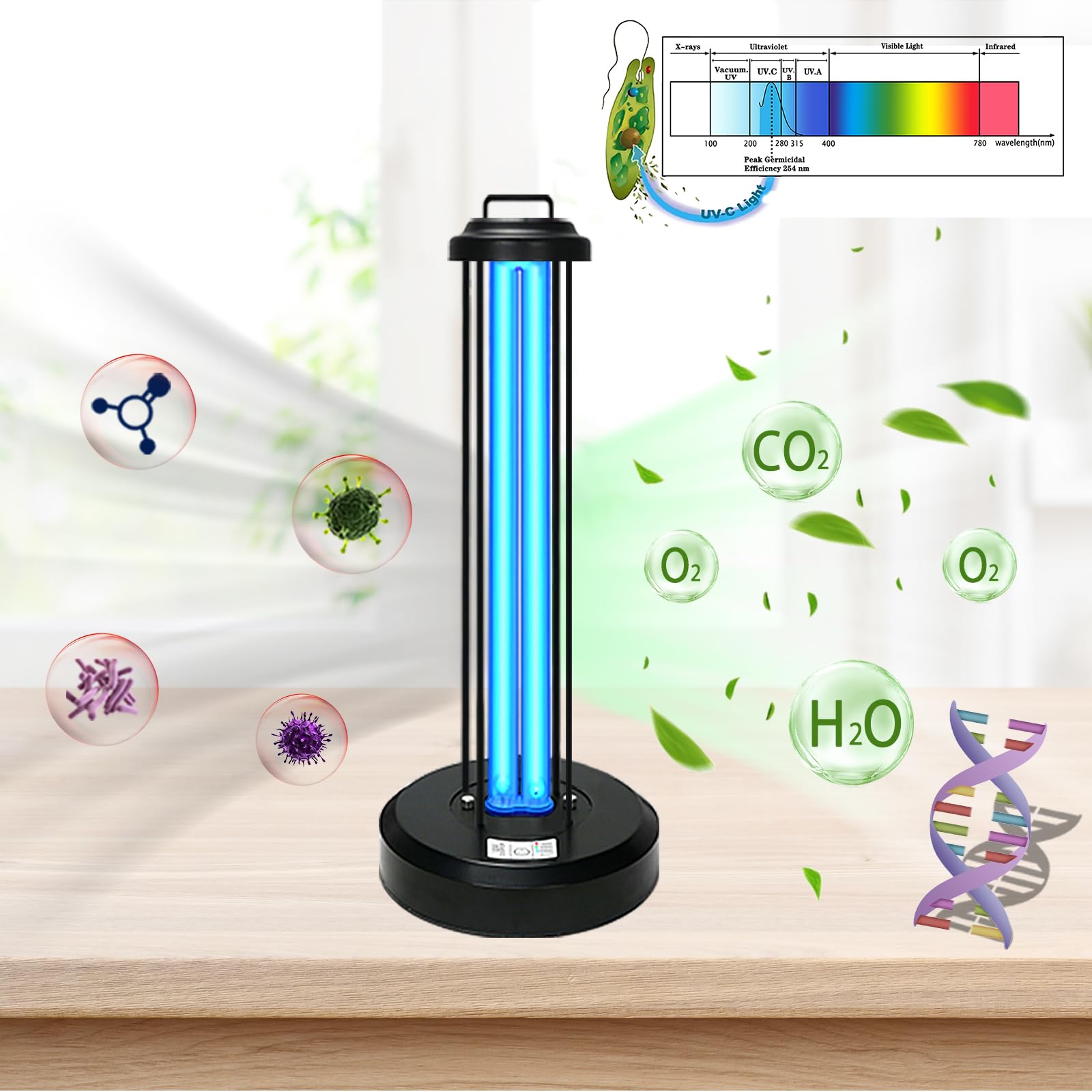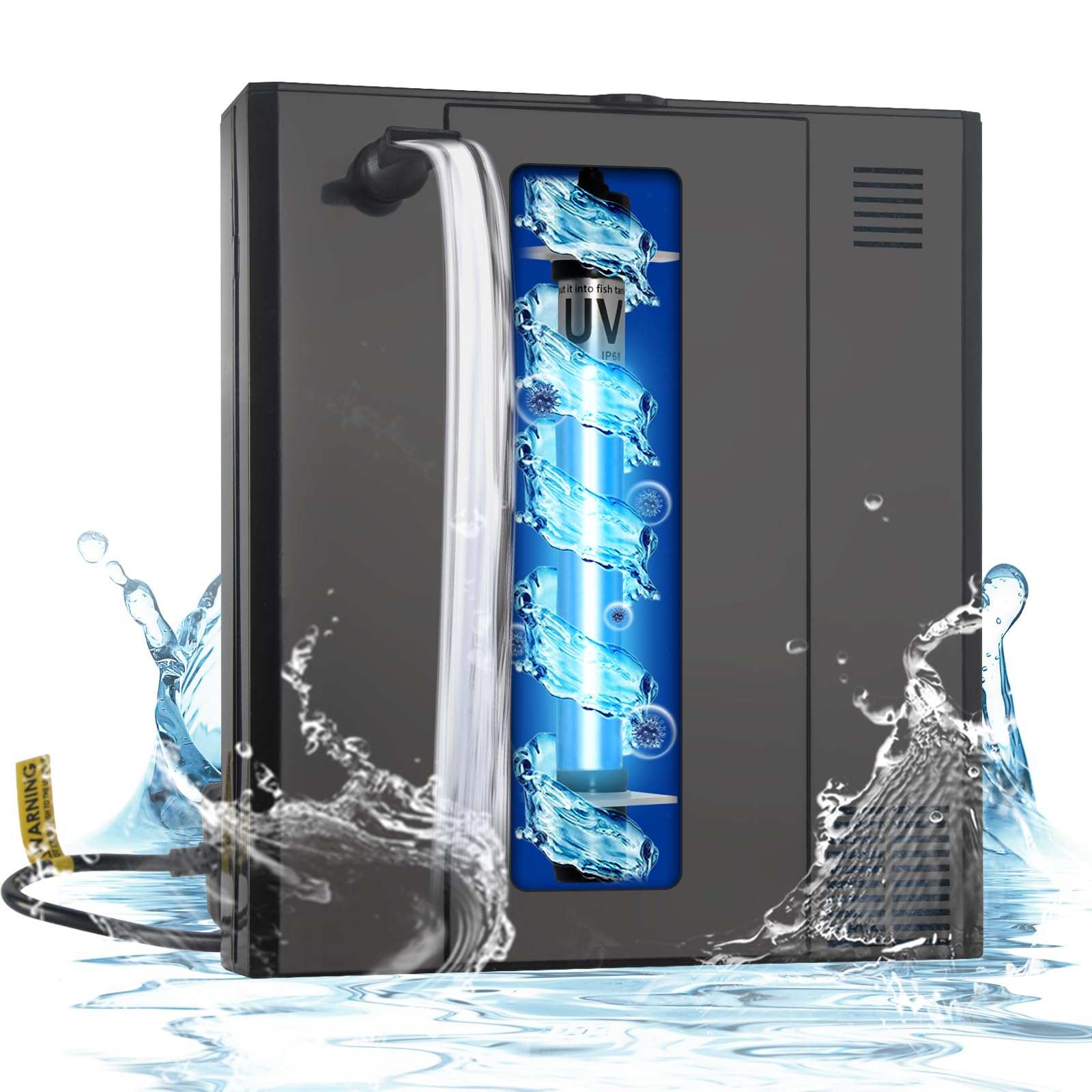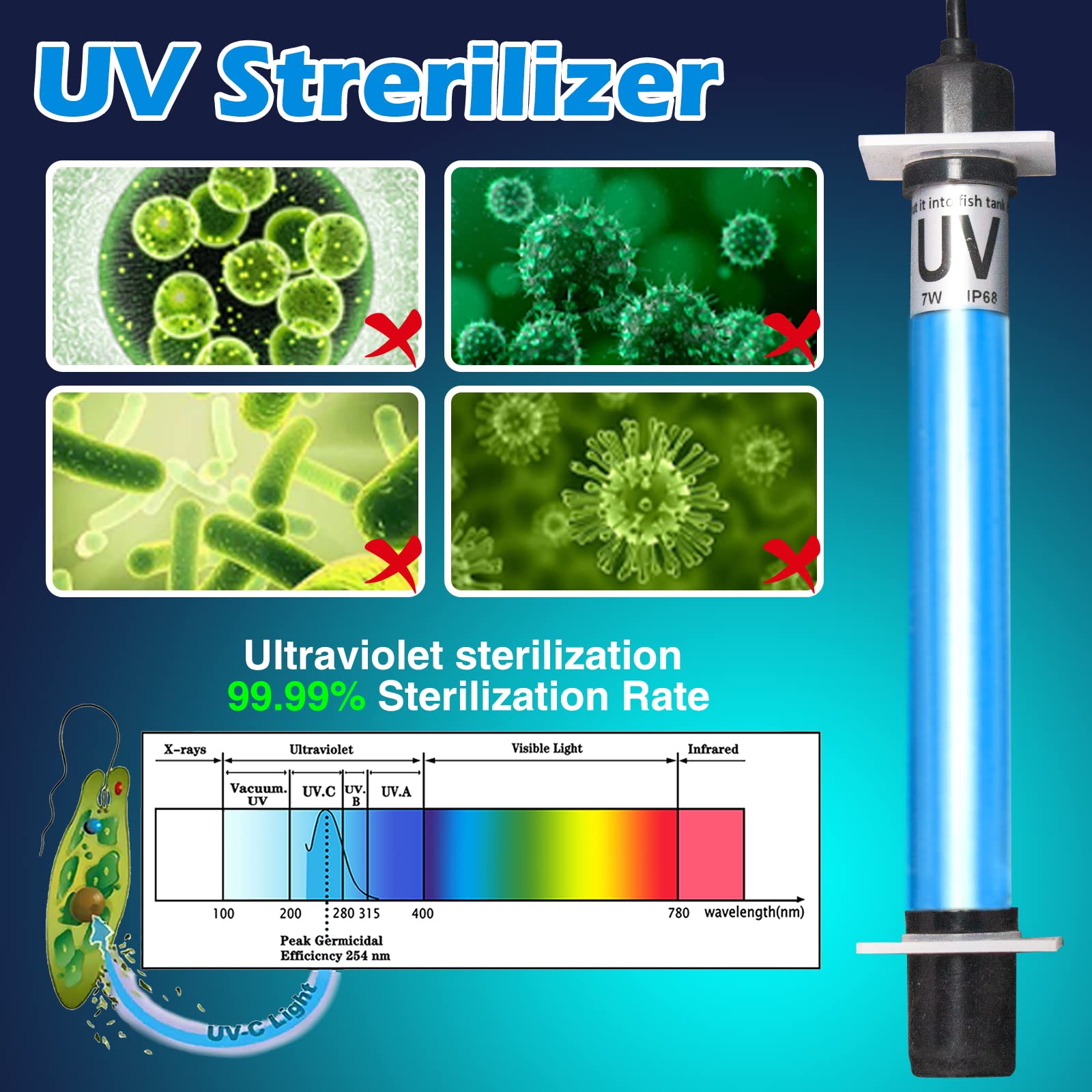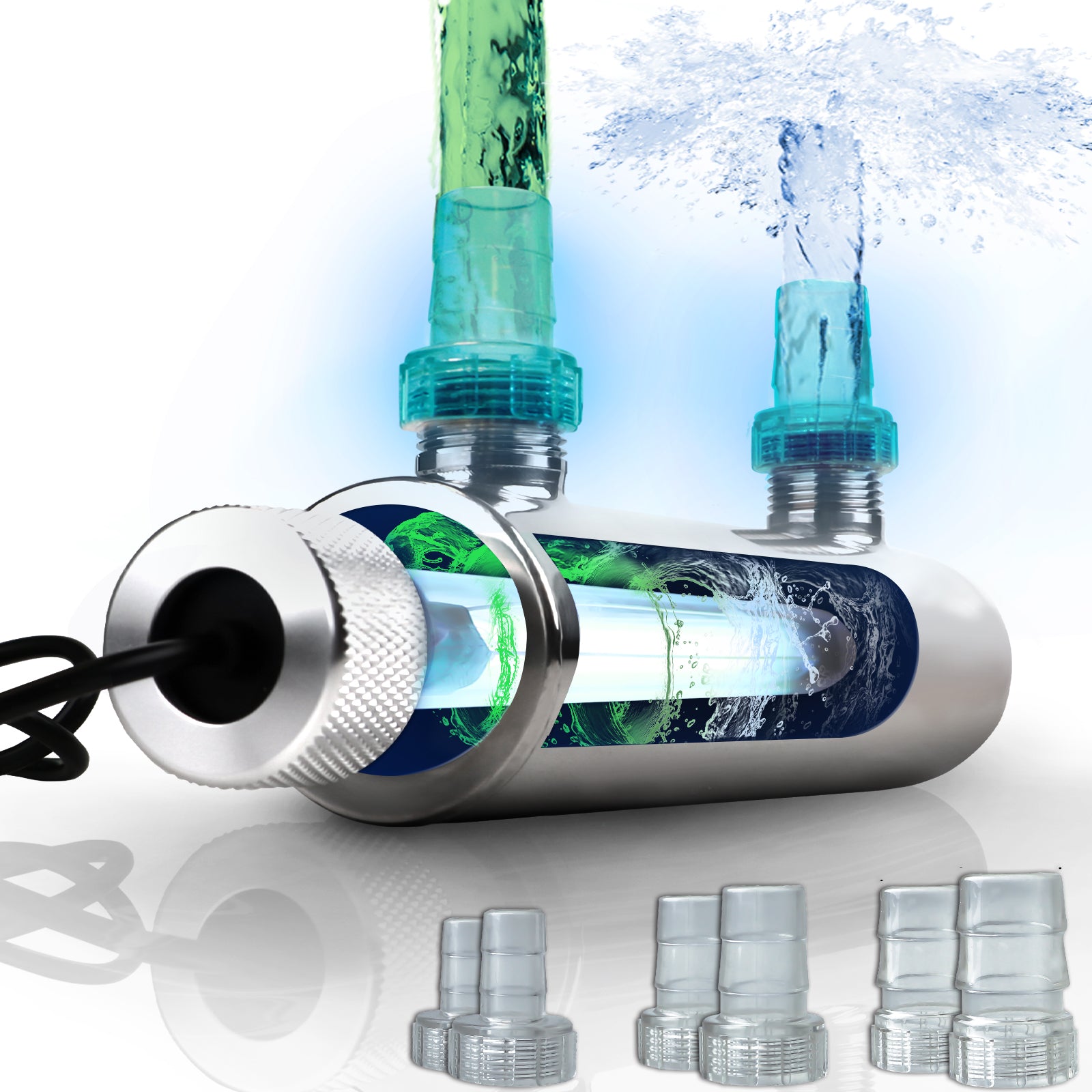
Industrial ultraviolet (UV) systems play a critical role in modern manufacturing, helping businesses achieve faster production speeds, consistent product quality, and efficient processing. From UV curing in printing and coating applications to ultraviolet disinfection in water treatment and food processing, these systems provide reliable solutions across a wide range of industries.
However, even the most advanced industrial UV equipment requires regular maintenance to deliver consistent results. Over time, UV lamps lose output, optical components accumulate contamination, cooling systems become less efficient, and electrical components experience wear. Without a structured maintenance program, these issues can lead to reduced productivity, inconsistent processing, higher energy consumption, and unexpected equipment failures.
For manufacturers operating continuous production lines, an unexpected UV system shutdown can be particularly costly. A single equipment failure may interrupt production, damage materials, delay customer orders, and increase operating expenses.
Fortunately, many of these problems can be prevented through proper industrial UV system maintenance.
By implementing preventive maintenance procedures, monitoring critical operating parameters, and replacing components at appropriate intervals, manufacturers can extend equipment service life while maintaining optimal UV performance.
This comprehensive guide explores the essential practices for maintaining industrial UV systems, including UV lamp care, reflector cleaning, cooling system maintenance, electrical inspections, performance monitoring, troubleshooting, and long-term maintenance planning.
Whether you operate a UV curing system, industrial UV disinfection equipment, or a high-power ultraviolet processing line, these strategies will help you improve equipment reliability, reduce downtime, and maximize the return on your investment.
1. Understanding Industrial UV Systems and Their Maintenance Requirements
Before developing an effective maintenance strategy, it is important to understand how industrial UV systems operate and which components require regular attention.
Industrial UV systems use ultraviolet radiation to initiate chemical reactions, deactivate microorganisms, or perform specialized manufacturing processes.
Although their applications vary, most industrial UV systems contain several interconnected components that must operate together to deliver consistent results.
UV Light Sources
The UV light source is the central component of an industrial ultraviolet system.
Common industrial UV light sources include:
-
Medium-pressure mercury UV lamps
-
Low-pressure mercury and amalgam UV lamps
-
Metal halide UV lamps
-
UV LED modules
-
Excimer UV lamps
Each technology has different operating characteristics, maintenance requirements, and expected service life.
For example, conventional mercury-based UV lamps gradually experience reduced ultraviolet output as their electrodes, arc tubes, and internal materials age.
UV LED systems typically offer longer operating lifetimes and eliminate certain maintenance requirements associated with conventional lamps. However, they still require effective thermal management, clean optical surfaces, and properly functioning electronic drivers.
Understanding the specific technology used in your equipment is essential for selecting appropriate maintenance procedures.
Reflectors and Optical Components
Many industrial UV curing systems use reflectors to direct ultraviolet radiation toward the target surface.
Reflectors help improve energy utilization by concentrating or redirecting radiation that would otherwise be lost.
Over time, dust, coating residue, ink mist, and other contaminants may accumulate on reflector surfaces.
This contamination can reduce the amount of UV energy reaching the product, even when the lamp itself remains functional.
Some UV systems also incorporate quartz windows, optical lenses, protective covers, and other components that require periodic inspection and cleaning.
Power Supplies and Electronic Controls
Industrial UV lamps require properly regulated electrical power.
Depending on the system design, this may involve electronic ballasts, transformers, power controllers, LED drivers, ignition circuits, and monitoring electronics.
Electrical problems can cause unstable lamp output, ignition failures, overheating, and premature component degradation.
Regular electrical inspections are therefore an important part of industrial UV equipment maintenance.
Cooling and Ventilation Systems
High-power UV equipment generates substantial heat during operation.
Cooling systems help maintain acceptable operating temperatures for lamps, electronic components, reflectors, and surrounding equipment.
Common cooling methods include forced-air cooling, liquid cooling, and integrated heat-extraction systems.
If cooling performance deteriorates, excessive temperatures may shorten component life and compromise processing quality.
Sensors and Monitoring Equipment
Modern industrial UV systems may incorporate sensors that monitor lamp intensity, operating temperature, cooling conditions, electrical performance, and system status.
These monitoring devices provide valuable information about equipment condition.
However, sensors must also be inspected, cleaned, and calibrated when required to maintain measurement accuracy.
A reliable maintenance program should address the complete UV system rather than focusing exclusively on the light source.
2. Establish a Preventive Maintenance Schedule
One of the most effective ways to extend industrial UV system lifespan is to establish a structured preventive maintenance schedule.
Reactive maintenance involves repairing equipment after a failure occurs.
Preventive maintenance, by contrast, focuses on identifying and correcting developing problems before they cause unexpected shutdowns.
For industrial UV equipment, preventive maintenance should be based on manufacturer recommendations, operating hours, production conditions, and historical equipment performance.
Daily Maintenance Tasks
Daily inspections should focus on identifying obvious changes in operating conditions.
Operators should check system status indicators, review alarm messages, and confirm that the equipment is operating within its approved parameters.
Important daily checks include verifying cooling airflow or liquid flow, checking operating temperatures, reviewing UV intensity readings where available, and listening for unusual mechanical or electrical noises.
Operators should also inspect accessible areas for visible contamination, damaged components, or abnormal operating conditions.
These checks should be performed without opening energized enclosures, defeating interlocks, or exposing personnel to UV radiation.
A short daily inspection can identify problems before they develop into more serious failures.
Weekly Maintenance Tasks
Weekly maintenance should include a more detailed review of system performance.
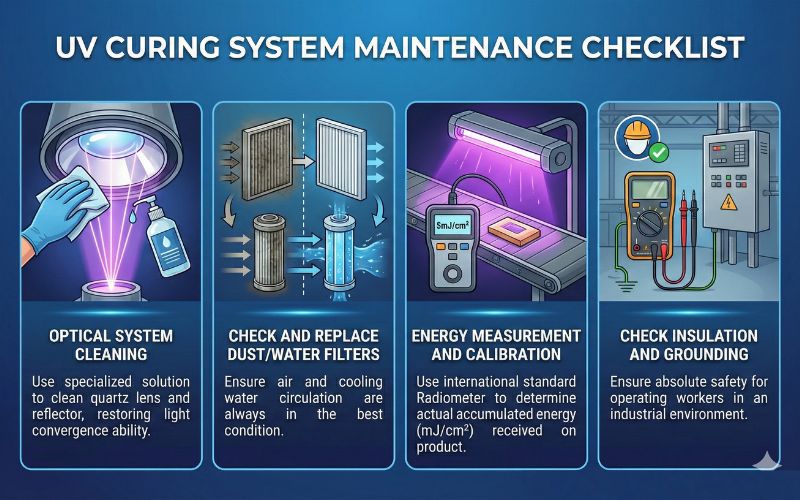
Maintenance personnel may inspect accessible cooling filters, ventilation openings, external electrical connections, and optical components.
They should also compare current UV output readings with established baseline measurements.
A gradual decline in UV intensity may indicate lamp aging, reflector contamination, optical degradation, or another developing problem.
Documenting these changes helps maintenance teams identify performance trends.
Monthly Maintenance Tasks
Monthly inspections may include more comprehensive cleaning, verification of cooling system performance, and examination of mechanical components.
Depending on the equipment design, qualified personnel may also inspect electrical connections, power supply ventilation, lamp mounting hardware, and sensor condition.
Any work requiring access to hazardous electrical, thermal, or UV components must follow the manufacturer's shutdown, isolation, and safety procedures.
Annual and Major Service Intervals
Major maintenance activities may include scheduled lamp replacement, detailed electrical testing, cooling system servicing, optical component replacement, and performance validation.
The appropriate interval depends on the system's design, operating environment, and accumulated service hours.
Rather than applying one universal schedule to every installation, manufacturers should develop maintenance plans tailored to their specific equipment and production requirements.
3. Maintain UV Lamps to Maximize Service Life
UV lamp maintenance is one of the most important factors affecting industrial UV system performance.
In conventional UV curing systems, lamps gradually lose their ability to deliver the required ultraviolet energy.
This decline can occur even when the lamp continues to illuminate normally.
Consequently, visual brightness alone is not a reliable indicator of useful UV output.
Monitor Lamp Operating Hours
Industrial UV lamps are typically assigned a recommended service life based on their design and operating conditions.
However, the actual useful life of a lamp depends on several factors, including operating temperature, power settings, ignition cycles, cooling performance, and environmental conditions.
Maintaining accurate operating-hour records helps operators plan replacements before lamp degradation affects production.
For example, a lamp operating continuously under stable conditions may experience a different aging pattern than an identical lamp subjected to frequent startup and shutdown cycles.
Operators should follow the lamp manufacturer's specifications rather than assuming that all UV lamps have the same replacement interval.
Avoid Unnecessary Startup and Shutdown Cycles
Frequent switching can place additional stress on certain conventional UV lamp technologies.
Repeated ignition may accelerate electrode wear and affect lamp stability.
Some lamps also require specific warm-up and cool-down periods.
Manufacturers should evaluate production schedules and operating procedures to avoid unnecessary switching while complying with the equipment manufacturer's instructions.
This does not mean that UV lamps should remain energized whenever production stops.
Instead, operating decisions should consider the lamp technology, energy consumption, safety requirements, and manufacturer-approved operating modes.
Maintain Proper Lamp Temperature
Lamp temperature directly influences the performance of many conventional UV light sources.
Excessive cooling or insufficient cooling may alter lamp operating characteristics and reduce UV output.
Overheating can also damage lamp seals, electrical connections, and nearby components.
Maintenance teams should verify that the cooling system maintains the temperature conditions specified by the equipment manufacturer.
For UV LED systems, maintaining appropriate junction temperatures is particularly important because excessive heat can accelerate output degradation and reduce electronic component reliability.
Handle UV Lamps Carefully
Improper handling can damage UV lamps before they are installed.
When replacing a lamp, technicians should follow the manufacturer's handling instructions and use appropriate clean gloves or other approved protective equipment.
Contamination from skin oils, dust, or other materials may create localized heating or optical problems on certain lamp surfaces.
Lamps should be protected from mechanical impact, excessive force, and improper installation.
Technicians should also verify that replacement lamps match the required electrical ratings, dimensions, spectral characteristics, and equipment compatibility.
Installing an incorrect lamp can result in poor performance, equipment damage, or unsafe operating conditions.
Replace Lamps Based on Performance
A UV lamp does not necessarily remain suitable for production until it stops emitting light.
For UV curing applications, the lamp must deliver sufficient energy within the wavelengths required by the photoinitiator system.
For UV disinfection applications, the equipment must deliver the validated UV dose required by the treatment process.
Replacement decisions should therefore consider measured UV performance, operating hours, process requirements, and manufacturer recommendations.
A performance-based replacement strategy can help prevent premature disposal while avoiding quality problems caused by excessive lamp aging.
4. Keep Reflectors and Optical Components Clean
Reflectors are essential to the performance of many industrial UV curing systems.
Their primary function is to direct ultraviolet radiation toward the material being processed.
Even a relatively small amount of contamination can affect the optical efficiency of the system, depending on the reflector design and the nature of the deposits.
Common Sources of Reflector Contamination
Industrial environments expose UV equipment to a variety of contaminants.
In printing applications, ink mist and airborne particles may accumulate around the curing assembly.
In coating operations, overspray and volatile processing residues may deposit on optical surfaces.
Dust, grease, adhesive residue, and other materials can also reduce reflector effectiveness.
As contamination accumulates, less usable UV radiation may reach the target surface.
Operators may attempt to compensate by increasing lamp power or reducing production speed.
However, these adjustments can increase operating costs without addressing the underlying problem.
Establish Proper Cleaning Procedures
Reflector cleaning should be performed only after the equipment has been shut down, isolated, and allowed to cool according to the manufacturer's instructions.
Maintenance personnel should use cleaning materials approved for the specific reflector coating and substrate.
Abrasive cleaning tools, aggressive solvents, and excessive mechanical pressure may damage reflective surfaces.
Some reflector coatings are particularly sensitive to scratches and chemical exposure.
For this reason, cleaning procedures should be based on the optical component manufacturer's recommendations.
Inspect Reflectors for Permanent Damage
Cleaning cannot restore every reflector to its original condition.
Over time, reflectors may experience corrosion, coating degradation, discoloration, or mechanical deformation.
These defects can reduce optical efficiency even after surface contamination has been removed.
Maintenance teams should inspect reflectors for visible deterioration and compare system performance before and after cleaning.
If optical performance remains inadequate, reflector replacement may be necessary.
Maintain Quartz Windows and Protective Covers
Many industrial UV systems use quartz windows or protective optical covers to separate the light source from the processing environment.
Contamination on these surfaces can absorb or scatter ultraviolet radiation.
Cleaning frequency should reflect the operating environment and the sensitivity of the process.
Technicians should also inspect optical components for cracks, cloudiness, discoloration, and other signs of deterioration.
Damaged optical components should be replaced with manufacturer-approved parts.
5. Optimize Cooling System Performance
Effective thermal management is essential for maintaining industrial UV system reliability.
High-power UV lamps generate heat that must be controlled to protect the light source, electrical components, optical assemblies, and processed materials.
Inadequate cooling may cause unstable UV output, premature component failure, or automatic equipment shutdown.
Maintain Air-Cooled UV Systems
Air-cooled UV equipment typically uses fans, ducts, filters, and ventilation openings to remove heat.
Over time, airborne dust and processing residues may restrict airflow.
Blocked filters and ventilation openings can reduce cooling capacity and increase operating temperatures.
Maintenance personnel should inspect cooling filters regularly and clean or replace them according to manufacturer recommendations.
Fans should be checked for abnormal noise, vibration, reduced airflow, and signs of bearing wear.
Air ducts should also be inspected for obstructions, leaks, and improper connections.
When evaluating airflow, technicians should use the measurement methods and acceptance limits specified by the equipment manufacturer.
Maintain Water-Cooled UV Systems
Some high-power industrial UV systems use liquid cooling to remove heat from lamps, reflectors, LED modules, or power electronics.
These systems may incorporate pumps, heat exchangers, cooling channels, flow sensors, and temperature-control equipment.
Common maintenance concerns include restricted coolant flow, leaks, corrosion, mineral deposits, and deteriorating pump performance.
Maintenance personnel should verify coolant flow, pressure, temperature, and quality where applicable.
The correct coolant composition and water-quality requirements depend on the equipment design.
Using unsuitable cooling water may cause scaling, corrosion, biological growth, or electrical conductivity problems.
Only manufacturer-approved cooling fluids and treatment procedures should be used.
Monitor Operating Temperatures
Temperature monitoring provides an early indication of cooling system problems.
A gradual increase in operating temperature may indicate filter contamination, reduced airflow, pump degradation, or heat exchanger fouling.
Maintenance teams should establish acceptable temperature ranges for critical components and investigate readings that deviate from normal operating conditions.
Where supported by the equipment, automated temperature alarms and shutdown protections can help prevent damage.
However, protective systems should not replace routine cooling system maintenance.
6. Inspect Electrical Components and Power Supplies
Electrical reliability is another critical factor in industrial UV system maintenance.
UV equipment may contain high-voltage ignition circuits, high-current power supplies, electronic drivers, transformers, and other components that require specialized handling.
Electrical maintenance must be performed by qualified personnel following applicable electrical safety requirements and the equipment manufacturer's instructions.
Inspect Power Supply Performance
Power supplies regulate the electrical energy delivered to UV lamps or LED modules.
Unstable power delivery can affect UV output and accelerate component deterioration.
Maintenance personnel should review available diagnostic readings and investigate abnormal voltage, current, power, or fault indications.
Any electrical measurements requiring access to hazardous circuits should be performed only by qualified technicians using approved procedures and suitable test equipment.
Examine Electrical Connections
Thermal cycling and mechanical vibration can contribute to deterioration of electrical connections.
Loose or damaged connections may cause localized heating, unstable operation, or equipment failure.
During approved maintenance shutdowns, qualified personnel should inspect accessible terminals, connectors, cables, and grounding arrangements.
Any tightening or replacement work should follow the manufacturer's torque specifications and electrical procedures.
Maintain Electronic Cooling
Power electronics generate heat during operation.
Dust accumulation, blocked ventilation, and failed cooling fans can increase electronic component temperatures.
Maintenance teams should inspect power supply cooling systems and keep ventilation openings clear.
Where equipment supports diagnostic monitoring, temperature trends and fault histories should be reviewed regularly.
Investigate Repeated Electrical Faults
Repeated lamp ignition failures, unexpected shutdowns, or unstable power readings should not be treated as isolated incidents.
These symptoms may indicate deteriorating electrical components, cooling problems, incompatible replacement parts, or other system-level issues.
A structured diagnostic process can help identify the underlying cause and prevent recurring failures.
7. Measure UV Output and Monitor System Performance
One of the most important principles of industrial UV system maintenance is that equipment condition should be evaluated through measurable performance rather than appearance alone.
A lamp may appear bright while delivering insufficient ultraviolet energy for the intended process.
Similarly, a system may operate without alarms while experiencing a gradual decline in optical efficiency.
Regular UV performance measurements help identify these problems before they affect product quality.
Understand UV Irradiance and UV Energy
In UV curing applications, two important measurement parameters are irradiance and radiant exposure.
Irradiance describes the rate at which ultraviolet energy reaches a surface and is commonly expressed in milliwatts per square centimeter (mW/cm²) or watts per square centimeter (W/cm²).
Radiant exposure describes the accumulated energy delivered per unit area and is commonly expressed in millijoules per square centimeter (mJ/cm²) or joules per square centimeter (J/cm²).
Both parameters can influence curing performance.
However, their relative importance depends on the coating formulation, photoinitiator chemistry, substrate, and process conditions.
A material that receives sufficient total energy may still cure inadequately if peak irradiance or the spectral distribution is unsuitable.
Use Appropriate UV Measurement Instruments
Industrial UV curing systems can be evaluated using radiometers or other measurement instruments designed for the relevant UV wavelength range.
Measurement devices should be compatible with the system's spectral output, intensity range, and operating environment.
A radiometer designed for a conventional broadband mercury lamp may not provide an appropriate measurement of a narrowband UV LED system without suitable spectral calibration.
For UV disinfection equipment, monitoring methods and acceptance criteria should follow the validated system design and applicable process requirements.
Establish Baseline Measurements
Baseline measurements provide a reference for evaluating equipment condition over time.
After installing a new lamp or completing major maintenance, operators should record UV performance under defined operating conditions.
Relevant parameters may include lamp power, operating temperature, measurement distance, conveyor speed, and UV intensity.
Future measurements should be performed under comparable conditions.
Without consistent measurement procedures, changes in operating settings may be mistaken for equipment deterioration.
Track Performance Trends
A single UV measurement provides information about equipment condition at a particular moment.
A series of measurements provides a more useful picture of long-term performance.
By recording UV output over time, maintenance teams can identify gradual lamp aging, reflector contamination, optical degradation, and other changes.
Performance trends can also support more accurate maintenance planning and replacement decisions.
Calibrate Measurement Equipment
UV measurement instruments themselves require maintenance.
Sensor contamination, calibration drift, and environmental exposure can affect measurement accuracy.
Radiometers and UV sensors should be calibrated according to manufacturer recommendations and the requirements of the production process.
Accurate measurements are essential for making reliable maintenance decisions.
8. Maintain UV LED Systems for Long-Term Reliability
UV LED technology has become increasingly important in industrial curing and specialized ultraviolet processing applications.
Compared with conventional mercury-based systems, UV LED equipment can offer advantages such as rapid switching, targeted wavelength output, compact construction, and reduced maintenance of certain lamp-related components.
However, UV LED systems are not maintenance-free.
Their long-term reliability depends on effective thermal management, clean optical components, stable electrical operation, and appropriate operating conditions.
Protect UV LED Modules From Excessive Heat
Temperature is a major factor affecting UV LED performance and lifespan.
As operating temperatures increase, LED output may decrease, and long-term degradation may accelerate.
Manufacturers should maintain the cooling conditions specified for their UV LED equipment.
Cooling fans, liquid cooling circuits, heat sinks, and temperature sensors should be inspected regularly.
Any persistent temperature increase should be investigated promptly.
Keep Optical Surfaces Clean
UV LED modules often incorporate lenses, protective windows, or other optical components.
Contamination can reduce the amount of ultraviolet energy delivered to the processing surface.
In some designs, contamination may also contribute to localized heating or optical damage.
Cleaning procedures should follow the equipment manufacturer's instructions, particularly because certain optical materials and coatings are sensitive to chemicals or abrasion.
Monitor LED Output Degradation
UV LEDs generally experience gradual output degradation rather than a predictable sudden failure at a fixed operating hour.
The rate of degradation depends on operating temperature, drive current, device design, and environmental conditions.
Manufacturers should monitor UV output and compare measurements with established process requirements.
Replacement decisions should be based on measured performance, equipment specifications, and production needs.
Maintain LED Drivers and Control Electronics
LED drivers regulate the electrical current supplied to UV LED modules.
Driver faults may cause unstable output, unexpected shutdowns, or damage to connected components.
Maintenance teams should monitor diagnostic information, inspect cooling arrangements, and investigate recurring electrical faults.
Replacement drivers must meet the equipment manufacturer's compatibility requirements.
9. Prevent Contamination in Industrial UV Processing Environments
Environmental conditions can significantly influence industrial UV system maintenance requirements.
Facilities that process inks, coatings, adhesives, powders, or other materials may expose UV equipment to airborne contaminants.
Without effective contamination control, optical components, cooling systems, and electrical assemblies may require more frequent maintenance.
Control Dust and Airborne Particles
Dust can accumulate on UV lamps, reflectors, cooling filters, and optical windows.
In severe cases, contamination may restrict airflow or reduce optical efficiency.
Facilities should maintain appropriate housekeeping procedures and use suitable filtration or extraction systems where required.
The appropriate approach depends on the production environment and equipment design.
Manage Coating and Ink Residues
Printing and coating operations may generate overspray, ink mist, or other processing residues.
These materials can accumulate on UV equipment and interfere with performance.
Proper equipment positioning, process ventilation, and regular cleaning can help reduce contamination.
Maintenance teams should also investigate unusual increases in residue accumulation, as these may indicate changes in upstream production conditions.
Control Humidity and Corrosive Exposure
Excessive humidity and corrosive contaminants may affect electrical components, reflectors, mechanical assemblies, and other equipment surfaces.
Facilities should operate UV systems within the environmental limits specified by the manufacturer.
Where corrosive exposure is unavoidable, equipment selection and maintenance planning should account for the operating environment.
Prevent Contamination During Maintenance
Maintenance activities can introduce contaminants if components are handled or stored improperly.
Replacement lamps, reflectors, optical windows, and LED modules should be kept in appropriate protective packaging until installation.
Tools and cleaning materials should be suitable for the equipment being serviced.
Maintaining a clean work area reduces the risk of introducing new problems during routine maintenance.
10. Implement a Reliable UV System Troubleshooting Process
Even with effective preventive maintenance, industrial UV systems may occasionally experience performance problems.
A structured troubleshooting process helps maintenance teams identify faults efficiently and avoid unnecessary component replacement.
The first step is to document the symptoms, operating conditions, recent maintenance activities, and any system alarms.
Troubleshooting should then follow the equipment manufacturer's diagnostic procedures.
Problem: Reduced UV Output
Reduced UV output may result from lamp aging, reflector contamination, optical window degradation, incorrect power settings, or cooling problems.
Technicians should compare current measurements with baseline performance data and verify that the measurement method is appropriate.
The investigation should consider the complete optical and electrical system rather than assuming that the lamp is always responsible.
Problem: Inconsistent UV Curing
Inconsistent curing may appear as tacky surfaces, poor adhesion, insufficient hardness, or variation across the processed material.
Potential causes include uneven UV exposure, changes in conveyor speed, incorrect lamp positioning, contamination, and unsuitable spectral output.
However, curing performance also depends on coating formulation, film thickness, substrate characteristics, and environmental conditions.
Maintenance teams should coordinate with production and process engineering personnel to distinguish equipment-related problems from material or process changes.
Problem: Frequent Lamp Failures
Premature lamp failures may be associated with incorrect electrical operation, unsuitable cooling conditions, excessive switching, mechanical stress, or incompatible replacement lamps.
A review of lamp operating hours, failure history, temperature records, and power supply diagnostics may reveal recurring patterns.
Repeated failures should trigger a broader system investigation rather than automatic replacement of the lamp alone.
Problem: Overheating
Overheating may indicate restricted airflow, blocked cooling channels, malfunctioning fans, inadequate coolant flow, or abnormal electrical operation.
Operators should follow the equipment's alarm and shutdown procedures.
The system should not be restarted until the cause has been identified and corrected in accordance with manufacturer instructions.
Problem: Unexpected Shutdowns
Unexpected shutdowns may result from protective interlocks, electrical faults, cooling failures, sensor problems, or control system errors.
Maintenance personnel should review available fault codes and operating records.
Safety interlocks and protective shutdown functions must never be bypassed to maintain production.
If the cause cannot be identified through approved diagnostic procedures, qualified service support should be obtained.
11. Prioritize Safety During Industrial UV System Maintenance
Industrial UV equipment presents several hazards that require careful control during maintenance.
Depending on the system design, these hazards may include ultraviolet radiation, high voltage, hot surfaces, moving machinery, pressurized cooling circuits, and hazardous lamp materials.
Maintenance procedures should address these risks before work begins.
Protect Personnel From UV Radiation
Direct or reflected exposure to ultraviolet radiation can injure the eyes and skin.
UV systems should be operated with appropriate shielding, enclosures, and protective interlocks.
Maintenance personnel should never look directly at an energized UV lamp or expose themselves to radiation from an unshielded system.
Where a manufacturer-approved procedure requires work near an energized UV source, a documented risk assessment and suitable engineering controls and personal protective equipment are essential.
Follow Electrical Isolation Procedures
Industrial UV systems may contain hazardous electrical energy even after the equipment has been switched off.
Before servicing electrical components, qualified personnel should follow applicable lockout/tagout procedures and manufacturer instructions.
Stored electrical energy must be addressed using approved procedures.
Electrical enclosures should not be opened by unqualified personnel.
Allow Equipment to Cool
UV lamps, reflectors, and surrounding components may remain extremely hot after operation.
Maintenance personnel should follow the manufacturer's specified cooling period before handling components.
Cooling systems should remain operational during shutdown when required by the equipment design.
Handle Mercury-Containing Lamps Correctly
Some conventional industrial UV lamps contain mercury.
These lamps require appropriate handling, storage, and disposal.
If a mercury-containing lamp breaks, personnel should follow the facility's approved spill-response procedures and applicable environmental requirements.
Spent lamps should be managed through appropriate recycling or disposal channels.
Maintain Safety Systems
Protective covers, emergency stops, interlocks, temperature alarms, and other safety devices should be inspected and tested according to the manufacturer's instructions.
Any malfunctioning safety component should be corrected before the equipment returns to service.
Safety must remain a fundamental part of every industrial UV maintenance program.
12. Use Predictive Maintenance to Reduce Unexpected Downtime
Preventive maintenance follows established schedules, while predictive maintenance uses equipment condition and operating data to identify developing problems.
For industrial UV systems, predictive maintenance can provide additional insight into lamp aging, cooling performance, and electrical reliability.
Monitor Key Operating Parameters
Useful operating data may include UV irradiance, lamp operating hours, electrical power, cooling temperatures, airflow, coolant flow, and fault frequency.
When these measurements are recorded consistently, maintenance teams can identify patterns that may indicate deterioration.
For example, a gradual decline in UV output under otherwise stable operating conditions may indicate lamp aging or optical contamination.
Similarly, increasing operating temperatures may indicate deteriorating cooling performance.
Establish Maintenance Thresholds
Maintenance thresholds should be based on manufacturer specifications, validated process requirements, and historical operating data.
A UV curing system may require a minimum irradiance or radiant exposure to achieve acceptable product quality.
A UV disinfection system may require specific operating conditions to maintain its validated treatment performance.
When measurements approach established limits, maintenance personnel can schedule corrective work before production quality is affected.
Use Equipment Monitoring Software
Modern industrial UV systems may support automated data collection and integration with plant monitoring systems.
These capabilities can help maintenance teams track operating hours, review alarm histories, and identify performance trends.
For facilities operating multiple UV systems, centralized monitoring may simplify maintenance planning and provide greater visibility into equipment condition.
However, monitoring software should complement physical inspections and qualified technical judgment rather than replace them.
13. Maintain Accurate Equipment and Maintenance Records
Reliable maintenance records are essential for improving industrial UV system performance over time.
Without accurate documentation, maintenance teams may struggle to determine whether recurring problems are related to equipment aging, operating conditions, or previous repairs.
A structured maintenance log should record component replacements, cleaning activities, inspections, performance measurements, and equipment failures.
Record Lamp Replacement History
Each lamp replacement should be documented with the installation date, lamp model, operating-hour reading, and reason for replacement.
Where practical, maintenance teams should also record UV output measurements before and after replacement.
This information can help identify differences in lamp performance and improve future replacement planning.
Document Maintenance Activities
Maintenance records should identify which components were inspected, cleaned, adjusted, or replaced.
Any abnormal conditions should be recorded along with the corrective action taken.
Consistent documentation helps technicians understand equipment history and avoid repeating unsuccessful repairs.
Track Production-Related Performance
Maintenance records become more valuable when they can be compared with production results.
For UV curing operations, relevant information may include coating quality, curing defects, conveyor speed, and process settings.
For UV disinfection systems, records may include validated operating parameters and treatment performance indicators.
Combining maintenance and production information can help identify relationships between equipment condition and process outcomes.
Review Maintenance Data Regularly
Maintenance managers should periodically review equipment records to identify recurring failures, unusual replacement frequency, and opportunities to improve maintenance procedures.
These reviews can also help determine whether existing maintenance intervals are appropriate.
14. Train Operators and Maintenance Personnel
A well-designed maintenance program depends on the knowledge and consistency of the people responsible for operating the equipment.
Even high-quality industrial UV systems may experience avoidable problems when operators are unfamiliar with correct operating procedures.
Training should address normal operation, performance monitoring, contamination prevention, alarm response, and maintenance responsibilities.
Provide Equipment-Specific Training
Industrial UV systems vary considerably in design.
A technician familiar with conventional mercury lamp equipment may require additional training before servicing a UV LED system.
Likewise, UV curing equipment and UV disinfection systems may have different performance criteria and maintenance requirements.
Training should reflect the specific equipment installed at the facility.
Establish Clear Operating Procedures
Operators should understand approved startup and shutdown sequences, normal operating parameters, and the actions required when an alarm occurs.
Standard operating procedures should be accessible and updated when equipment or production processes change.
Define Maintenance Responsibilities
Routine visual inspections may be performed by trained operators, while electrical testing and major component replacement may require qualified maintenance personnel.
Clearly defining these responsibilities helps prevent unsafe or inconsistent maintenance practices.
Encourage Early Problem Reporting
Operators are often the first to notice unusual equipment behavior.
Changes in system noise, temperature, alarm frequency, or production quality should be reported promptly.
Early reporting allows maintenance teams to investigate developing problems before they cause more significant disruption.
15. Select High-Quality Replacement Parts and Compatible Components
Replacement component quality can significantly influence the long-term reliability of industrial UV equipment.
Using unsuitable lamps, reflectors, cooling components, or power supplies may reduce performance and create additional maintenance problems.
Choose Compatible UV Lamps
Replacement UV lamps must meet the equipment's electrical, mechanical, thermal, and spectral requirements.
Two lamps with similar dimensions may have different operating characteristics.
For example, differences in arc length, electrical rating, or spectral output can affect curing performance and equipment compatibility.
Manufacturers should use replacement lamps approved or verified as compatible with their specific UV systems.
Evaluate Reflector Quality
Reflector performance depends on material selection, surface geometry, coating quality, and resistance to the operating environment.
A replacement reflector should provide the optical characteristics required by the equipment design.
Improper reflector selection may alter UV distribution and reduce process consistency.
Maintain Replacement Part Traceability
Recording component model numbers, suppliers, installation dates, and service history can help identify quality problems.
If a particular component experiences repeated premature failures, traceability records can support a more effective investigation.
Balance Purchase Price and Operating Cost
The lowest-priced replacement component is not necessarily the most economical option over its full service life.
Manufacturers should consider compatibility, expected durability, maintenance requirements, process performance, and the consequences of equipment downtime.
A component that provides stable performance and reliable operation may reduce total operating costs even if its initial purchase price is higher.
16. Optimize Industrial UV System Operating Conditions
Maintenance and operating practices are closely connected.
Even a well-maintained UV system may experience premature wear or inconsistent performance when operated outside its intended conditions.
Manufacturers should review operating parameters regularly to ensure that equipment performance aligns with production requirements.
Use Appropriate UV Power Settings
Operating at unnecessarily high power may increase energy consumption and thermal loading.
However, reducing power excessively can compromise curing or treatment performance.
The correct operating setting depends on the application, UV source, process speed, material characteristics, and required ultraviolet dose.
Power settings should be established through appropriate process validation rather than arbitrary adjustment.
Maintain Proper Equipment Positioning
In UV curing applications, the distance between the light source and the processed material can influence irradiance and exposure uniformity.
Incorrect positioning may cause inconsistent curing or excessive heating.
Maintenance personnel should verify lamp housing alignment, conveyor geometry, and mechanical mounting conditions according to the equipment specifications.
Coordinate Conveyor Speed With UV Exposure
In continuous production lines, conveyor speed affects the duration of UV exposure.
Increasing production speed without ensuring adequate UV energy delivery may result in incomplete curing.
Reducing speed unnecessarily may lower productivity or create excessive thermal exposure.
Production teams should maintain validated relationships between conveyor speed, lamp output, and process requirements.
Monitor Changes in Materials
Changes in coatings, inks, adhesives, substrates, or other process materials may alter UV exposure requirements.
A maintenance team may incorrectly interpret a material-related curing problem as equipment deterioration.
Whenever production materials change, process engineers should verify that the existing UV system settings remain suitable.
17. Develop a Long-Term Industrial UV Maintenance Strategy
An effective industrial UV maintenance program should evolve as equipment ages and production requirements change.
A long-term strategy combines preventive maintenance, condition monitoring, component management, operator training, and periodic performance reviews.
Establish Equipment Performance Objectives
Manufacturers should define measurable objectives for their UV systems.
These may include equipment availability, process consistency, acceptable UV output, maintenance costs, and unplanned downtime.
Performance objectives should reflect the requirements of the specific application.
Plan Maintenance Around Production
For facilities operating continuous production lines, maintenance scheduling is particularly important.
Where practical, planned maintenance should be coordinated with production shutdowns or scheduled changeovers.
This approach can reduce disruption while ensuring that necessary inspections and replacements are completed.
However, safety-critical maintenance and corrective actions should never be postponed solely to maintain production.
Maintain an Inventory of Critical Spare Parts
Unexpected equipment failures may result in extended downtime if replacement components are unavailable.
Facilities should identify critical spare parts based on failure history, supplier lead times, and the operational consequences of component failure.
Depending on the equipment, critical inventory may include UV lamps, optical components, cooling fans, filters, sensors, and selected electrical components.
Inventory levels should reflect actual operational needs rather than a universal stocking rule.
Review Equipment Modernization Opportunities
As industrial UV technology develops, manufacturers may identify opportunities to improve system efficiency, reliability, and maintenance requirements.
For some applications, upgrading conventional UV equipment or transitioning to UV LED technology may provide operational benefits.
However, modernization decisions should consider spectral compatibility, process validation, cooling requirements, equipment integration, capital costs, and expected service life.
A new technology should be evaluated against the requirements of the actual production process.
18. Frequently Asked Questions About Industrial UV System Maintenance
How often should industrial UV systems be maintained?
Industrial UV systems should receive routine inspections and preventive maintenance according to manufacturer recommendations, operating conditions, and production requirements.
Daily operational checks, periodic cleaning, scheduled performance measurements, and major service intervals can all form part of a comprehensive maintenance program.
Equipment operating in dusty, high-temperature, or heavily contaminated environments may require more frequent attention.
How long do industrial UV lamps last?
Industrial UV lamp lifespan varies according to lamp technology, design, operating conditions, and application requirements.
Conventional mercury-based lamps and UV LED modules have different aging characteristics and service-life specifications.
The useful life of a UV source should be evaluated using manufacturer guidance, operating-hour records, and measured UV output.
A lamp may require replacement before complete electrical failure if its output no longer meets process requirements.
What causes industrial UV lamps to fail prematurely?
Premature UV lamp failure may result from incorrect electrical operation, inadequate cooling, excessive startup cycles, mechanical damage, improper handling, or incompatible replacement components.
Repeated failures should be investigated systematically to identify the underlying cause.
How can manufacturers improve UV curing consistency?
Consistent UV curing requires appropriate UV irradiance, radiant exposure, spectral output, process speed, and material compatibility.
Manufacturers should maintain clean optical components, monitor lamp performance, verify equipment alignment, and control production parameters.
Regular curing tests and UV measurements can help confirm that the process remains within established operating limits.
Why is UV reflector cleaning important?
Reflectors direct ultraviolet radiation toward the processing surface.
Contamination and surface deterioration can reduce the amount of usable UV energy reaching the product.
Regular inspection and manufacturer-approved cleaning help preserve optical performance and reduce unnecessary energy losses.
Do industrial UV LED systems require maintenance?
Yes. Although UV LED systems eliminate certain maintenance requirements associated with conventional lamps, they still require cooling system maintenance, optical cleaning, electrical inspections, and performance monitoring.
Proper thermal management is especially important for maintaining long-term UV LED output and reliability.
How can industrial UV system downtime be reduced?
Downtime can be reduced through preventive maintenance, condition monitoring, accurate equipment records, operator training, and appropriate spare-parts management.
Investigating early signs of deterioration can help prevent minor problems from developing into major equipment failures.
When should an industrial UV system be upgraded?
An upgrade may be considered when existing equipment no longer meets production requirements, experiences recurring reliability problems, or incurs operating costs that justify modernization.
The decision should be based on a technical and economic evaluation of the existing system and available alternatives.
Conclusion: Maximize Industrial UV System Lifespan Through Proactive Maintenance
Industrial UV systems are essential assets in many modern manufacturing and processing operations. Their ability to deliver reliable ultraviolet energy directly influences production efficiency, product quality, operating costs, and equipment availability.
However, achieving maximum equipment lifespan and optimal performance requires more than replacing UV lamps when they fail.
A comprehensive industrial UV system maintenance program should address every major component, including light sources, reflectors, optical windows, cooling systems, electrical assemblies, sensors, and monitoring equipment.
Regular inspections and cleaning help preserve optical efficiency, while proper thermal management protects lamps, LED modules, and electronic components from excessive heat.
Accurate UV performance measurements allow manufacturers to identify gradual output degradation and make informed replacement decisions before production quality is compromised.
Preventive maintenance schedules, detailed equipment records, qualified personnel, and compatible replacement parts further improve long-term system reliability.
For manufacturers operating high-power UV curing systems or continuous industrial production lines, these practices can help minimize unexpected shutdowns, maintain consistent processing conditions, and reduce total equipment ownership costs.
Ultimately, the most effective maintenance strategy combines manufacturer-approved procedures with performance-based monitoring and continuous operational improvement.
By treating industrial UV maintenance as an ongoing investment rather than an occasional repair activity, businesses can achieve more reliable equipment performance, longer component service life, and greater production stability.
Looking for reliable industrial UV lamps, high-performance UV curing solutions, or professional guidance on industrial UV system maintenance? Leave us a message to discuss your application requirements and request a personalized quotation.