Introduction: The Biggest Choice Facing Industrial UV Curing in 2026
Industrial UV curing technology has become a critical part of modern manufacturing. From electronics assembly and optical bonding to printing, coatings, medical devices, and advanced materials processing, UV curing systems help manufacturers achieve faster production speeds, stronger bonding performance, and improved product consistency.
For decades, mercury lamps dominated the industrial UV curing market. Their high intensity, broad wavelength output, and proven reliability made them the standard choice for many factories.
However, the rapid development of UV LED technology has changed the industry landscape.
By 2026, manufacturers are facing an important question:
Should they continue using traditional mercury lamps, or should they upgrade to UV LED curing systems?
The answer is not simply about choosing the newest technology. The real question is:
Which light source provides the best overall value for your specific production needs?
Cost-performance evaluation involves much more than the initial equipment price. Companies must consider:
- Energy consumption
- Lamp replacement frequency
- Maintenance costs
- Production efficiency
- Heat management
- Environmental requirements
- Material compatibility
- Long-term operating expenses
A mercury lamp may appear cheaper at first, while a UV LED system may require a higher initial investment. However, the total cost over years of operation can tell a completely different story.
This article provides a detailed comparison of mercury lamps and UV LED curing systems in 2026, helping manufacturers understand which technology delivers better value.
Understanding Industrial UV Curing Light Sources
Before comparing costs, it is important to understand how these two technologies work.
Both mercury lamps and UV LEDs use ultraviolet radiation to initiate photochemical reactions. When UV-sensitive materials absorb the correct wavelength of light, photoinitiators activate and begin polymerization.
This process transforms materials such as:
- Adhesives
- Coatings
- Inks
- Resins
- Sealants
from liquid or semi-liquid states into solid structures.
However, the way mercury lamps and UV LEDs generate UV energy is completely different.
Mercury Lamp Technology: The Traditional Industry Standard
Mercury lamps have been used in industrial UV curing applications for decades.
They generate UV radiation through an electrical discharge inside a mercury vapor-filled tube.
When electricity passes through the mercury vapor, it produces intense ultraviolet light across a wide wavelength range.
Typical mercury lamp systems produce wavelengths including:
- UVA
- UVB
- UVC
- Visible light
This broad spectrum has historically made mercury lamps highly versatile.
Advantages of Mercury Lamps
1. High UV Intensity Output
One of the biggest advantages of mercury lamps is their powerful UV intensity.
They can deliver strong energy output, making them suitable for:
- High-speed production lines
- Thick coatings
- Large-area curing
- Industrial printing
For applications requiring extremely high energy density, mercury systems still have competitive advantages.
2. Broad Spectrum Radiation
Unlike UV LEDs, which usually emit a narrow wavelength range, mercury lamps produce multiple wavelengths.
This is useful because some materials contain photoinitiators that respond to different parts of the UV spectrum.
A broad spectrum can improve curing performance for certain traditional formulations.
3. Established Industrial Experience
Many factories already have years of experience with mercury UV systems.
Advantages include:
- Familiar operating procedures
- Existing equipment infrastructure
- Available technical knowledge
- Proven production results
For companies with stable manufacturing processes, replacing equipment may require additional validation.
Disadvantages of Mercury Lamps
Despite their long history, mercury lamps have several limitations.
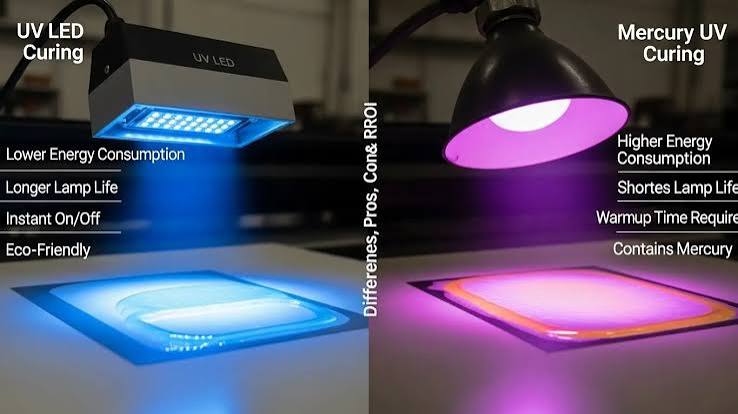
1. High Energy Consumption
Mercury lamps require significant electrical power.
A large portion of consumed energy is converted into:
- Heat
- Infrared radiation
- Unused wavelengths
rather than useful curing energy.
This creates higher operating costs, especially in factories running multiple production lines.
2. Shorter Operating Life
Traditional mercury lamps typically have limited service life.
Over time:
- UV intensity decreases
- Curing consistency declines
- Replacement becomes necessary
Frequent replacement creates:
- Material costs
- Labor costs
- Production downtime
3. Heat Generation Problems
Mercury lamps produce substantial heat.
This can create challenges when curing:
- Heat-sensitive plastics
- Electronic components
- Precision assemblies
Additional cooling systems may be required.
4. Warm-Up Time Requirements
Mercury lamps usually require warm-up periods before reaching stable output.
This affects:
- Startup efficiency
- Intermittent production
- Energy usage
For production lines requiring frequent starts and stops, this can become inefficient.
5. Environmental Concerns
Mercury-containing products require careful handling and disposal.
Companies must consider:
- Waste management
- Environmental regulations
- Worker safety procedures
These factors increase operational complexity.
UV LED Technology: The New Generation of Industrial Curing
UV LED curing technology uses semiconductor-based light-emitting diodes to produce ultraviolet radiation.
Instead of generating a broad spectrum, UV LEDs typically emit a specific wavelength.
Common industrial UV LED wavelengths include:
- 365nm
- 385nm
- 395nm
- 405nm
Each wavelength is designed for different material requirements.
Advantages of UV LED Systems
1. Extremely Long Service Life
One of the biggest advantages of UV LEDs is their durability.
High-quality UV LED modules can operate for thousands of hours.
Compared with mercury lamps, UV LEDs offer:
- Fewer replacements
- Less downtime
- Lower maintenance requirements
For continuous production environments, this difference can significantly reduce operating expenses.
2. Lower Energy Consumption
UV LEDs convert electrical energy into UV output more efficiently.
Benefits include:
- Reduced electricity usage
- Lower operating costs
- Improved factory energy efficiency
For companies focused on reducing manufacturing expenses, this advantage is becoming increasingly important.
3. Instant On/Off Operation
UV LEDs reach full output immediately.
There is no warm-up period.
This allows:
- Faster production startup
- Better automation control
- Reduced idle energy consumption
For modern smart factories, instant operation is a major advantage.
4. Less Heat Generation
UV LEDs produce much less unwanted heat compared with mercury lamps.
This makes them suitable for:
- Electronics
- Precision components
- Heat-sensitive materials
Reduced heat also simplifies system design.
5. Better Environmental Performance
UV LEDs do not contain mercury.
They also reduce:
- Energy consumption
- Waste from lamp replacement
- Disposal concerns
This makes them attractive for companies seeking cleaner manufacturing processes.
Direct Cost Comparison: Mercury Lamps vs UV LED Systems
When companies evaluate UV curing equipment, the initial purchase price is often the first factor considered.
However, industrial equipment decisions should not be based only on upfront cost.
A more accurate evaluation considers the total cost of ownership, including:
- Equipment investment
- Energy consumption
- Maintenance frequency
- Replacement parts
- Labor costs
- Production downtime
- Cooling requirements
- Long-term reliability
A cheaper machine today may become more expensive after years of operation.
Initial Investment: Which Technology Costs More?
Mercury Lamp Systems
Traditional mercury curing systems often have a lower initial purchase price.
This is because:
- The technology is mature
- Manufacturing processes are well established
- Many suppliers already produce these systems
For companies with limited budgets, mercury lamps may appear attractive.
However, the purchase price is only the beginning of the investment.
UV LED Systems
UV LED curing equipment usually requires a higher initial investment.
The reasons include:
- Advanced semiconductor technology
- Precision optical design
- Specialized cooling systems
- Intelligent control components
However, the higher initial cost can often be recovered through lower operating expenses.
Energy Efficiency: The Long-Term Cost Advantage of UV LED
Energy consumption is one of the biggest differences between these two technologies.
Mercury lamps consume significant power because they produce a broad spectrum of radiation, much of which is not used for curing.
Energy is lost through:
- Heat generation
- Infrared radiation
- Unnecessary wavelengths
UV LEDs are more targeted.
They generate specific wavelengths that match the absorption characteristics of modern photoinitiators.
This means more electrical energy becomes useful curing energy.
For factories operating UV equipment for many hours each day, energy savings can become substantial.
Maintenance Costs: Where UV LED Gains a Clear Advantage
Maintenance is often overlooked during equipment selection.
However, industrial production depends on stable operation.
Mercury Lamp Maintenance Requirements
Mercury systems require regular maintenance, including:
- Lamp replacement
- Reflector cleaning
- Cooling system checks
- Optical component inspection
As lamps age, output intensity decreases.
This can affect:
- Curing consistency
- Product quality
- Production reliability
Frequent replacement also creates production interruptions.
UV LED Maintenance Advantages
UV LED systems typically require less routine maintenance.
Benefits include:
- Longer operating life
- Stable output performance
- Reduced replacement frequency
- Less downtime
For automated production lines, reduced maintenance can directly improve productivity.
Production Efficiency Comparison
Modern manufacturing focuses not only on equipment operation but also on production flexibility.
UV curing systems must support:
- Faster startup
- Consistent output
- Automated processes
- Reduced downtime
Mercury Lamps in Production Environments
Mercury lamps can provide excellent curing performance, especially for established processes.
However, limitations include:
- Warm-up requirements
- Cooling delays
- Regular maintenance interruptions
These factors can reduce efficiency in flexible manufacturing environments.
UV LEDs in Smart Manufacturing
UV LEDs fit well with modern automated production.
Advantages include:
- Instant activation
- Precise control
- Digital adjustment
- Easy integration with automation systems
Manufacturers can control:
- Exposure time
- Energy output
- Operating cycles
This makes UV LED systems attractive for Industry 4.0 production environments.
Performance Comparison: Which Produces Better Curing Results?
Cost is important, but curing quality remains the most important consideration.
A cheaper system that produces unreliable results creates additional costs.
Mercury Lamp Curing Performance
Mercury lamps remain effective for many traditional UV materials.
They perform well when applications require:
- Broad wavelength exposure
- High UV intensity
- Deep curing capability
Industries with long-established mercury-compatible materials may continue benefiting from this technology.
UV LED Curing Performance
UV LEDs provide excellent performance when materials are designed for LED wavelengths.
Advantages include:
- Precise wavelength matching
- Stable output
- Controlled curing conditions
Modern material manufacturers increasingly develop formulations specifically optimized for UV LED systems.
The Importance of Matching Wavelength and Material Chemistry
A common misunderstanding is that newer technology automatically cures every material better.
This is not always true.
The success of UV curing depends on matching:
- Light source wavelength
- Photoinitiator absorption range
- Material thickness
- Required curing depth
- Production speed
For example:
A 395nm LED may perform extremely well with a compatible resin but may not effectively cure a material designed for a mercury spectrum.
Likewise, a mercury lamp may remain the better choice for certain specialized coatings.
The best technology is the one that matches the application.
Industry Application Comparison
Different industries have different priorities.
Electronics Manufacturing
Electronics production requires:
- Precision
- Low heat exposure
- Reliable bonding
Common applications include:
- Component fixing
- Sensor assembly
- Display bonding
- Circuit protection
Recommended choice: UV LED
Why?
UV LEDs provide:
- Lower heat output
- Precise wavelength control
- Stable operation
They are especially valuable for heat-sensitive electronic components.
Optical Manufacturing
Optical products require extremely accurate curing.
Applications include:
- Camera modules
- Lens bonding
- Optical sensors
- Fiber components
Recommended choice: UV LED or specialized mercury systems
The choice depends on adhesive formulation.
UV LEDs are often preferred because they provide:
- Controlled exposure
- Reduced thermal stress
- High precision
Printing Industry
UV printing has traditionally relied heavily on mercury lamps.
Applications include:
- Packaging printing
- Labels
- Commercial printing
Recommended choice: Depends on production scale
Mercury systems remain common in some high-speed applications.
However, UV LED printing continues to grow because of:
- Lower energy use
- Longer lifetime
- Reduced maintenance
Coating Industry
Industrial coatings require consideration of:
- Coating thickness
- Material composition
- Required hardness
Recommended choice: Application dependent
Mercury lamps may still be useful for certain thick coatings.
UV LEDs are increasingly suitable for optimized modern coatings.
Medical Device Manufacturing
Medical products require:
- High reliability
- Clean production
- Stable curing
UV LED systems offer advantages including:
- Reduced heat
- Better process control
- Lower maintenance
However, all curing systems must meet strict validation requirements.
3D Printing and Resin Applications
The growth of resin-based manufacturing has increased demand for UV LED technology.
Advantages include:
- Efficient wavelength matching
- Compact equipment design
- Lower operating costs
UV LEDs are now widely used in many resin curing applications.
Environmental and Workplace Considerations
Manufacturers in 2026 are paying more attention to sustainability.
UV curing technology affects:
- Energy consumption
- Waste generation
- Workplace conditions
Mercury Lamp Environmental Challenges
Mercury lamps involve several concerns:
- Mercury-containing materials
- Disposal requirements
- Higher energy consumption
Companies must manage these issues carefully.
UV LED Environmental Benefits
UV LEDs support cleaner production through:
- Lower energy usage
- Longer service life
- Reduced waste
- No mercury content
For companies developing sustainable manufacturing strategies, UV LED technology offers important advantages.
When Should Companies Continue Using Mercury Lamps?
Despite the growth of UV LED, mercury lamps are not obsolete.
They may still be the better choice when:
Existing Materials Are Mercury-Optimized
Some production processes have been developed around mercury lamp output.
Changing systems may require:
- New materials
- Testing
- Process validation
Extremely High Intensity Is Required
Certain industrial applications may still benefit from mercury lamp power.
Budget Constraints Are the Main Concern
For small operations with limited production hours, the lower initial cost may be attractive.
When Should Companies Upgrade to UV LED?
UV LED conversion is especially beneficial when companies need:
Lower Operating Costs
Long-term energy and maintenance savings can justify the investment.
Better Production Flexibility
Instant operation and precise control support modern manufacturing.
Reduced Heat Exposure
Sensitive materials benefit from cooler curing processes.
Environmental Improvement
Companies seeking cleaner production can reduce energy use and waste.
The 2026 Decision Guide: Mercury Lamp or UV LED?
Before choosing a UV curing system, manufacturers should evaluate:
1. Material Compatibility
Ask:
- What wavelength does the material require?
- Is the photoinitiator optimized for LED curing?
- What curing depth is needed?
2. Production Schedule
Consider:
- Daily operating hours
- Production speed
- Startup frequency
- Automation requirements
3. Total Operating Cost
Calculate:
- Electricity expenses
- Maintenance costs
- Replacement frequency
- Downtime losses
4. Future Expansion Plans
A system that meets today's needs may not support tomorrow's production goals.
Consider:
- Automation upgrades
- Energy goals
- New product development
ownership over several years rather than comparing equipment prices on the day of purchase.
A Practical Total Cost of Ownership Model
When evaluating mercury lamps and UV LEDs, consider the following categories.
Initial Equipment Cost
Include:
- UV curing unit
- Power supply
- Cooling system
- Optical components
- Control system
- Installation
Electricity Consumption
Calculate expected electricity usage based on:
- Operating hours per day
- Working days per year
- Number of curing units
- Rated power consumption
A small difference in power consumption can become significant when multiplied across multiple production lines.
Replacement Costs
For mercury systems, include:
- Lamp replacement
- Reflector replacement
- Other consumable components
For UV LED systems, consider:
- LED module replacement when eventually required
- Cooling component maintenance
- Power supply service
Labor Costs
Maintenance requires employee time.
Consider the labor involved in:
- Lamp replacement
- Cleaning
- Calibration
- Troubleshooting
- Production restart
Reduced maintenance frequency can therefore provide savings beyond the parts themselves.
Downtime Costs
Downtime is often one of the most expensive hidden costs in manufacturing.
If a UV lamp fails unexpectedly, production may stop until the problem is resolved.
The resulting cost can include:
- Lost production
- Delayed orders
- Labor inefficiency
- Equipment restart time
For high-volume manufacturing, avoiding downtime may be more valuable than saving a few dollars on equipment.
Why UV LED May Have a Higher Upfront Price but Lower Long-Term Cost
UV LED technology demonstrates an important principle in industrial purchasing:
Higher initial investment does not necessarily mean higher overall cost.
A UV LED system can offset its initial price through:
- Lower energy consumption
- Reduced lamp replacement
- Less routine maintenance
- Lower heat management requirements
- Reduced production downtime
The actual payback period depends heavily on operating conditions.
A factory running UV curing equipment occasionally may not achieve the same financial benefit as a facility operating multiple systems continuously.
Therefore, each company should calculate its own operating profile rather than relying on a generic payback estimate.
Do Not Compare Wattage Alone
One of the most common mistakes when comparing UV curing systems is looking only at electrical wattage.
A higher electrical power rating does not automatically mean better curing performance.
Manufacturers should instead evaluate:
- Irradiance
- Dose
- Wavelength
- Exposure distance
- Curing speed
- Beam uniformity
- Effective curing area
For example, a UV LED system with lower electrical consumption may deliver highly concentrated UV energy at the target wavelength.
A mercury system with higher electrical consumption may distribute energy across a much broader spectrum.
The numbers cannot be compared directly without considering the complete curing process.
Irradiance and UV Dose: The Numbers That Really Matter
Two measurements are especially important in industrial UV curing.
Irradiance
Irradiance describes the UV power received over a specific area, commonly expressed in units such as W/cm².
Higher irradiance can allow faster curing in suitable formulations.
However, maximum irradiance is not always the goal.
The correct value depends on:
- Material chemistry
- Coating thickness
- Production speed
- Exposure distance
UV Dose
UV dose represents the amount of UV energy delivered over time.
It is commonly expressed in units such as J/cm².
A curing process may require a specific dose to achieve:
- Adequate conversion
- Surface hardness
- Bond strength
- Chemical resistance
Manufacturers should therefore evaluate both irradiance and dose rather than focusing on lamp power alone.
Wavelength Selection Can Determine the Winner
UV LED systems are particularly attractive because they provide precise wavelength selection.
Common industrial wavelengths include:
365nm
Often useful when a formulation has photoinitiators that respond strongly around the shorter UVA range.
Potential applications include:
- Optical bonding
- Electronics
- Precision adhesive curing
385nm
A popular wavelength for many modern UV curing formulations.
It can provide a balance between curing performance and LED system efficiency.
395nm
Widely used for:
- Adhesives
- Coatings
- Printing
- Resin curing
Its availability and compatibility with many formulations make it a common industrial choice.
405nm
Although technically near the boundary between violet visible light and UVA, 405nm systems are widely used in curing and resin applications.
The important point is that the correct wavelength must match the photoinitiator chemistry.
The Most Expensive Mistake: Choosing the Wrong Wavelength
A company can purchase an expensive UV LED system and still experience poor curing if the wavelength does not match the material.
Symptoms may include:
- Sticky surfaces
- Incomplete curing
- Poor adhesion
- Weak bonds
- Slow production
- Inconsistent hardness
The solution is not necessarily increasing UV power.
The first step should be checking the relationship between:
Wavelength + photoinitiator + material formulation + dose.
Before purchasing equipment, request curing test data from the supplier whenever possible.
Why Material Formulation Is Becoming More Important
The development of UV LED technology has encouraged chemical manufacturers to create specialized LED-compatible formulations.
Modern UV adhesives, inks, coatings, and resins can be formulated around specific wavelengths.
This creates an important advantage:
The light source and chemistry can be optimized as a complete system.
Instead of asking:
“Which lamp is strongest?”
Manufacturers should ask:
“Which light source and material combination produces the required result most efficiently?”
This approach can dramatically improve curing consistency.
Cooling System Design Matters
UV LED systems generate less unwanted heat than mercury lamps, but they still generate heat.
High-power LED arrays require effective thermal management.
A good system may use:
- Heat sinks
- Fans
- Liquid cooling
- Temperature sensors
- Intelligent thermal protection
Poor thermal management can reduce LED performance and shorten component life.
When comparing UV LED systems, do not evaluate the LED chips alone.
Evaluate the entire thermal design.
Reliability and Production Stability
For an industrial production line, reliability is often more important than maximum output.
A reliable UV curing system should provide:
- Stable irradiance
- Consistent wavelength
- Controlled temperature
- Predictable operation
- Easy monitoring
UV LED systems can provide excellent stability when properly designed.
However, not every LED system is equal.
Important quality factors include:
- LED chip quality
- Optical design
- Cooling system
- Power electronics
- Control software
- Manufacturing quality
Choosing a reputable equipment supplier can therefore be just as important as choosing the technology itself.
Common UV LED Purchasing Mistakes
Mistake 1: Choosing the Cheapest LED System
Low-cost equipment may use inferior:
- LED chips
- Drivers
- Cooling systems
- Optical components
The result can be unstable output and shortened service life.
Mistake 2: Focusing Only on Rated Power
Electrical power does not tell you how effectively UV energy reaches the workpiece.
Ask for actual irradiance measurements at the production distance.
Mistake 3: Ignoring Beam Uniformity
A system may produce high peak intensity but still have poor uniformity.
Uneven UV exposure can create:
- Part-to-part variation
- Incomplete curing
- Different surface hardness
For large curing areas, uniformity is critical.
Mistake 4: Ignoring Maintenance Support
Industrial equipment needs technical support.
Before purchasing, ask about:
- Warranty
- Replacement parts
- Technical assistance
- Calibration
- Service response time
The cheapest equipment can become expensive if support is unavailable.
Common Mercury Lamp Purchasing Mistakes
Mercury systems also require careful evaluation.
Do not assume that every mercury lamp has the same performance.
Consider:
- Lamp spectrum
- Lamp power
- Reflector design
- Cooling configuration
- Replacement availability
- Expected service life
A high-quality reflector and optimized optical system can significantly influence the amount of useful UV energy reaching the product.
Can Mercury Lamps and UV LEDs Coexist?
Absolutely.
The industrial UV market does not need to be an immediate “all mercury” or “all LED” decision.
Many manufacturers can use a hybrid strategy.
For example:
- Existing mercury systems can remain on established production lines.
- New production lines can use UV LED technology.
- LED systems can gradually replace older mercury equipment.
- Materials can be reformulated as production requirements evolve.
This approach can reduce transition risk.
A Practical Migration Strategy for 2026
Companies considering a transition from mercury to UV LED should avoid replacing every system immediately.
A phased approach can be more practical.
Step 1: Identify Suitable Production Lines
Look for applications where:
- The material is LED-compatible.
- Operating hours are high.
- Energy consumption is significant.
- Maintenance costs are high.
These lines may offer the fastest financial return.
Step 2: Perform Laboratory or Production Testing
Test:
- Adhesion
- Hardness
- Cure depth
- Surface quality
- Production speed
- Temperature
Do not change production equipment based solely on theoretical specifications.
Step 3: Calculate Operating Costs
Compare realistic annual costs.
Include:
- Electricity
- Consumables
- Maintenance
- Labor
- Downtime
Step 4: Start With a Pilot Line
A pilot installation allows manufacturers to evaluate:
- Real production performance
- Operator acceptance
- Maintenance requirements
- Material compatibility
Step 5: Expand After Validation
Once the system demonstrates stable performance, companies can gradually introduce UV LED technology to additional production lines.
The Future of Industrial UV Curing
The transition toward UV LED technology is likely to continue, but the future will not be defined by LEDs alone.
Several developments are shaping industrial UV curing.
Smarter UV Curing Systems
Future systems will increasingly integrate:
- Digital monitoring
- Automated intensity measurement
- Temperature monitoring
- Production data collection
- Remote diagnostics
This will make UV curing easier to monitor and control.
More Precise Wavelength Control
As photoinitiator technology improves, manufacturers will increasingly optimize formulations around specific wavelengths.
This can improve:
- Energy efficiency
- Cure speed
- Surface quality
- Process consistency
Greater Energy Efficiency
Manufacturers face increasing pressure to control operating expenses.
Efficient UV curing can reduce energy consumption while maintaining production output.
UV LED technology is well positioned for this trend because it can deliver targeted UV energy without generating the broad spectrum associated with traditional mercury systems.
More Compact Equipment
UV LED systems can be designed in compact formats.
This makes them attractive for:
- Robotic manufacturing
- Automated assembly
- Precision equipment
- Small production cells
Compact UV sources can be positioned close to the workpiece, enabling highly controlled curing.
Better Integration With Automation
Modern production lines increasingly require equipment to communicate with centralized control systems.
UV LED systems can be integrated with:
- PLCs
- Sensors
- Robotics
- Vision systems
- Manufacturing execution systems
This enables curing parameters to become part of the broader production process.
Mercury Lamp or UV LED: The Final Verdict for 2026
So, which technology wins the 2026 cost-performance battle?
The answer depends on the application.
Choose Mercury Lamps When:
- Existing materials are optimized for broad-spectrum UV.
- Very high-intensity curing is required.
- The current system already delivers reliable production.
- The cost of changing materials or equipment is high.
- Production requirements are well established.
Choose UV LED When:
- Energy efficiency is a priority.
- Operating hours are high.
- Maintenance costs need to be reduced.
- Heat-sensitive materials are involved.
- Instant on/off operation is valuable.
- Precise wavelength control is required.
- New production lines are being designed.
- Long-term operating costs matter more than the lowest initial price.
The Real Winner Is the System With the Best Overall Economics
The debate between mercury lamps and UV LEDs should not be reduced to “old technology versus new technology.”
Mercury lamps remain valuable for certain industrial applications.
UV LEDs, however, offer major advantages in efficiency, controllability, maintenance, and long-term operating economics.
For many new industrial installations in 2026, UV LED technology deserves serious consideration.
But the final decision should always be based on actual production requirements.
Before making a purchase, evaluate:
- Wavelength compatibility
- Required irradiance
- Required UV dose
- Material chemistry
- Curing speed
- Operating hours
- Energy consumption
- Maintenance costs
- Expected equipment life
- Production downtime
- Cooling requirements
- Supplier support
The best UV curing system is not necessarily the one with the highest power or lowest purchase price.
It is the system that delivers the required curing result with the lowest practical total cost over its working life.
Final Thoughts: Think Beyond the Purchase Price
Industrial UV curing is entering an increasingly efficient and precise era.
Mercury lamps built the foundation of industrial UV curing and remain useful in many established applications. UV LEDs are now changing the economics of the industry by combining targeted wavelengths, instant operation, lower energy consumption, long service life, and improved process control.
For manufacturers evaluating equipment in 2026, the most important question is not:
“Which technology is cheaper?”
It is:
“Which technology gives our production line the best combination of curing performance, reliability, efficiency, and long-term value?”
For some applications, the answer will still be mercury.
For many new or upgraded production lines, the answer may increasingly be UV LED.
The smartest manufacturers will not choose based on technology trends alone. They will test the material, measure the curing performance, calculate the complete operating cost, and select the light source that delivers the strongest business case.
In the end, the real cost-performance winner is not determined by the name printed on the lamp.
It is determined by how efficiently the entire curing system turns electrical energy into reliable, repeatable production results.