For decades, industrial manufacturers have relied on heat, evaporation, and chemical reactions to dry, coat, bond, and finish products. These conventional methods helped build modern manufacturing, but they also came with significant limitations: long processing times, high energy consumption, large production footprints, solvent emissions, extended curing periods, and inconsistent results.
Today, ultraviolet curing technology is changing that equation.
UV curing uses ultraviolet light to trigger a rapid photochemical reaction in specially formulated materials. Instead of waiting for heat or solvents to evaporate, manufacturers can transform a liquid coating, adhesive, ink, resin, or other formulation into a solid or highly stable material within seconds—or even fractions of a second—when the right formulation and UV energy are applied.
This ability has made UV curing an increasingly important technology across industrial manufacturing. From electronics and automotive components to packaging, flooring, furniture, medical devices, optical products, and advanced composites, UV technology is helping manufacturers rethink how products are coated, bonded, printed, protected, and assembled.
But the real significance of UV curing is not simply that it is fast.
Its greatest impact comes from the way it changes the entire manufacturing process.
By reducing curing time, lowering thermal exposure, improving production consistency, enabling compact production lines, and supporting more efficient material use, UV curing can help manufacturers build faster and more flexible production systems.
What Is UV Curing?
UV curing is a manufacturing process in which ultraviolet light initiates a chemical reaction that converts a liquid or semi-liquid formulation into a solid material.
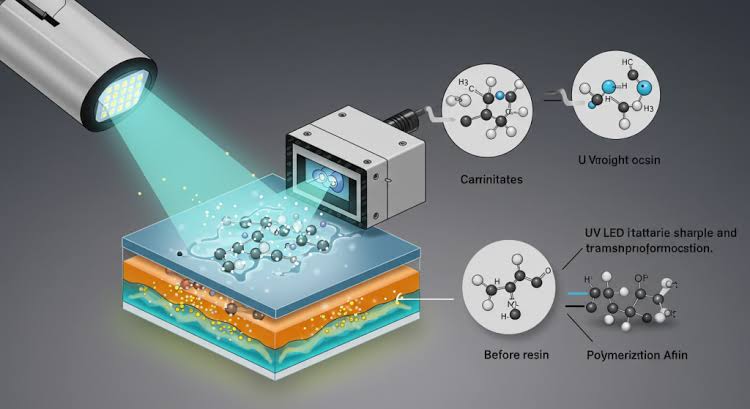
A typical UV-curable formulation contains photoinitiators. When exposed to an appropriate wavelength of ultraviolet light, these compounds absorb the light energy and generate reactive species. Those reactive species initiate polymerization or cross-linking within the formulation.
The result is a rapid transformation from a liquid state to a cured solid.
UV curing is commonly used with:
-
Coatings
-
Adhesives
-
Inks
-
Resins
-
Sealants
-
Protective finishes
-
Optical materials
-
Encapsulation compounds
-
3D printing materials
-
Electronic assembly materials
The exact chemistry varies according to the application.
Some systems use free-radical polymerization, while others rely on cationic chemistry. Formulations can also be engineered to deliver specific properties such as hardness, flexibility, chemical resistance, scratch resistance, optical clarity, or adhesion.
This flexibility is one reason UV curing has become so valuable to modern manufacturing.
Why UV Curing Is Different From Traditional Curing
Traditional curing processes often depend on heat, evaporation, oxidation, or extended chemical reactions.
For example, a conventional coating may require heating to drive off water or solvent. A thermally cured adhesive may need to remain at elevated temperature for a specific period before reaching its final properties.
UV curing takes a different approach.
The curing reaction is activated by light.
This creates an important manufacturing advantage: the material does not necessarily need to be heated to the same degree as it would in a conventional thermal process.
Instead, UV energy is delivered directly to the formulation.
That distinction can have major consequences for production.
A manufacturer may be able to reduce oven size, shorten production lines, reduce thermal exposure, increase line speed, and process heat-sensitive substrates that would otherwise be difficult to manufacture.
Speed: The Most Obvious Advantage
One of the biggest advantages of UV curing is speed.
Traditional coatings and adhesives may require minutes, hours, or even days to reach their final usable state depending on the chemistry and environmental conditions.
UV curing can dramatically shorten this window.
A product can often move from coating or bonding to handling and subsequent processing almost immediately after exposure to the appropriate UV energy.
This can eliminate long waiting periods between manufacturing steps.
Consider a production line applying a protective coating to a component.
With a conventional curing system, the component may need to travel through a heated oven or remain in a controlled environment while the coating cures.
With a UV system, the component can pass beneath a UV source and emerge cured within a much shorter distance.
The manufacturing line can therefore become faster and more compact.
Higher Production Throughput
Shorter curing times can directly contribute to higher throughput.
If a manufacturing operation previously required a long curing stage, that stage may have represented a bottleneck.
UV curing can reduce the time products spend waiting for coatings, adhesives, or inks to become sufficiently stable for the next step.
Higher throughput can provide several benefits:
-
More products produced per shift
-
Shorter production cycles
-
Reduced work-in-progress inventory
-
Faster order fulfillment
-
Better equipment utilization
-
Greater manufacturing flexibility
For high-volume manufacturers, even a small reduction in cycle time can have a substantial cumulative effect.
Energy Efficiency and Process Optimization
UV curing can also change how manufacturers use energy.
A conventional thermal curing system may need to heat a large oven, maintain that temperature, circulate heated air, and continue operating for long periods.
UV curing concentrates energy on the curing reaction itself.
This does not mean every UV system automatically consumes less energy than every conventional process. Actual energy performance depends on equipment design, formulation, line speed, substrate, UV wavelength, and process conditions.
However, UV curing can reduce the need for prolonged bulk heating and can therefore offer meaningful opportunities for energy optimization.
Manufacturers evaluating UV technology should look at the entire process rather than comparing only the rated power of individual lamps.
UV LED Technology Is Expanding the Possibilities
Traditional UV curing systems often relied on arc lamps.
Modern UV LED technology has introduced another major development.
UV LEDs generate ultraviolet radiation using semiconductor devices rather than conventional lamps. Depending on the application, LED systems can provide advantages such as longer operating life, reduced heat transfer to the substrate, instant on/off capability, and more controllable energy delivery.
One of the most important characteristics of UV LED systems is their ability to operate without the same warm-up and cool-down requirements associated with some traditional lamp technologies.
This can be particularly valuable in automated production.
A UV LED system can be switched on when curing is required and switched off when it is not, helping manufacturers match energy use more closely to actual production demand.
Better Control Over Manufacturing Processes
Modern manufacturing increasingly depends on precise process control.
UV curing fits naturally into this trend because UV energy can be measured, monitored, adjusted, and integrated with automated equipment.
Important process variables may include:
-
UV wavelength
-
Irradiance
-
Exposure time
-
Energy dose
-
Working distance
-
Lamp or LED temperature
-
Conveyor speed
-
Material thickness
-
Formulation characteristics
Controlling these variables helps manufacturers establish repeatable curing conditions.
This is especially important in industries where product performance depends on consistent coating thickness, bond strength, surface hardness, or optical properties.
The Importance of UV Dose
One common misunderstanding is that UV curing is simply a matter of exposing a material to a powerful lamp.
In reality, successful curing depends on the relationship between irradiance and exposure time.
A useful concept is UV dose.
UV dose represents the amount of UV energy delivered over a specific period and is commonly expressed in units such as millijoules per square centimeter.
A process can fail if the material receives insufficient energy.
But excessive exposure does not necessarily guarantee better results either.
The correct curing window depends on the formulation and application.
Manufacturers therefore need to validate the curing process rather than assuming that higher UV intensity is always better.
Precision Manufacturing for Electronics
The electronics industry is one of the areas where UV curing can provide substantial value.
Modern electronic products increasingly contain compact components, complex assemblies, sensors, displays, connectors, and delicate materials.
Many of these components are sensitive to heat.
UV-curable adhesives and coatings can provide localized curing without exposing the entire assembly to prolonged high temperatures.
Applications can include:
-
Component bonding
-
Wire protection
-
Encapsulation
-
Display assembly
-
Sensor manufacturing
-
Optical bonding
-
Conformal coatings
-
Connector assembly
The ability to cure quickly can also help electronics manufacturers increase automation.
Optical Bonding and Clear Materials
Optical manufacturing presents particularly demanding requirements.
Adhesives used for lenses, displays, sensors, and other optical components may need excellent transparency, low shrinkage, strong adhesion, and controlled curing behavior.
UV-curable optical adhesives can be designed to provide rapid curing while maintaining optical performance.
However, optical applications require careful attention to UV transmission.
If the material being bonded blocks the curing wavelength, the adhesive may not receive enough energy to cure properly.
This is one reason dual-cure formulations are sometimes used.
A material may be designed to cure with UV light where light can reach it and then continue curing through another chemical mechanism in shadowed areas.
Automotive Manufacturing
The automotive industry is another major application area.
Modern vehicles contain extensive use of coatings, adhesives, sensors, lighting components, plastics, electronic modules, and decorative surfaces.
UV curing can be used in selected processes involving:
-
Interior components
-
Decorative coatings
-
Protective coatings
-
Lighting components
-
Electronic assemblies
-
Adhesive bonding
-
Surface finishing
Automotive manufacturing demands high consistency and durability.
A coating may need to withstand abrasion, chemicals, temperature changes, sunlight, and mechanical stress.
UV-curable formulations can be engineered to provide many of these characteristics.
Furniture and Wood Finishing
UV curing has also transformed aspects of furniture and wood-product manufacturing.
Traditional wood coatings may require extended drying time between coats.
UV-curable finishes can dramatically reduce the waiting period.
This makes it possible to create faster finishing lines for products such as:
-
Cabinets
-
Flooring
-
Tables
-
Doors
-
Decorative panels
-
Engineered wood products
-
Furniture components
Another important benefit is surface performance.
UV-cured finishes can provide strong resistance to scratching, chemicals, and everyday wear when properly formulated and cured.
For high-volume flooring production, fast curing can be particularly valuable because finished panels can move quickly to subsequent production or packaging stages.
Printing and Packaging
UV curing has played an especially important role in industrial printing.
UV-curable inks can be cured almost immediately after printing.
This allows printing systems to work with a broader range of substrates and reduces the waiting period associated with drying.
UV printing is used in applications involving:
-
Labels
-
Packaging
-
Promotional products
-
Industrial graphics
-
Signage
-
Decorative surfaces
-
Specialty printing
Because the ink can cure rapidly, printed surfaces can often be handled much sooner.
This is particularly useful in high-speed manufacturing environments where traditional drying would slow production.
Reduced Solvent Dependence
Many conventional coatings and inks rely on solvents that evaporate during drying.
UV-curable systems can be formulated with high solid content and can significantly reduce reliance on volatile solvents in appropriate applications.
This can provide advantages in manufacturing environments concerned with air emissions, workplace conditions, and material efficiency.
However, UV curing should not automatically be described as completely emission-free.
Formulations can contain reactive components and other substances that require appropriate handling.
The correct approach is to evaluate the entire formulation and process rather than assuming that the use of UV light alone determines environmental performance.
Less Heat Can Mean More Material Choices
One of the most important consequences of UV curing is the ability to process materials that are sensitive to prolonged heat.
Conventional thermal curing can deform, discolor, or damage certain substrates.
UV curing can provide localized energy to the coating or adhesive while limiting overall thermal exposure.
This can expand the range of materials suitable for certain manufacturing processes.
Potential substrates include:
-
Plastics
-
Films
-
Paper
-
Wood
-
Composite materials
-
Electronics
-
Specialty fabrics
-
Heat-sensitive components
The actual suitability depends on the formulation and UV process, but the principle is powerful.
Manufacturers are no longer limited to materials that can survive long periods inside a high-temperature oven.
Compact Production Lines
Traditional curing equipment can occupy substantial floor space.
Large ovens require heating zones, ventilation, insulation, conveyors, and supporting infrastructure.
UV curing systems can often be integrated into much smaller production areas.
This can be particularly valuable when factory space is expensive or limited.
A shorter curing section may allow manufacturers to:
-
Reduce line length
-
Increase production density
-
Simplify equipment layouts
-
Add curing stages to existing lines
-
Improve material flow
For manufacturers expanding production without constructing a completely new facility, compact UV systems can offer an attractive option.
Automation and Smart Manufacturing
UV curing is highly compatible with automation.
A UV curing system can be integrated with:
-
Conveyor systems
-
Robotic arms
-
Sensors
-
Cameras
-
Programmable controllers
-
Automated dispensing equipment
-
Production monitoring systems
For example, a robot may dispense adhesive onto a component, position a second component, and then activate a UV curing system.
The entire process can occur within a tightly controlled production cycle.
Sensors can monitor position, exposure, and equipment status.
This makes UV curing a natural component of modern automated factories.
Quality Control Matters
Fast curing does not eliminate the need for quality control.
In fact, the speed of UV processing makes process monitoring even more important.
If a production line is operating rapidly, a curing problem can affect thousands of products before the issue is discovered.
Manufacturers should establish controls for:
-
UV output
-
Lamp or LED condition
-
Energy dose
-
Conveyor speed
-
Material thickness
-
Formulation batch consistency
-
Surface cleanliness
-
Working distance
Regular equipment inspection and process validation are essential.
What Happens When UV Curing Is Incomplete?
Under-curing can cause serious performance problems.
A material that appears solid may not have reached its required final properties.
Possible consequences include:
-
Reduced hardness
-
Poor adhesion
-
Lower chemical resistance
-
Surface tackiness
-
Reduced durability
-
Weak bonding
-
Premature failure
-
Residual reactive components
This is why visual inspection alone is not always sufficient.
Manufacturers may need to use appropriate testing methods to verify that the cured material meets its required specifications.
Can Too Much UV Exposure Be a Problem?
Yes.
Overexposure can affect some formulations and substrates.
Depending on the chemistry, excessive UV exposure may contribute to:
-
Yellowing
-
Surface degradation
-
Excessive heating
-
Material embrittlement
-
Substrate damage
-
Changes in appearance
The correct goal is not maximum UV exposure.
The goal is the correct UV process window.
UV Wavelength Selection
Different UV-curable formulations respond to different wavelengths.
This means that the UV source must be compatible with the photoinitiator system.
Common industrial UV systems may operate in different portions of the ultraviolet spectrum, including UVA, UVB, or shorter-wavelength regions depending on the application.
Modern LED systems are particularly useful because they can be designed around specific wavelength bands.
The correct wavelength can improve curing efficiency and process consistency.
Safety in Industrial UV Curing
UV curing technology provides major manufacturing benefits, but ultraviolet radiation must be treated as a workplace hazard.
Direct exposure to certain UV radiation can harm the eyes and skin.
Industrial UV curing systems should therefore be designed with appropriate engineering controls.
These may include:
-
Enclosures
-
Interlocks
-
Shields
-
Protective barriers
-
Warning indicators
-
Access controls
-
Appropriate personal protective equipment
-
Proper operating procedures
Workers should never bypass safety systems simply to speed up production.
The curing chamber should be designed so that normal operation does not require workers to be exposed to the UV source.
Maintenance of UV Curing Equipment
A UV curing system is only as reliable as its maintenance program.
Dust, contamination, aging components, optical degradation, cooling problems, and changes in lamp or LED output can affect curing performance.
A maintenance program should address:
-
Cleaning optical surfaces
-
Checking cooling systems
-
Monitoring UV output
-
Inspecting electrical connections
-
Checking safety interlocks
-
Replacing aging components
-
Verifying process calibration
For production-critical systems, maintenance records can help identify performance trends before they become major problems.
The Role of Formulation Chemistry
UV curing equipment is only one part of the process.
The formulation itself is equally important.
A high-performance UV source cannot compensate for an unsuitable formulation.
Formulation developers must consider:
-
Photoinitiator concentration
-
Resin chemistry
-
Pigment loading
-
Film thickness
-
Additives
-
Oxygen sensitivity
-
Substrate compatibility
-
Desired mechanical properties
For example, heavily pigmented coatings can be more challenging to cure because pigments may absorb or scatter UV radiation.
This means equipment and chemistry should be developed together.
UV Curing in 3D Printing
UV-curable materials have also become central to many additive manufacturing technologies.
In photopolymer-based 3D printing, light selectively cures liquid resin layer by layer.
This enables the production of highly detailed components without traditional molds or machining.
Applications include:
-
Prototypes
-
Dental models
-
Jewelry patterns
-
Engineering components
-
Medical models
-
Consumer products
The same basic principle—using light to initiate polymerization—can therefore support both high-volume industrial production and advanced digital manufacturing.
Customization and On-Demand Manufacturing
Another important advantage is flexibility.
Because UV curing can work rapidly, manufacturers can switch between product variations without waiting for long curing cycles.
This supports shorter production runs and greater customization.
For businesses responding to changing customer demand, the ability to manufacture smaller batches efficiently can be a competitive advantage.
Instead of maintaining large inventories of finished products, manufacturers may be able to produce more products closer to the time of demand.
The Economics of UV Curing
Installing a UV curing system requires an initial investment.
The equipment itself is only part of the cost.
Manufacturers should evaluate:
-
UV equipment
-
Power consumption
-
Cooling
-
Maintenance
-
Consumables
-
Formulation costs
-
Production speed
-
Labor requirements
-
Floor space
-
Waste
-
Downtime
-
Product quality
The most meaningful comparison is total process economics.
A UV system that costs more initially may still provide a strong return if it significantly increases throughput, reduces curing space, lowers maintenance requirements, or reduces production waste.
How Manufacturers Should Evaluate UV Technology
Before adopting UV curing, manufacturers should conduct a structured process evaluation.
Start by identifying the current bottleneck.
Is the problem:
-
Slow drying?
-
Excessive heat?
-
Long production lines?
-
High energy consumption?
-
Limited substrate compatibility?
-
Inconsistent curing?
-
Labor-intensive processing?
-
Large factory footprint?
Then determine whether UV curing actually addresses the problem.
Next, test the formulation and substrate together.
Do not purchase equipment solely based on lamp power or marketing specifications.
A successful UV process requires compatibility among the formulation, UV source, optics, distance, exposure time, substrate, and production speed.
The Future of UV Curing
The future of UV curing is closely connected to the broader evolution of manufacturing.
Factories are becoming more automated, more data-driven, more flexible, and increasingly focused on efficient resource use.
UV curing fits naturally into this transformation.
Future systems are likely to emphasize:
-
Intelligent UV monitoring
-
Real-time energy measurement
-
Automated dose control
-
Advanced UV LED systems
-
More specialized formulations
-
Smaller production footprints
-
Greater process automation
-
Predictive maintenance
-
Digital production monitoring
The result will not simply be faster curing.
It will be smarter curing.
UV Curing and Sustainable Manufacturing
Manufacturers are under increasing pressure to reduce resource consumption while maintaining product quality.
UV curing can contribute to this goal when properly implemented.
Potential benefits include:
-
Reduced thermal processing
-
Lower energy consumption in suitable applications
-
Faster production cycles
-
Less material waiting time
-
Reduced production footprint
-
Lower solvent dependence in appropriate formulations
-
Less waste from inconsistent curing
However, sustainability should always be evaluated across the complete manufacturing system.
Equipment manufacturing, raw materials, formulation chemistry, electricity sources, product lifespan, maintenance, and end-of-life considerations all contribute to environmental impact.
UV curing is a tool—not a guarantee.
Its value comes from using that tool intelligently.
From Faster Curing to Smarter Manufacturing
The real power of UV technology is that it changes the relationship between time, energy, materials, and production.
Traditional curing often treats time as an unavoidable part of manufacturing.
UV curing challenges that assumption.
A coating does not necessarily need to remain wet for hours.
An adhesive does not necessarily need to wait for a long thermal cycle.
An ink does not necessarily need an extended drying period.
When the formulation and equipment are properly matched, light can initiate a rapid transformation and allow the manufacturing process to move forward almost immediately.
That changes more than one production step.
It can change the design of the entire factory.
Conclusion
UV curing has evolved from a specialized industrial process into a powerful manufacturing technology capable of transforming how products are coated, bonded, printed, finished, and assembled.
Its greatest advantages include rapid curing, precise process control, reduced thermal exposure, compact equipment, automation compatibility, and the ability to support advanced materials and high-speed production.
UV LED technology is pushing this evolution even further by providing more precise energy delivery, operational flexibility, and new opportunities for equipment integration.
From electronics and automotive components to furniture, flooring, packaging, printing, optical products, and additive manufacturing, UV curing is helping manufacturers build faster and more responsive production systems.
But successful implementation requires more than installing a UV lamp.
Manufacturers must select the right formulation, wavelength, irradiance, exposure time, equipment configuration, and safety controls. They must monitor UV dose, maintain equipment, validate curing performance, and understand the specific requirements of their materials.
When these factors are carefully managed, UV curing can become much more than a faster way to dry a coating.
It can become a foundation for a more efficient, precise, automated, and flexible manufacturing process.
The future of industrial production will increasingly depend on technologies that can deliver high performance while reducing unnecessary time, energy, space, and waste. UV curing is positioned to play an important role in that future.
As manufacturers continue to pursue faster production cycles, smarter automation, improved product quality, and more efficient processes, the power of ultraviolet curing will continue to expand—turning light into one of the most valuable tools in modern industrial manufacturing.