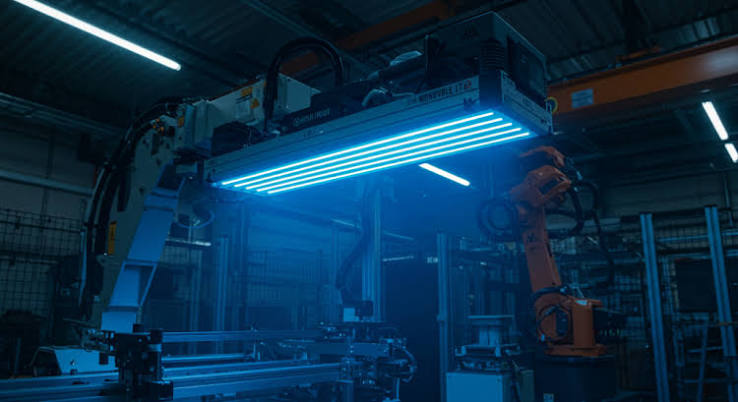
Ultraviolet (UV) technology has long been associated with disinfection. From sanitizing drinking water to reducing microorganisms on surfaces, UV lamps have become a familiar tool in environments where cleanliness and microbial control are essential. But limiting UV technology to disinfection overlooks one of its most valuable characteristics: ultraviolet energy can trigger, accelerate, or control a wide range of physical and chemical processes.
Today, advanced UV lamps are becoming increasingly important across industrial manufacturing, chemical processing, printing, electronics, coatings, wastewater treatment, food production, pharmaceuticals, and environmental engineering. Their ability to deliver controlled energy without direct physical contact makes UV systems particularly attractive for modern production lines where speed, precision, consistency, and reduced chemical consumption matter.
The industrial value of UV technology is therefore expanding from simply “killing microorganisms” to controlling chemistry, modifying materials, curing products, improving manufacturing efficiency, and supporting cleaner production processes.
This article explores the advanced industrial applications of UV lamps, how different UV wavelengths influence industrial processes, what types of UV systems are available, and what companies should consider when designing or upgrading a UV-based production system.
Understanding UV Technology Beyond Disinfection
Ultraviolet radiation is part of the electromagnetic spectrum between visible light and X-rays. Industrial UV systems generally operate across several wavelength ranges, with different wavelengths producing different physical and chemical effects.
UV-A generally covers approximately 315–400 nanometers. UV-B occupies approximately 280–315 nanometers, while UV-C covers roughly 100–280 nanometers. Vacuum ultraviolet, or VUV, extends into shorter wavelengths and is used in specialized industrial environments.
The distinction is important because industrial UV applications depend heavily on wavelength.
A wavelength that is effective for microbial control may not be the best choice for curing a coating. A wavelength that initiates photochemical reactions may be unsuitable for another material. Industrial UV design is therefore not simply a matter of selecting the strongest lamp.
Instead, engineers must consider:
-
Target wavelength
-
Irradiance
-
Exposure time
-
Distance from the target
-
Material composition
-
Optical transmission
-
Temperature
-
Production speed
-
Required energy dose
-
Lamp lifetime
-
Cooling requirements
-
Safety controls
This is why advanced UV systems are often engineered as complete process solutions rather than treated as ordinary lighting equipment.
1. UV Curing in Industrial Manufacturing
One of the most significant applications of industrial UV lamps is UV curing.
Traditional curing methods may rely on heat, solvent evaporation, or extended drying periods. UV curing uses ultraviolet energy to initiate a photochemical reaction that transforms a liquid or semi-liquid formulation into a solid material.
This technology is widely used for:
-
Industrial coatings
-
Adhesives
-
Inks
-
Wood finishes
-
Plastic coatings
-
Electronics
-
Optical components
-
Flooring
-
Automotive components
-
Metal finishing
A typical UV-curable formulation contains photoinitiators. When exposed to the appropriate UV energy, these compounds generate reactive species that initiate polymerization. The material can therefore harden rapidly without waiting for conventional evaporation or thermal drying.
Why UV curing is attractive
The biggest advantage is speed.
A production line that previously required substantial drying space may be redesigned around near-instant curing. This can reduce floor-space requirements and potentially increase manufacturing throughput.
UV curing can also provide:
Lower thermal exposure: Heat-sensitive substrates may be processed without being exposed to the high temperatures required by conventional thermal curing.
Reduced drying time: UV curing can transform materials rapidly, allowing products to move through production stages faster.
Improved process control: UV dose, conveyor speed, lamp intensity, and exposure geometry can be monitored and adjusted.
Potentially lower solvent emissions: Many UV-curable formulations contain fewer volatile solvents than traditional formulations, depending on the chemistry.
Consistent surface performance: Properly formulated and cured coatings can provide controlled hardness, gloss, abrasion resistance, and chemical resistance.
For manufacturers looking to increase production speed while maintaining repeatable quality, UV curing can be a powerful alternative to conventional drying technologies.
2. UV Technology in Industrial Printing
The printing industry has been transformed by UV curing technology.
Traditional printing inks may require significant drying time. UV-curable inks, by contrast, can be rapidly cured after printing, allowing printed materials to be handled almost immediately.
UV printing is used for:
-
Packaging
-
Labels
-
Commercial graphics
-
Industrial markings
-
Product decoration
-
Plastic films
-
Metal sheets
-
Glass
-
Wood
-
Specialty substrates
One major advantage is that UV-curable ink can remain relatively stable until it receives the required UV exposure. Once the printed ink passes through the curing zone, the photochemical reaction begins and the ink rapidly solidifies.
This makes UV curing particularly useful for high-speed production environments.
UV LED curing for printing
UV LED technology has become increasingly attractive in industrial printing because LED systems can provide targeted wavelengths, lower operating temperatures, long service life, and rapid electronic control.
Unlike conventional mercury-based UV lamps, UV LEDs do not necessarily require long warm-up periods. They can often be switched on and off rapidly, which can be valuable for intermittent production processes.
However, UV LED systems must be matched carefully to the photoinitiator system used in the ink or coating. A formulation designed for one spectral output may not perform properly under another.
The lesson is simple: lamp selection and material chemistry must be designed together.
3. UV Curing for Industrial Adhesives
Adhesive bonding is another field where UV technology can provide major advantages.
UV-curable adhesives are used in electronics, optics, medical-device manufacturing, glass assembly, automotive components, and precision manufacturing.
The process is particularly useful when manufacturers need:
-
Rapid bonding
-
Accurate positioning
-
Clean processing
-
Minimal thermal exposure
-
Automated production
-
Consistent curing
-
Controlled adhesive thickness
An assembly can be positioned while the adhesive remains workable. Once the components are correctly aligned, UV energy can initiate curing.
This creates an important manufacturing advantage: the adhesive can provide extended working time followed by rapid fixation.
In automated production, this can simplify assembly sequences and reduce waiting time between bonding and subsequent processing.
For optical components, however, UV transmission through the materials being bonded becomes critical. If glass, plastic, or another substrate blocks the required wavelength, the adhesive may not receive enough energy to cure properly.
4. Electronics Manufacturing and UV Processing
Modern electronics manufacturing requires highly controlled processes, and UV technology can play several roles.
UV curing can be used for:
-
Conformal coatings
-
Encapsulation materials
-
Adhesives
-
Solder-mask processes
-
Protective coatings
-
Component bonding
-
Optical assembly
Electronic components are often sensitive to excessive heat. Conventional thermal curing can therefore create challenges for certain assemblies.
UV curing provides an alternative in applications where the formulation and substrate permit sufficient UV transmission.
Another benefit is localized processing. UV energy can be directed toward specific regions rather than heating an entire assembly.
This targeted approach may help reduce unnecessary thermal exposure and improve process efficiency.
5. Surface Modification and Activation
UV lamps can do more than cure materials. They can also change surface chemistry.
Many industrial materials have surfaces that are difficult to bond, coat, print, or otherwise modify. Surface treatment can improve their compatibility with subsequent manufacturing processes.
UV-based surface modification may involve photochemical reactions that alter organic contaminants or surface functional groups.
Applications include:
-
Plastic surface treatment
-
Adhesion improvement
-
Coating preparation
-
Printing preparation
-
Optical manufacturing
-
Electronics
-
Polymer processing
In certain systems, UV energy is combined with ozone or oxygen chemistry to clean and activate surfaces.
The objective is not necessarily to remove large amounts of material. Instead, the process may modify the surface at a microscopic or molecular level.
This can be especially valuable when manufacturers need to improve adhesion without aggressive mechanical abrasion or harsh chemical treatment.
6. UV/Ozone Cleaning for Precision Manufacturing
UV/ozone systems are increasingly useful where extremely clean surfaces are required.
Short-wavelength UV radiation can interact with oxygen in the surrounding environment, producing reactive species that help break down organic contamination.
This approach can be used for cleaning:
-
Glass
-
Silicon
-
Metals
-
Optical components
-
Electronic substrates
-
Laboratory components
-
Precision manufacturing surfaces
The major advantage is that UV/ozone cleaning can address thin organic contamination without requiring traditional solvent-intensive cleaning procedures.
For industries where microscopic contamination can affect product performance, this capability can be extremely valuable.
However, ozone is hazardous to inhale, so UV/ozone equipment must be properly enclosed, ventilated, monitored, and interlocked.
7. Photochemical Manufacturing
Perhaps one of the most interesting industrial uses of UV technology is photochemistry.
Photochemical processes use light energy to initiate or accelerate chemical reactions.
UV wavelengths can provide energy that changes molecular structures or activates specific compounds. This creates opportunities in:
-
Chemical synthesis
-
Polymerization
-
Oxidation processes
-
Specialty chemical production
-
Material development
-
Pharmaceutical manufacturing
-
Environmental treatment
Compared with conventional chemical reactions driven primarily by heat, photochemical processes can sometimes provide highly selective reaction pathways.
This is one reason UV technology is attracting attention in advanced manufacturing.
Instead of thinking of a UV lamp as a light source, engineers can think of it as an energy-delivery device for controlling chemical reactions.
8. Advanced Water and Wastewater Treatment
UV disinfection remains important in water treatment, but industrial UV systems can perform functions beyond conventional microbial control.
Advanced UV processes can be combined with oxidizing agents to create highly reactive species capable of breaking down difficult organic compounds.
These systems are commonly described as advanced oxidation processes.
Potential applications include treatment of:
-
Industrial wastewater
-
Process water
-
Reuse water
-
Chemical manufacturing effluent
-
Pharmaceutical wastewater
-
Contaminated groundwater
-
Specialty industrial streams
The basic concept is that UV energy helps initiate chemical reactions that transform contaminants into smaller or less problematic compounds.
UV-based advanced oxidation can therefore complement filtration, biological treatment, adsorption, and other water-treatment technologies.
The engineering challenge is that different contaminants respond differently to UV energy. System performance depends on factors such as UV transmittance, contaminant concentration, water chemistry, reactor geometry, and energy dose.
9. Food and Beverage Processing
The food industry has traditionally relied on thermal processing, chemical sanitation, filtration, refrigeration, and other methods.
UV technology can provide an additional processing option.
Potential applications include treatment of:
-
Water
-
Air
-
Packaging surfaces
-
Production surfaces
-
Certain liquid food streams
-
Process environments
UV treatment can be attractive where manufacturers want to reduce chemical usage or process certain materials without adding heat.
For liquid applications, however, optical characteristics are important. Turbidity, color, suspended particles, and absorption can reduce UV penetration.
Therefore, successful UV treatment requires careful process validation rather than simply increasing lamp power.
10. Pharmaceutical and Biotechnology Applications
Pharmaceutical production requires stringent control over contamination, process consistency, and material quality.
UV systems may be incorporated into:
-
Water treatment
-
Surface treatment
-
Air-handling systems
-
Equipment processing
-
Photochemical synthesis
-
UV curing of specialized materials
In pharmaceutical manufacturing, UV technology can also serve as part of a broader contamination-control strategy.
But industrial pharmaceutical applications demand validated processes. Lamp intensity, exposure time, equipment configuration, maintenance intervals, and performance verification all need to be carefully controlled.
A UV lamp should never be treated as a substitute for an entire contamination-control program.
11. UV Technology for Coatings and Finishing
Industrial coatings can protect products from corrosion, abrasion, chemicals, moisture, and environmental exposure.
UV curing allows certain coatings to harden quickly after application.
Applications include:
-
Automotive components
-
Furniture
-
Flooring
-
Metal products
-
Plastic parts
-
Building materials
-
Consumer products
-
Industrial equipment
UV-cured coatings can provide excellent surface properties when properly formulated and cured.
The technology is especially attractive when production lines require rapid handling.
For example, a manufacturer may apply a coating, expose the product to a UV curing chamber, and immediately move the finished component to packaging or assembly.
This can dramatically reduce the space traditionally required for drying.
12. UV in 3D Printing and Additive Manufacturing
UV-sensitive photopolymers are fundamental to several additive manufacturing technologies.
Processes such as stereolithography rely on light to selectively cure liquid resin layer by layer.
In these systems, the UV or near-UV energy source is a critical part of the manufacturing process.
Industrial applications include:
-
Prototyping
-
Dental manufacturing
-
Jewelry production
-
Engineering components
-
Precision molds
-
Customized products
-
Functional prototypes
The importance of UV technology in additive manufacturing goes beyond simply hardening resin.
Engineers must control wavelength, exposure time, intensity, resin chemistry, layer thickness, optical resolution, and post-curing conditions.
Small variations in exposure can influence dimensional accuracy, mechanical properties, surface quality, and overall part performance.
13. UV Post-Curing
Some UV-based manufacturing processes use a secondary UV exposure after the primary manufacturing stage.
Post-curing can help improve:
-
Hardness
-
Strength
-
Chemical resistance
-
Surface stability
-
Dimensional consistency
This is particularly relevant to photopolymer-based manufacturing.
A part may appear fully formed after printing, but additional controlled UV exposure can continue polymerization and improve final material properties.
Industrial post-curing systems may use controlled chamber designs with rotating platforms, reflective interiors, multiple lamps, or LED arrays to provide more uniform exposure.
14. UV for Environmental Remediation
UV technology can contribute to environmental engineering beyond water disinfection.
UV-based oxidation systems can help address certain difficult-to-degrade organic contaminants.
Potential targets may include:
-
Industrial organic compounds
-
Solvent residues
-
Certain pharmaceutical compounds
-
Persistent process chemicals
-
Odor-causing compounds
The effectiveness of a UV treatment system depends strongly on the chemistry involved. Some contaminants respond readily, while others require catalysts, oxidants, longer exposure, or additional treatment stages.
Consequently, industrial environmental applications should be based on laboratory testing and pilot-scale validation rather than assumptions about UV effectiveness.
15. UV Decontamination of Industrial Air
UV systems can also be integrated into industrial air-handling equipment.
In controlled environments, UV energy can help reduce airborne microbial contamination when properly engineered.
Potential locations include:
-
HVAC systems
-
Manufacturing facilities
-
Cleanrooms
-
Food-processing areas
-
Laboratories
-
Industrial ventilation systems
Air treatment presents a different engineering problem from surface treatment because air moves continuously through the UV exposure zone.
The system must therefore provide sufficient exposure while maintaining the required airflow rate.
Factors such as duct geometry, air velocity, lamp placement, temperature, humidity, and lamp aging all affect performance.
16. UV LED Technology and the Future of Industrial Systems
One of the biggest developments in industrial UV technology is the transition toward UV LEDs.
Traditional UV lamps can provide broad-spectrum output and high power, but they may generate significant heat and require specialized maintenance.
UV LEDs offer several potential advantages:
-
Long operating life
-
Instant switching
-
Targeted wavelength output
-
Compact equipment design
-
Lower maintenance requirements
-
Reduced mercury concerns
-
Precise electronic control
UV LED systems are particularly attractive when the process requires specific wavelengths rather than broad-spectrum UV radiation.
However, LEDs are not automatically better for every application.
High-power industrial processes may still require conventional lamps, particularly when large-area exposure or specific spectral characteristics are needed.
The correct choice depends on the process rather than the technology trend.
17. Choosing the Right UV Wavelength
Wavelength selection is one of the most important decisions in industrial UV system design.
Different applications require different spectral characteristics.
For example:
UV-C: Frequently associated with microbial control and certain photochemical processes.
UV-B: Used in specialized photochemical and material-related applications.
UV-A: Commonly used for curing systems, inspection, fluorescence-related processes, and certain photochemical applications.
VUV: Used in highly specialized surface modification, cleaning, and semiconductor-related processes.
Manufacturers should never select a lamp solely because it has a high wattage rating.
A lower-power source at the correct wavelength may outperform a higher-power source with an unsuitable spectrum.
18. Irradiance Versus UV Dose
Two terms are particularly important in industrial UV engineering: irradiance and dose.
Irradiance describes the UV power arriving at a surface, typically expressed in units such as watts per square centimeter.
UV dose represents energy delivered over time.
A simplified relationship is:
UV Dose = Irradiance × Exposure Time
This relationship is fundamental to process design.
A fast production line may require higher irradiance to achieve the required dose within a short exposure period.
A slower process may achieve the same dose using lower irradiance over a longer period.
This means manufacturers should evaluate the complete energy balance rather than focusing on lamp wattage alone.
19. Lamp Geometry and System Design
Industrial UV performance depends heavily on geometry.
The distance between the lamp and the target can significantly influence irradiance. Reflectors can also redirect energy toward the workpiece.
Important design factors include:
-
Lamp-to-target distance
-
Reflector geometry
-
Product shape
-
Conveyor speed
-
Exposure angle
-
Shadowing
-
Chamber dimensions
-
Cooling
-
Air movement
A powerful lamp can still produce poor process results if the UV energy is distributed unevenly.
For three-dimensional components, shadowing can be particularly problematic.
Engineers may therefore use multiple lamps, rotating fixtures, specialized reflectors, or multiple exposure stages.
20. Monitoring and Process Validation
Advanced UV applications require more than installing a lamp and turning it on.
Industrial processes should be monitored to ensure that the required energy is consistently delivered.
Useful monitoring parameters may include:
-
UV intensity
-
Lamp operating hours
-
Conveyor speed
-
Temperature
-
Cooling performance
-
Exposure time
-
Electrical power
-
UV dose
-
Product quality
Lamp output can decline over time, even if the lamp continues to produce visible light.
This is an important maintenance issue because operators may mistakenly assume that a functioning lamp is still delivering its original UV output.
Industrial UV systems should therefore incorporate appropriate monitoring and maintenance procedures.
21. Maintenance of Industrial UV Lamps
Regular maintenance is essential for reliable performance.
Dust, residue, fingerprints, and deposits on lamp surfaces or protective quartz components can reduce UV transmission.
Maintenance programs may include:
-
Cleaning lamp surfaces
-
Inspecting quartz sleeves
-
Checking reflectors
-
Monitoring lamp hours
-
Verifying cooling systems
-
Inspecting electrical connections
-
Measuring UV output
-
Replacing aging components
The exact maintenance schedule depends on the equipment and operating environment.
In industrial production, preventive maintenance is usually preferable to waiting until product quality begins to deteriorate.
22. Industrial UV Safety
UV technology offers major industrial benefits, but ultraviolet radiation can damage skin and eyes.
Industrial UV systems should therefore be designed with safety as a fundamental engineering requirement.
Effective safeguards may include:
-
Fully enclosed UV chambers
-
Interlocked access doors
-
Emergency shutdown systems
-
UV-resistant viewing windows where appropriate
-
Warning indicators
-
Restricted access
-
Appropriate personal protective equipment
-
Ozone control where relevant
-
Routine safety inspections
Workers should never assume that UV exposure is harmless simply because the radiation is invisible.
Some UV wavelengths can cause serious eye and skin injury without producing an obvious visual warning.
Safety engineering should therefore prevent accidental exposure rather than relying solely on worker awareness.
23. How UV Can Improve Manufacturing Efficiency
When properly implemented, industrial UV systems can improve manufacturing efficiency in several ways.
Faster production
Rapid curing can reduce processing time.
Smaller production footprint
UV curing can eliminate or reduce large drying areas.
Reduced thermal load
Certain processes can operate without heating entire products or production spaces.
Lower chemical consumption
Some UV-based processes can reduce reliance on solvents or chemical treatments.
Better automation
UV intensity and exposure can be digitally controlled and integrated into automated production lines.
Consistent quality
Controlled energy delivery can improve repeatability when the process is properly validated.
These advantages explain why UV technology continues to move beyond conventional sanitation applications.
24. Integrating UV Systems Into Smart Factories
The next generation of industrial UV equipment is likely to become increasingly connected.
Sensors can monitor lamp performance, temperature, conveyor speed, electrical consumption, and UV output.
Production-management systems can potentially use these measurements to identify changes before they become quality problems.
For example, if UV intensity gradually declines, an automated system could identify the trend and schedule maintenance before curing quality falls below specification.
This moves UV technology from a relatively simple energy source toward a data-driven process-control component.
25. Selecting an Industrial UV System
Companies evaluating UV technology should begin with the manufacturing objective rather than the lamp.
Ask:
-
What process needs to be changed?
-
What material is being processed?
-
What wavelength activates the required chemistry?
-
What UV dose is required?
-
How quickly does the product move?
-
What surface area needs exposure?
-
Are there shadows or blocked regions?
-
What operating temperature is acceptable?
-
What maintenance schedule is realistic?
-
What safety controls are required?
A successful UV system should be designed around these answers.
Simply purchasing a high-output lamp without understanding the process can result in excessive energy consumption, incomplete curing, material damage, or inconsistent production.
26. Conventional UV Lamps Versus UV LEDs
Both technologies have important industrial roles.
Conventional UV lamps may be advantageous when:
-
Broad spectral output is useful
-
Very high irradiance is required
-
Large treatment areas are involved
-
Existing industrial equipment is already lamp-based
UV LEDs may be advantageous when:
-
Specific wavelengths are required
-
Instant on/off operation matters
-
Compact equipment is desirable
-
Lower maintenance is important
-
Heat-sensitive substrates are being processed
-
Precise electronic control is valuable
The best solution depends on the application, not simply on which technology is newer.
27. The Economic Case for Industrial UV
UV technology should ultimately be evaluated through total process economics.
Important factors include:
-
Initial equipment cost
-
Lamp or LED lifetime
-
Electricity consumption
-
Maintenance
-
Production speed
-
Labor requirements
-
Floor-space savings
-
Material consumption
-
Waste reduction
-
Product quality
-
Downtime
A UV system with a higher initial purchase price may provide better long-term economics if it substantially increases throughput or reduces operating costs.
Conversely, an inexpensive system may become expensive if its output declines rapidly or requires frequent maintenance.
Total cost of ownership is therefore more useful than purchase price alone.
28. Common Mistakes When Implementing UV Technology
Several mistakes can undermine industrial UV projects.
Choosing based on wattage alone
Higher power does not automatically mean better performance.
Ignoring wavelength compatibility
The wrong wavelength may fail to activate the intended chemical reaction.
Underestimating product geometry
Complex shapes can create shadowed regions.
Neglecting lamp aging
UV output can decrease over operating time.
Failing to monitor dose
Without process verification, manufacturers may not know whether the target is receiving sufficient energy.
Ignoring heat
UV sources can introduce thermal loads that affect sensitive materials.
Treating safety as an afterthought
UV shielding and interlocks should be incorporated into equipment design from the beginning.
Assuming every material behaves the same
UV transmission, absorption, and degradation vary significantly between materials.
Avoiding these mistakes can dramatically improve the reliability of an industrial UV installation.
29. The Future of Advanced UV Applications
The industrial UV market is moving toward more precise, energy-efficient, and digitally controlled systems.
Several developments are particularly important.
High-power UV LEDs
As LED performance continues to improve, more industrial applications may become technically and economically practical.
Intelligent monitoring
Sensors and connected controls can improve predictive maintenance and process consistency.
Customized wavelengths
More precise spectral control can support specialized photochemical processes.
Hybrid treatment systems
UV may increasingly be combined with catalysts, oxidants, filtration, thermal processing, or other technologies.
Smaller modular systems
Compact UV modules can allow manufacturers to integrate treatment directly into production equipment.
Energy optimization
Advanced controls can adjust UV output according to production speed and product requirements.
The future is therefore unlikely to be defined by one universal UV technology. Instead, industrial systems will increasingly combine specific wavelengths, intelligent controls, optimized optics, and application-specific chemistry.
Conclusion
UV lamps have evolved far beyond their traditional reputation as simple disinfection devices.
Today, ultraviolet technology can support rapid curing, precision bonding, photochemical manufacturing, surface activation, advanced oxidation, electronics production, additive manufacturing, industrial coatings, printing, environmental treatment, and many other specialized processes.
The most important shift is conceptual.
UV should not simply be viewed as a source of ultraviolet light. In modern industry, it can function as a precisely controlled energy tool capable of triggering chemical reactions, modifying materials, and accelerating manufacturing processes.
The strongest industrial applications arise when lamp technology, wavelength, optics, material chemistry, process speed, monitoring, and safety engineering are considered as one integrated system.
For manufacturers exploring new production technologies, this creates a wide range of opportunities. A carefully engineered UV solution may reduce processing time, improve consistency, minimize thermal exposure, simplify automation, and create entirely new manufacturing possibilities.
The question is no longer simply, “Can UV light disinfect this?”
A more valuable question is:
“What industrial process can controlled UV energy make faster, cleaner, more precise, or more efficient?”
That question opens the door to the next generation of UV technology.