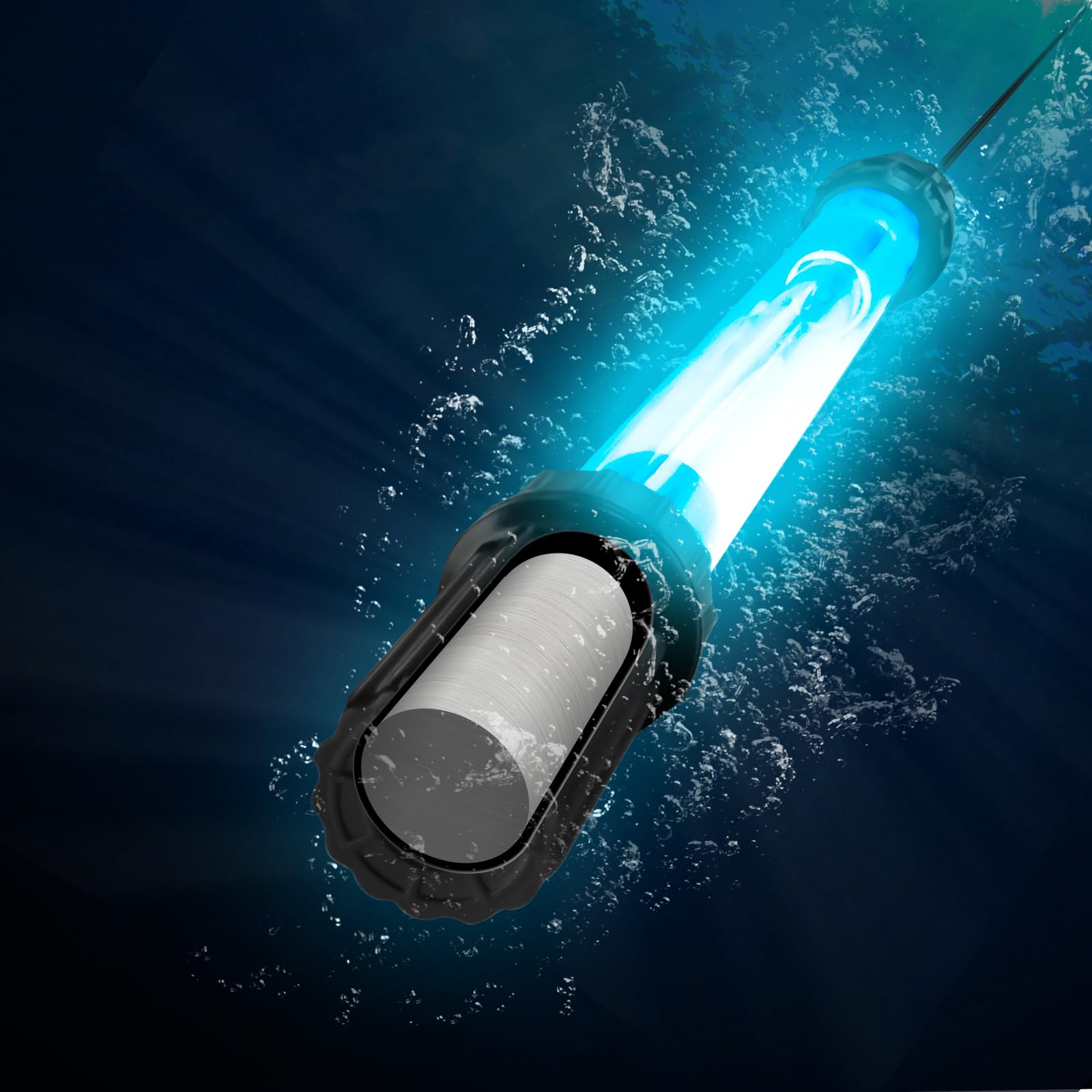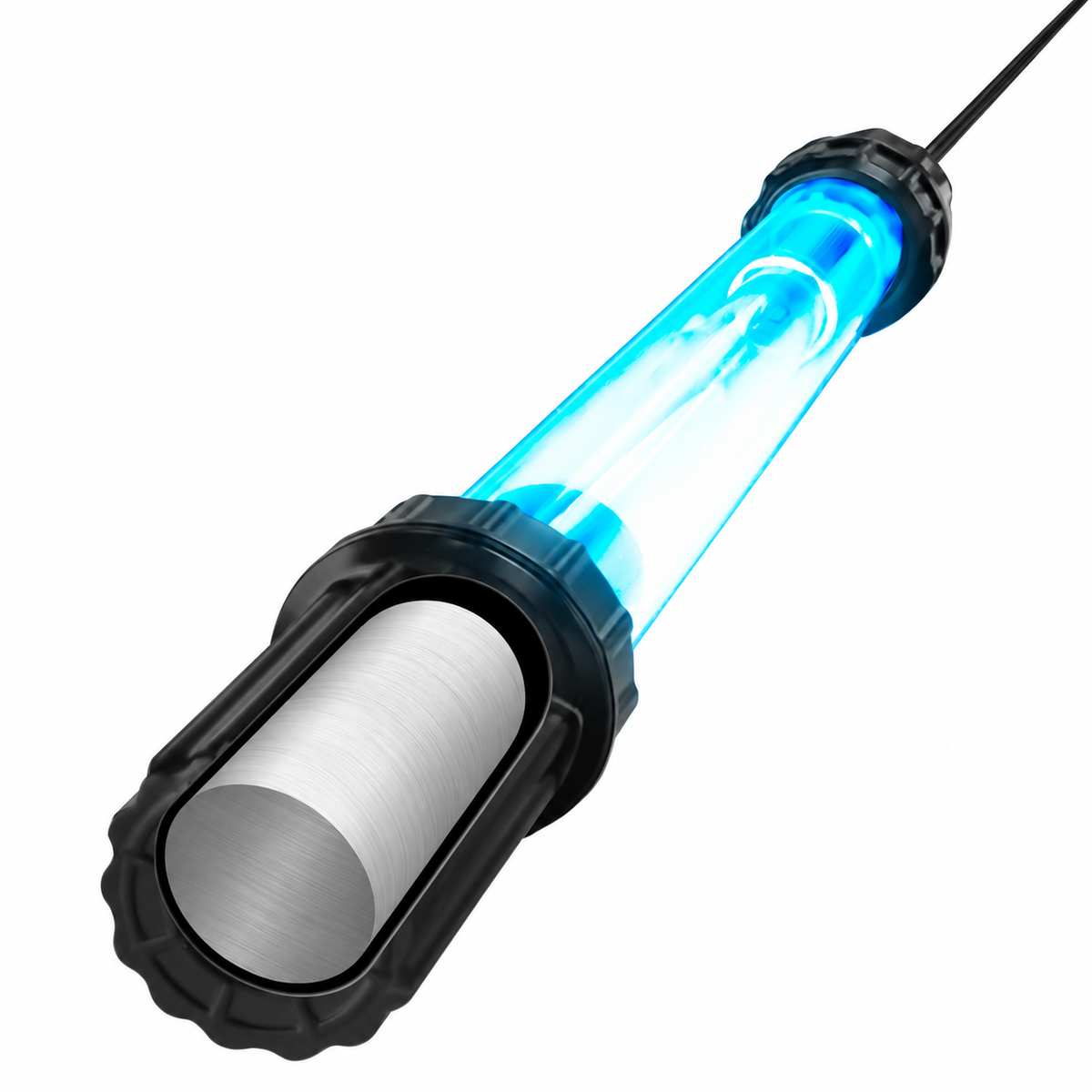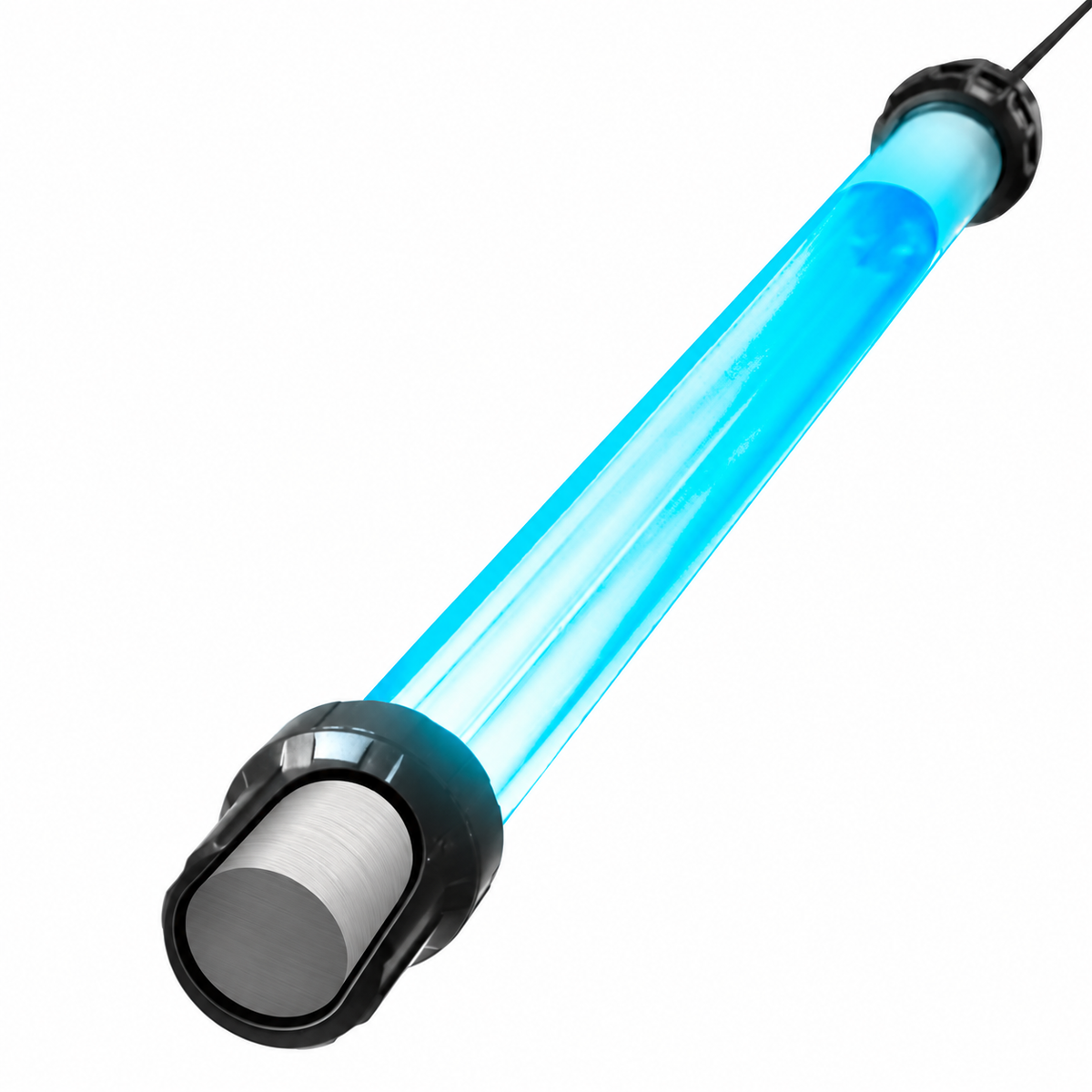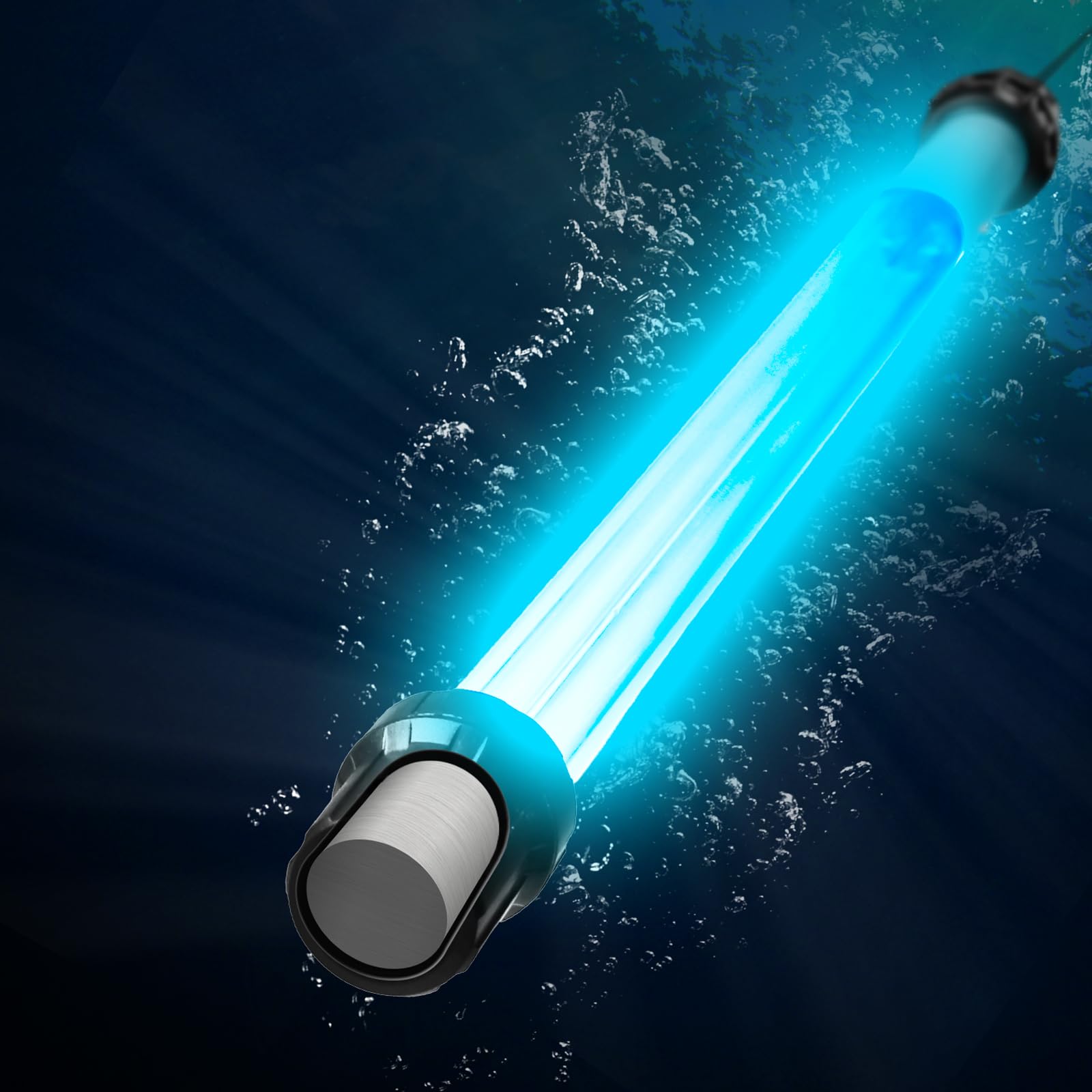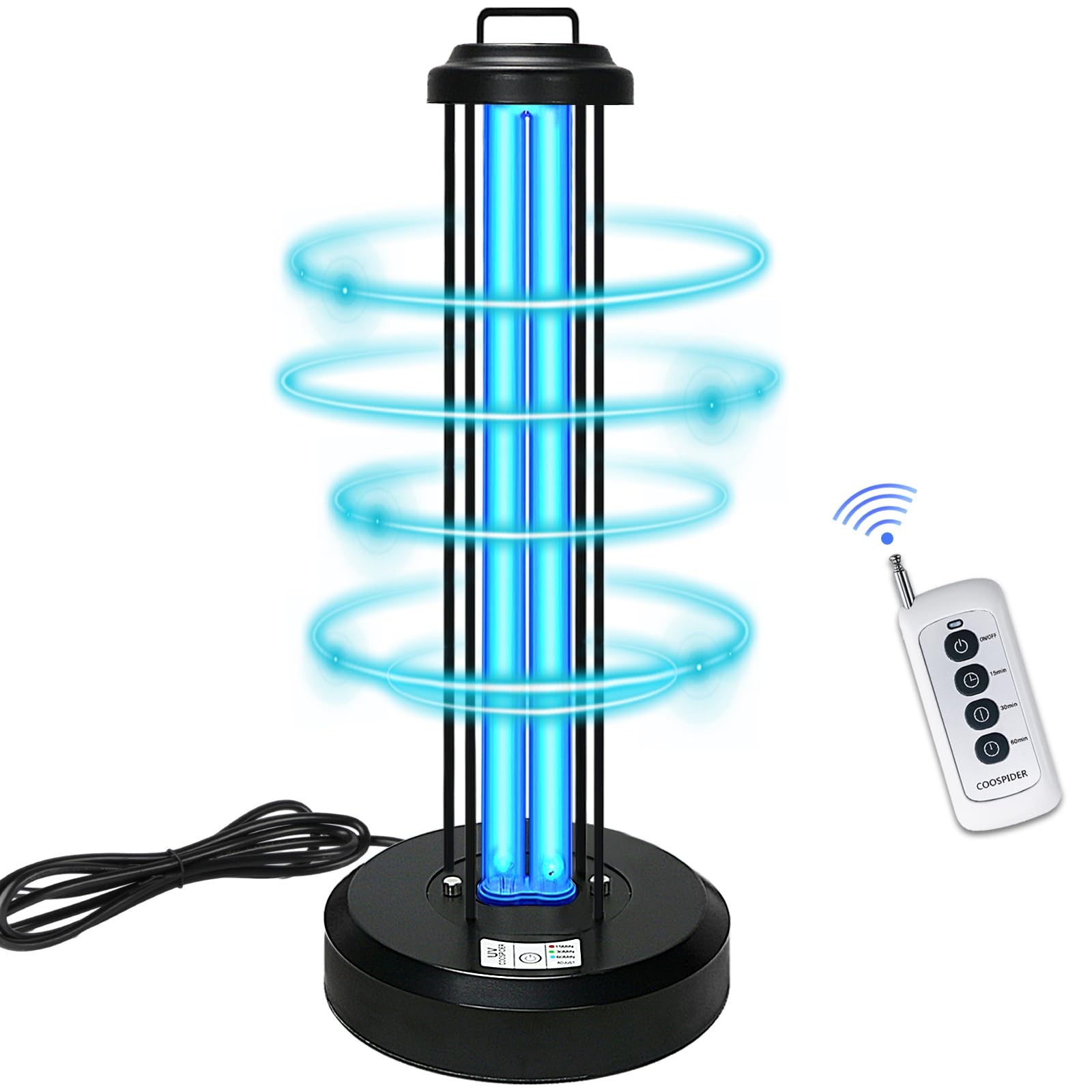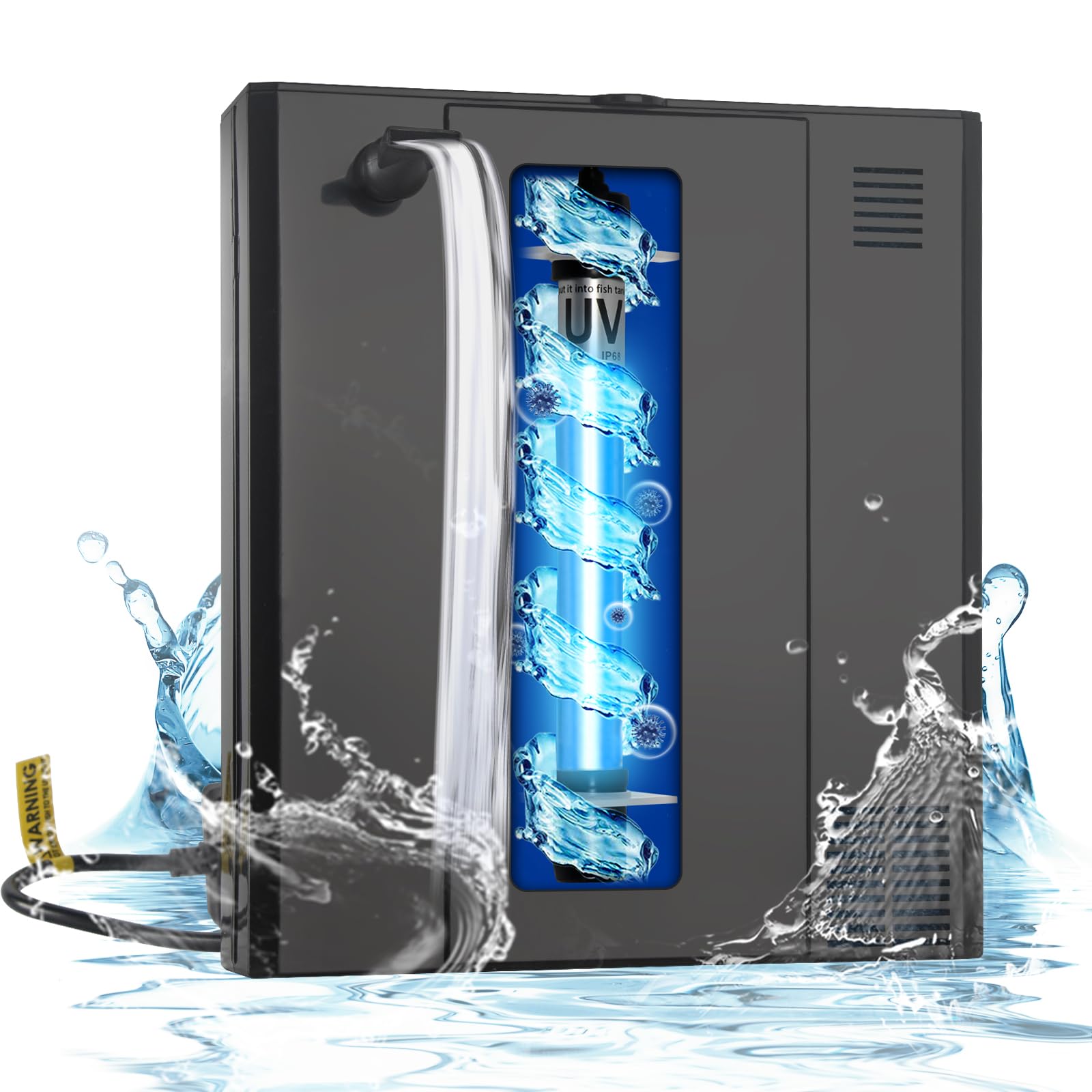
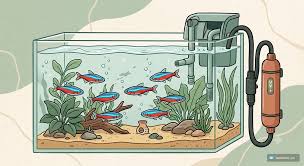
Choosing the right UV sterilizer for your aquarium is about more than matching a product to the number of gallons in your tank. The correct unit must also provide an appropriate flow rate, sufficient UV exposure, and enough treatment capacity for your specific aquarium setup. A UV sterilizer that is too small may deliver disappointing results, while an oversized unit with poorly controlled water flow may fail to provide the expected treatment.
Whether you maintain a small freshwater aquarium, a large tropical fish tank, a planted aquarium, a koi pond, or a marine reef system, understanding how aquarium size affects UV sterilizer selection can help you make a more informed decision.
UV sterilizers are commonly used to help control suspended algae and certain microorganisms as water passes through a chamber exposed to ultraviolet light. They can be particularly useful when green water reduces visibility or when aquarists want an additional water-treatment tool. However, they do not replace mechanical filtration, biological filtration, routine maintenance, or appropriate disease management.
In this guide, we will explain how to choose an aquarium UV sterilizer based on tank volume, flow rate, UV dose, lamp power, aquarium type, and intended use. We will also cover common sizing mistakes, installation tips, maintenance requirements, and practical examples to help you choose equipment that fits your aquarium.
1. Why Aquarium Size Matters When Choosing a UV Sterilizer
Aquarium size is one of the first things to consider when selecting a UV sterilizer because it determines how much water the system contains and how much water may need to pass through the treatment chamber.
However, tank volume alone does not determine the correct UV sterilizer size.
Two aquariums with the same water volume may have very different treatment requirements. One may be a lightly stocked freshwater aquarium with a stable biological filter, while the other may contain a heavy fish load, receive substantial feeding, or experience recurring green-water problems.
Their UV treatment needs may therefore differ.
Small aquariums
Small aquariums often contain relatively little water, so a compact UV sterilizer may be sufficient for the intended application.
However, small systems can also experience rapid changes in water quality and temperature. Equipment that adds too much heat, creates excessive flow, or takes up too much space may be unsuitable.
For these aquariums, look for a unit that can deliver the required UV dose at a flow rate appropriate for the tank and filtration system.
Medium-sized aquariums
Medium-sized aquariums may require a more capable sterilizer, especially if they contain many fish or experience persistent suspended algae.
A suitable unit should provide enough treatment capacity without forcing the entire filtration system to operate outside its intended flow range.
Depending on the installation, an inline unit or a dedicated UV loop may be practical.
Large aquariums
Large aquariums generally contain more water and may process substantial volumes through their filtration systems.
A larger UV chamber, a more powerful unit, or multiple appropriately designed units may be needed to achieve the desired treatment performance.
However, simply purchasing the highest-wattage model is not always the best solution. The relationship between lamp output, chamber design, water clarity, and flow rate is what determines the UV exposure delivered to the water.
The key principle is to size the sterilizer for both the aquarium's volume and its treatment objective.
A unit designed primarily for green-water control may have different flow requirements from one intended to provide a higher level of microbial reduction.
2. What Does an Aquarium UV Sterilizer Actually Do?
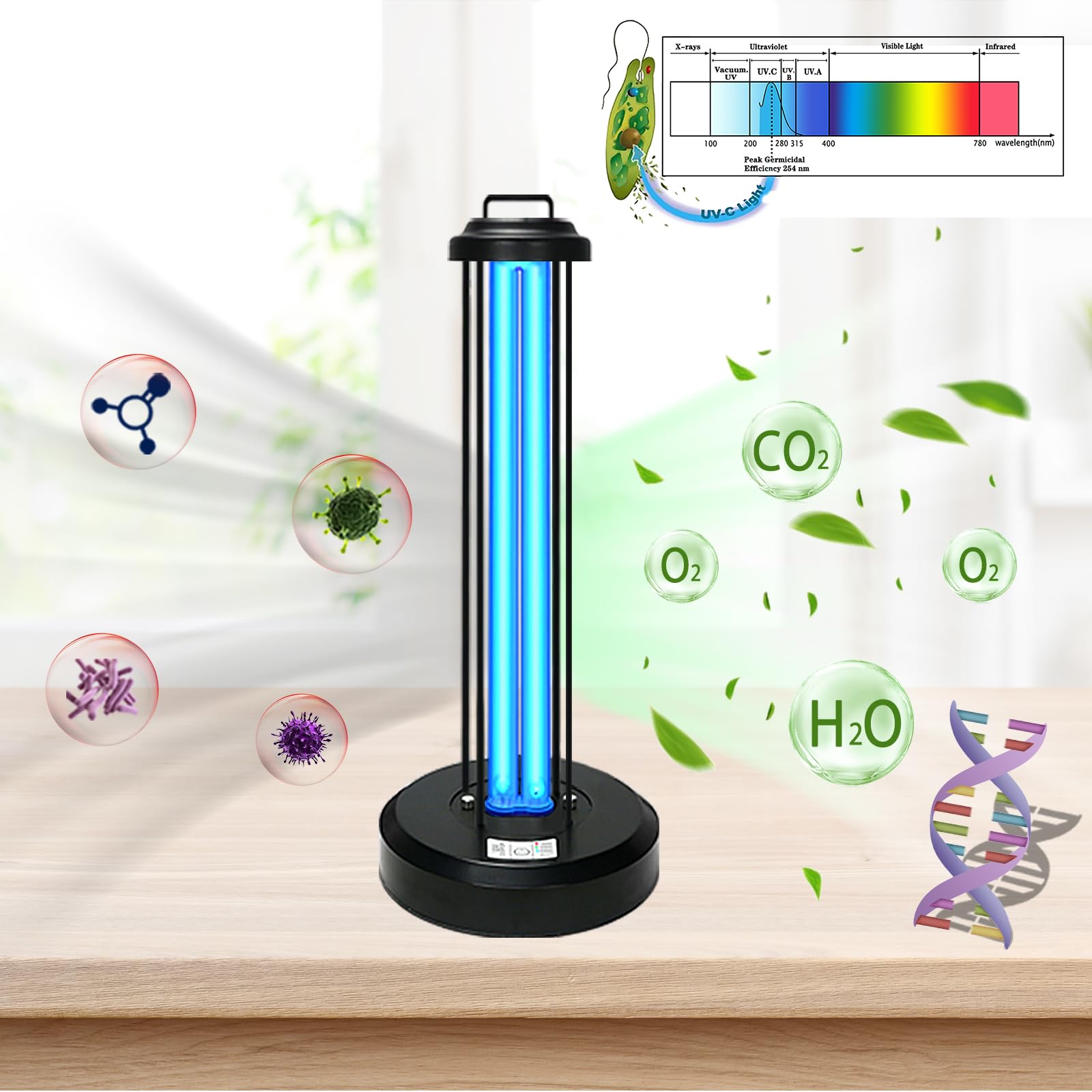
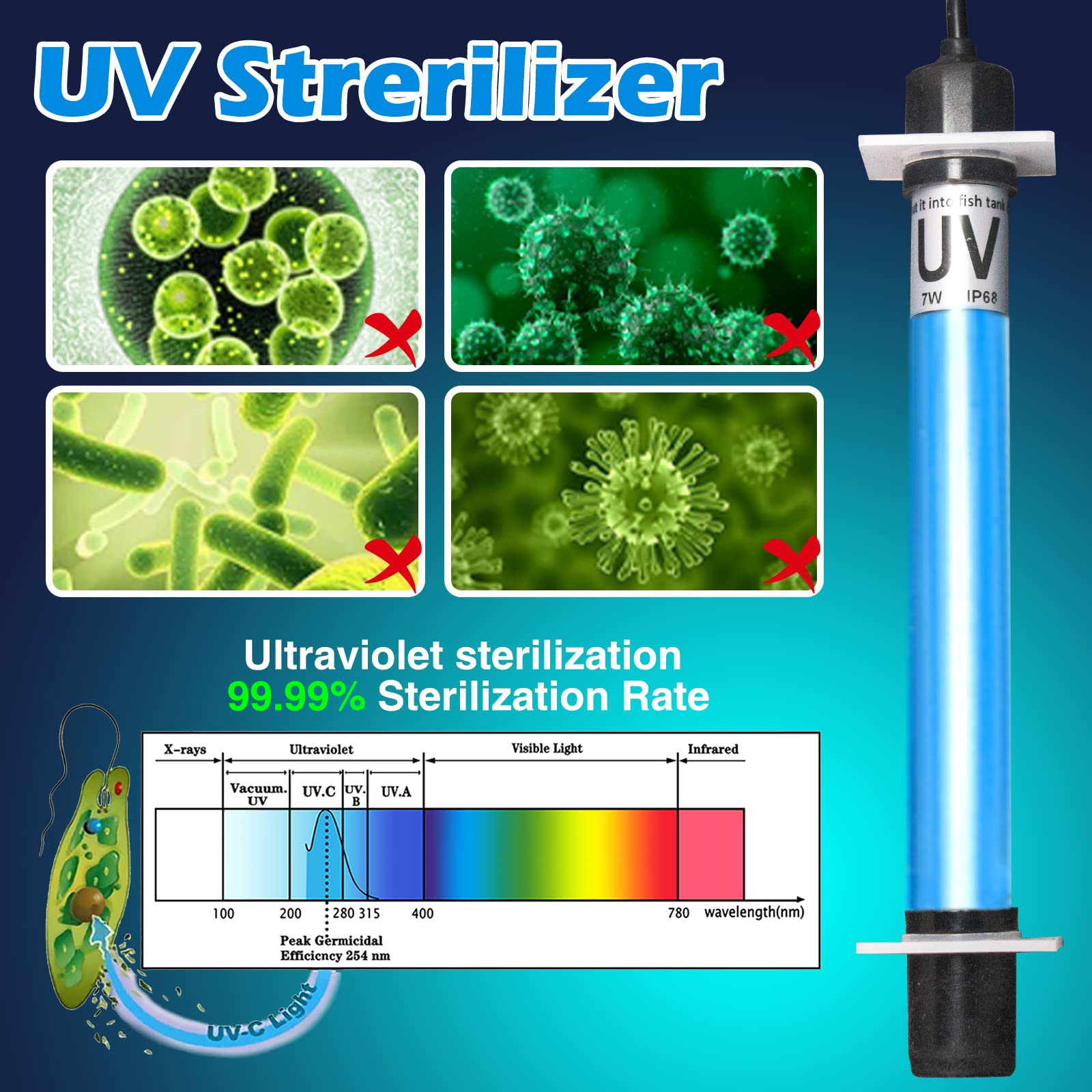
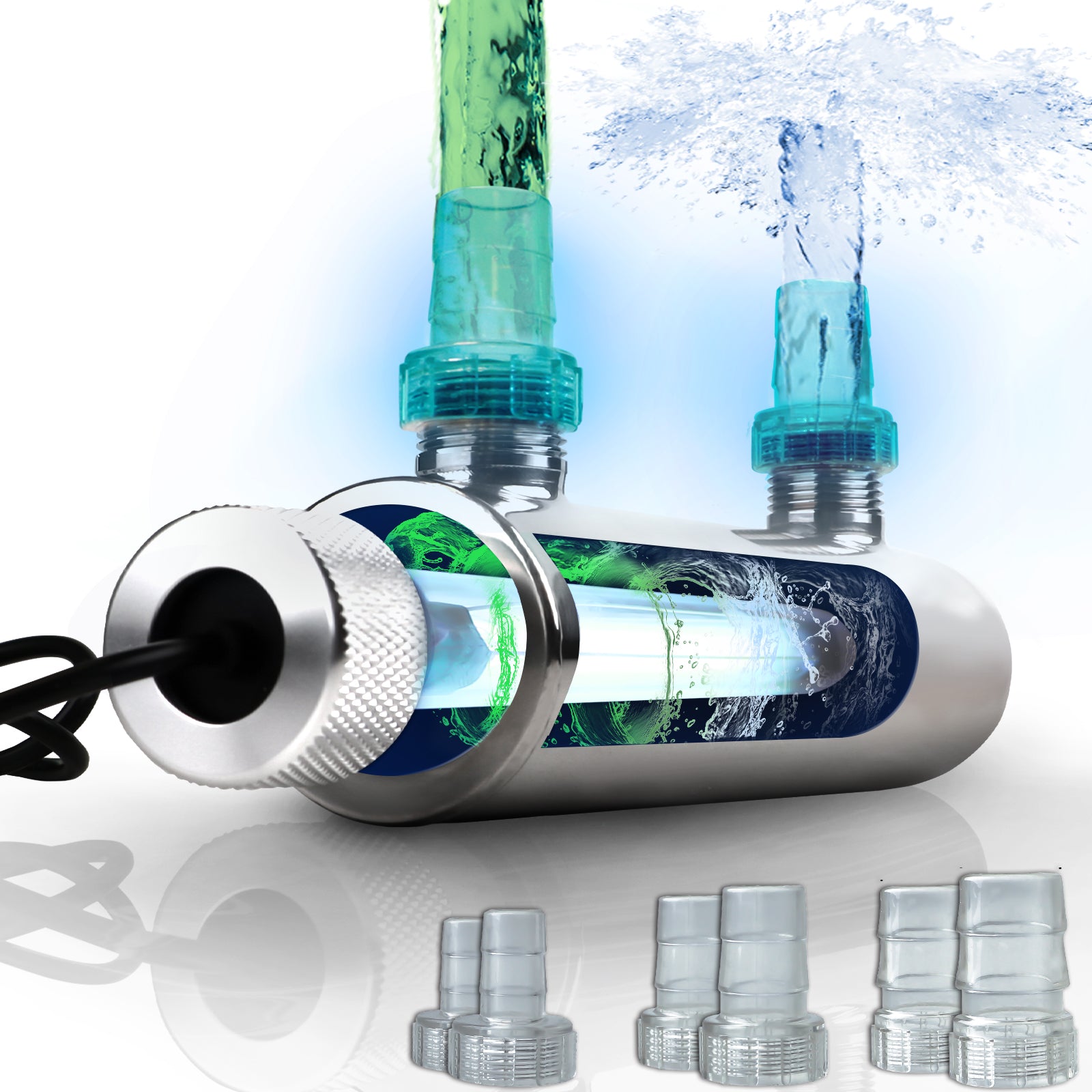
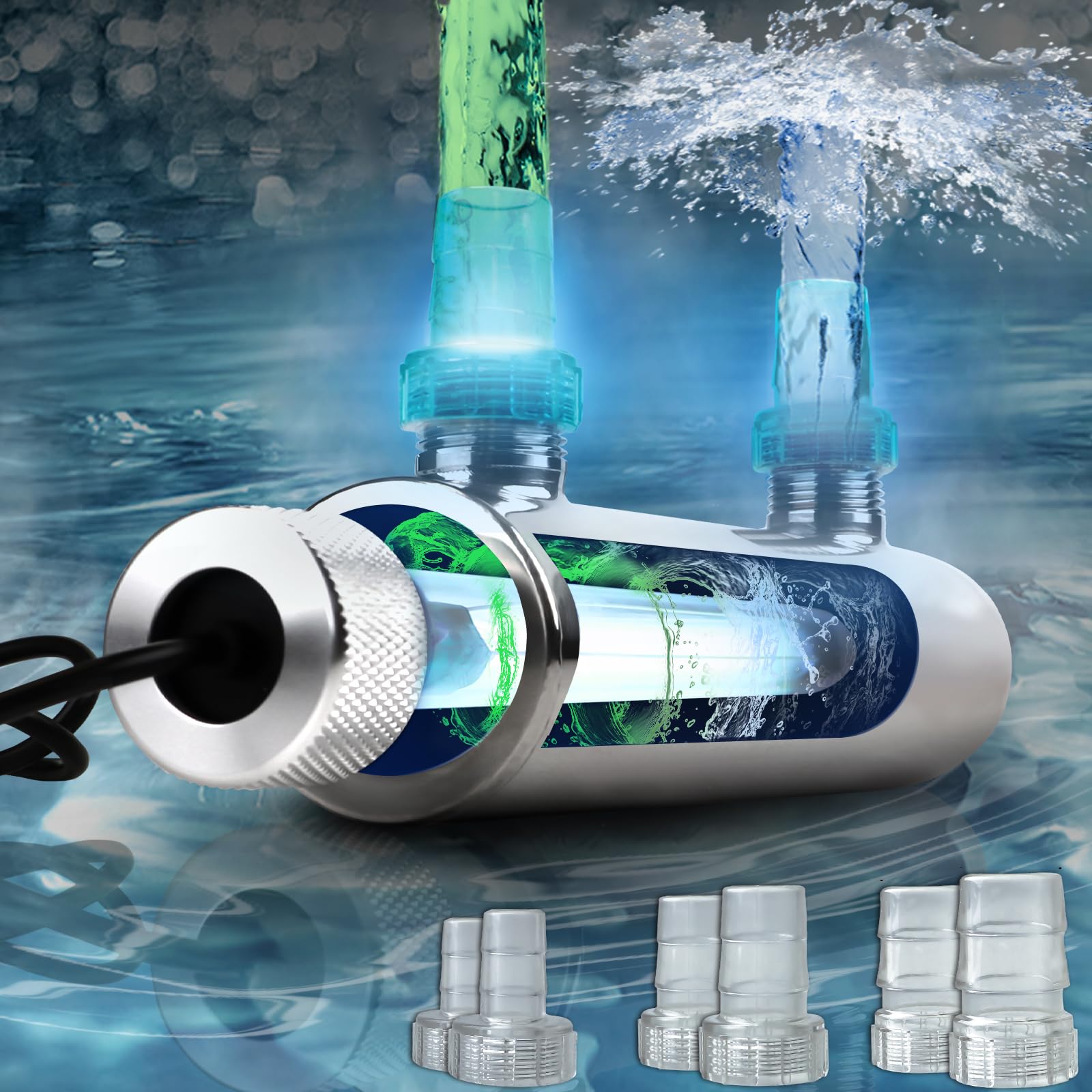
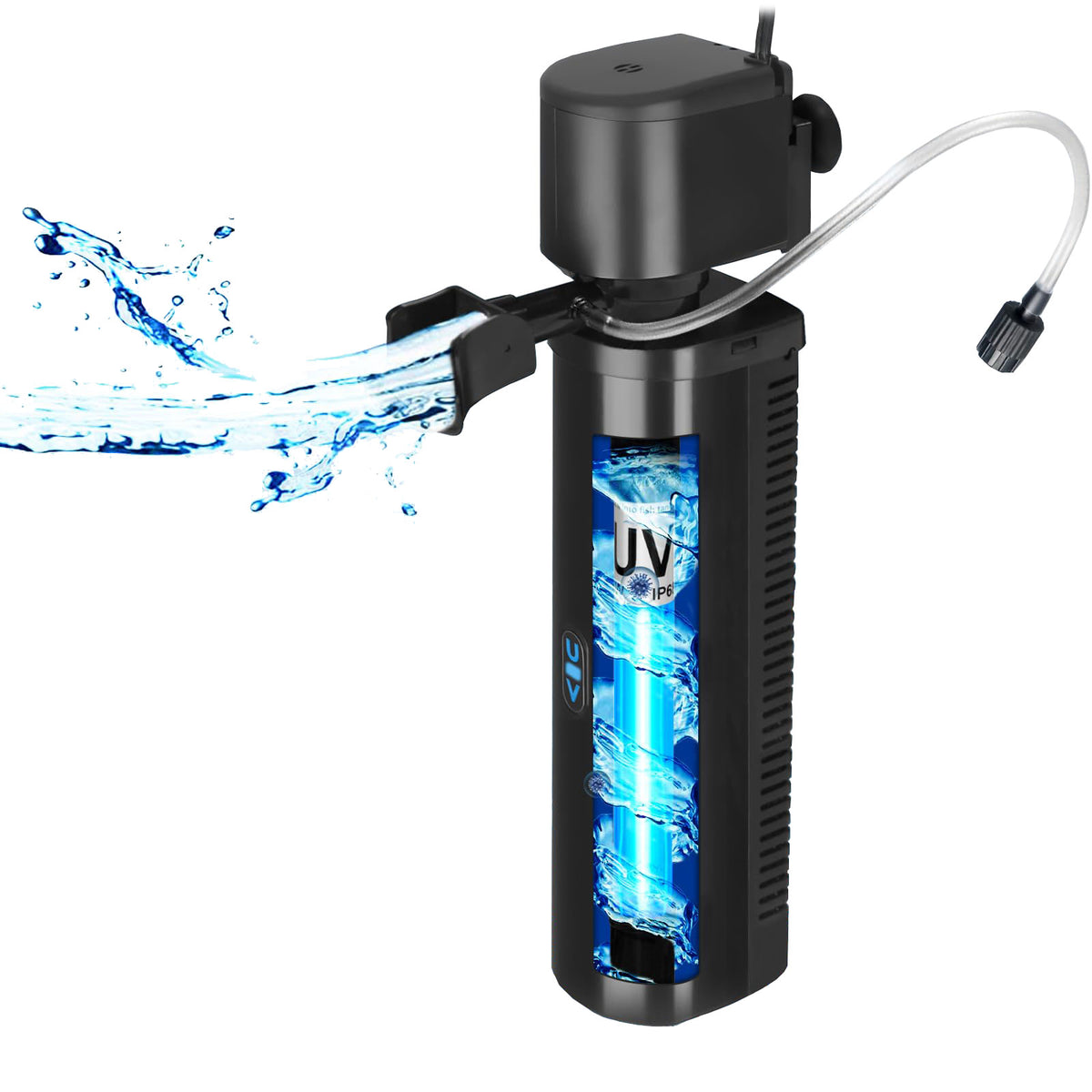
An aquarium UV sterilizer uses ultraviolet radiation, usually UV-C, to affect susceptible microorganisms as water passes through a treatment chamber.
UV-C radiation can damage the genetic material of exposed microorganisms, reducing their ability to reproduce. The effectiveness of treatment depends on the amount of UV energy delivered, the organism involved, and the conditions inside the unit.
UV treatment is not the same as physically removing particles from water. It also does not make every microorganism in the aquarium harmless.
Controlling green water
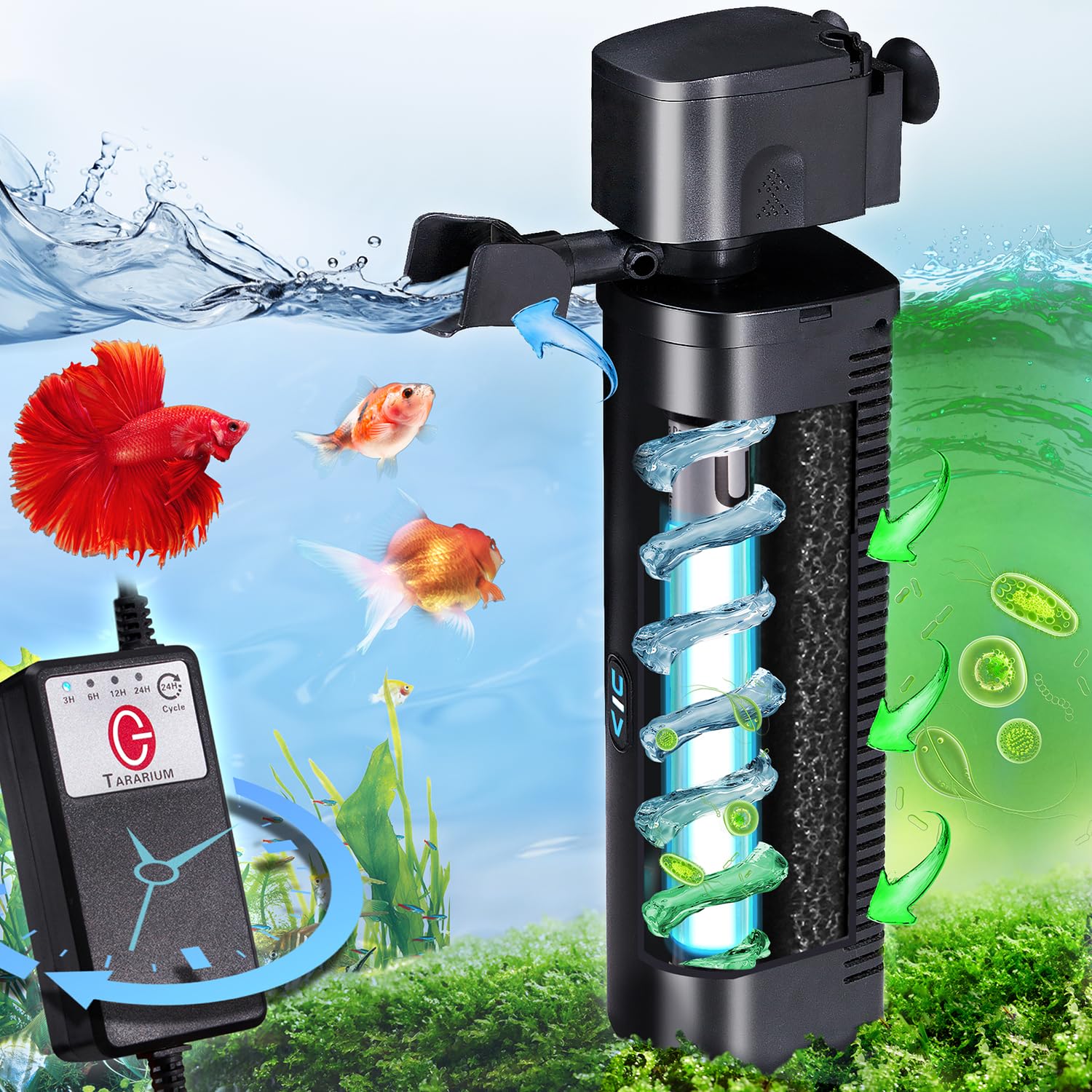
One of the most common uses for aquarium UV sterilizers is controlling green water caused by suspended algae.
When these algae pass through an appropriately sized UV chamber and receive a sufficient dose, their ability to reproduce can be reduced. With effective treatment and suitable supporting conditions, the aquarium water may gradually become clearer.
This makes UV sterilization a useful option for aquarists who struggle with persistent green water despite appropriate filtration and maintenance.
Reducing susceptible microorganisms in circulating water
UV treatment can also reduce certain susceptible microorganisms that pass through the chamber.
However, the effectiveness varies by organism and UV dose. Some organisms require substantially greater exposure than others.
A sterilizer cannot directly treat organisms attached to fish, growing on aquarium surfaces, or residing in locations where the treated water does not reach them.
For this reason, UV sterilization should not be considered a universal cure for fish diseases.
Improving water clarity indirectly
A UV sterilizer can help improve clarity when suspended algae are responsible for the cloudy green appearance.
It will not necessarily remove cloudy water caused by bacterial blooms, suspended waste, fine substrate particles, dissolved organic compounds, or other contaminants.
Identifying the cause of the problem before buying equipment can prevent unnecessary spending.
What UV sterilization does not replace
A UV sterilizer does not remove all dissolved pollutants, replace a biological filter, eliminate accumulated debris, or correct excessive nutrient input.
It should be considered one component of an aquarium management system rather than a complete water-treatment solution.
3. Understand the Three Most Important Sizing Factors
When comparing aquarium UV sterilizers, focus on three primary factors: tank volume, flow rate, and UV dose.
Lamp wattage is also important, but it should be evaluated alongside these factors rather than used as the sole measure of performance.
Factor 1: Aquarium volume
Aquarium volume is commonly measured in gallons in the United States.
The larger the aquarium, the more water the system contains. This affects how quickly the overall system can respond to treatment and how much water must circulate through the sterilizer.
However, the number of gallons alone does not establish a required wattage.
A 75-gallon aquarium with a low flow rate and a modest green-water problem may have different requirements from a 75-gallon aquarium that is heavily stocked or connected to a high-flow filtration system.
Factor 2: Flow rate
Flow rate measures how much water passes through the sterilizer over a period of time.
It is commonly expressed in gallons per hour, or GPH.
Flow rate matters because water moving through the chamber too quickly may receive insufficient UV exposure. Reducing the flow can increase exposure time, provided the chamber and UV output remain suitable for the intended application.
For example, a sterilizer rated for a relatively high flow for algae control may need a lower flow when used for a higher UV-dose application.
Always consult the manufacturer's performance table for the specific model.
Factor 3: UV dose
UV dose is the amount of UV energy delivered to a target organism over time. It is commonly expressed in millijoules per square centimeter, or mJ/cm².
In simplified terms, UV dose depends on UV intensity and exposure time.
A higher dose generally provides greater treatment effectiveness against susceptible organisms, but the exact relationship depends on the organism and the conditions under which the exposure occurs.
The required dose is not identical for all purposes.
Green-water control may be achievable under conditions that are inadequate for reducing more resistant microorganisms.
Therefore, a sterilizer's flow rating should always be interpreted in relation to the manufacturer's stated application and target dose.
Why these factors must work together
Imagine two UV sterilizers that both use a 25-watt lamp.
If one has a longer treatment chamber, better hydraulic design, or greater effective UV output, it may deliver a different dose at the same flow rate.
Similarly, two units with similar chamber designs may perform differently if their lamps have different UV outputs or their quartz sleeves have different levels of cleanliness.
This is why comparing wattage alone can lead to poor equipment choices.
4. How to Estimate UV Sterilizer Size for Your Aquarium
A practical selection process starts with your aquarium's actual water volume and then considers the treatment objective.
Step 1: Estimate the actual water volume
Begin with the aquarium's nominal capacity, but remember that the actual water volume is usually lower because of substrate, rocks, decorations, and the space left above the waterline.
For example, a tank sold as a 55-gallon aquarium may contain less than 55 gallons of water once filled and decorated.
If the aquarium is connected to a sump, include the water held in the sump and plumbing when estimating the system's total operating volume.
A more accurate estimate helps you compare equipment more realistically.
Step 2: Identify the main purpose
Determine whether you want to:
-
Control suspended green algae.
-
Reduce certain susceptible microorganisms in circulating water.
-
Provide supplementary treatment in a high-stock aquarium.
-
Support a pond or other specialized aquatic system.
Do not assume that a model suitable for one purpose will automatically be suitable for another.
Step 3: Check the manufacturer's flow recommendations
Look for the rated flow at the intended UV dose or treatment category.
Some manufacturers publish separate flow rates for algae control and microbial reduction. Others provide charts, performance curves, or application-specific recommendations.
If the manufacturer provides only a maximum flow rate without explaining the intended treatment level, ask for clarification before purchasing.
Step 4: Check the pump and plumbing
The pump must provide the required flow through the sterilizer under actual operating conditions.
A pump's advertised maximum flow is generally not the same as its flow through a complete installation. Head height, tubing diameter, elbows, valves, filter resistance, and the sterilizer itself can all affect delivered flow.
Choose equipment that can maintain the desired flow while remaining within the manufacturer's limits.
Step 5: Consider the aquarium environment
A heavily stocked aquarium, a system with persistent algae, or a setup exposed to substantial nutrient input may need a different approach from a lightly stocked display tank.
However, do not automatically compensate for every water-quality problem by installing a larger UV sterilizer.
First determine whether excess nutrients, inadequate filtration, excessive feeding, or poor maintenance are contributing to the issue.
Step 6: Compare the complete system
Evaluate the chamber design, lamp type, flow recommendations, maintenance requirements, replacement lamp cost, installation method, and suitability for your aquarium.
The best unit is not necessarily the one with the highest power rating. It is the one that can deliver the intended treatment under your actual operating conditions.
5. Choosing a UV Sterilizer for Small Aquariums
Small aquariums, such as those holding 5–20 gallons, require careful equipment selection because space is limited and water conditions may change quickly.
A compact UV sterilizer can be useful, but not every aquarium needs one.
If the main problem is green water, first examine lighting duration, nutrient input, and maintenance practices. UV treatment may be useful when suspended algae persist despite reasonable corrections.
What to look for
For a small aquarium, consider:
-
A compact design that fits the available space.
-
A flow rate appropriate for the aquarium and filter.
-
A clear manufacturer rating for the intended use.
-
Low heat transfer to the water, where relevant.
-
Easy access for lamp and sleeve maintenance.
-
Compatibility with the aquarium's filtration system.
Small all-in-one aquariums may have limited room for inline equipment. A dedicated external loop may be possible, but installation must account for leaks, electrical safety, and pump compatibility.
Avoid excessive flow
A compact UV sterilizer may be paired with a pump that moves water faster than the unit can effectively treat for the intended purpose.
If the manufacturer's guidance permits flow adjustment, a suitable valve or variable-speed pump can help maintain the recommended rate.
However, do not restrict a pump in a way that causes it to overheat or operate outside its design limits. Follow the pump manufacturer's instructions.
Does every small aquarium need UV?
No. A well-maintained small aquarium with stable water quality may have no need for UV sterilization.
If the goal is to manage a recurring green-water problem, identify the cause and evaluate whether UV treatment addresses it.
For a small tank containing sensitive fish or invertebrates, equipment compatibility and temperature management may be especially important.
6. Choosing a UV Sterilizer for Medium Aquariums
Aquariums in the approximate 20–75-gallon range are common in American homes. These systems offer more flexibility for equipment installation, but correct sizing remains essential.
A medium aquarium may use a hang-on-back filter, canister filter, sump, or a combination of filtration equipment.
The UV sterilizer should be compatible with the system's water flow and plumbing arrangement.
Match the unit to the filtration setup
If your aquarium uses a canister filter, an inline UV unit may be suitable if the manufacturer's instructions allow that arrangement and the flow rate is appropriate.
For a sump-based aquarium, you may be able to install the UV sterilizer on a dedicated return or treatment loop.
The ideal arrangement depends on the unit's design, whether it requires a particular orientation, and whether it can operate under the expected pressure.
Consider separate treatment loops
A separate loop can make it easier to adjust flow through the UV sterilizer without affecting the aquarium's primary filtration.
For example, the main filter can maintain the circulation required for biological filtration while a dedicated pump sends water through the UV chamber at a lower treatment flow.
This approach may be useful when the UV dose requirements differ from the flow needs of the main filtration system.
However, adding a separate loop increases installation complexity, power consumption, and maintenance requirements.
Evaluate the intended treatment
For green-water control, select a unit whose published algae-control flow is compatible with your aquarium's operating volume.
For microbial reduction, use the manufacturer's lower applicable flow rating or other dose-specific recommendation where provided.
Do not select a sterilizer based solely on the tank's advertised gallon capacity.
7. Choosing a UV Sterilizer for Large Aquariums
Large aquariums, including systems above approximately 75 gallons, often need more careful hydraulic planning.
The total water volume may be substantial, and the filtration system may operate at a high flow rate.
In these situations, the correct unit depends on the relationship between total system volume, circulation, and the desired treatment dose.
Larger does not always mean more effective
A high-wattage unit can still provide inadequate treatment if water moves through the chamber too quickly.
Conversely, a unit with suitable UV output and a carefully controlled flow may perform effectively without requiring the largest available lamp.
Check the manufacturer's published flow and dose specifications before selecting a model.
Consider multiple units
For some large systems, two appropriately sized units may provide a more practical solution than one oversized unit.
Multiple units can offer installation flexibility, but they also introduce additional maintenance and electrical requirements.
Their effectiveness depends on how the water is distributed through them. If most water bypasses the treatment chambers, the expected performance may not be achieved.
Parallel plumbing can increase total flow capacity, while serial plumbing exposes water to successive treatment stages. Neither arrangement is automatically superior; the correct design depends on the target dose, hydraulic conditions, and equipment specifications.
Include the sump volume
If the aquarium is connected to a sump, estimate the actual operating volume of the complete system rather than relying only on the display tank's nominal capacity.
For example, a display tank and sump may hold substantially more water than the display tank alone.
This additional volume can affect how frequently water passes through the UV chamber and how quickly the entire system responds.
Account for heavy stocking
A heavily stocked aquarium may benefit from carefully selected supplementary treatment, but UV sterilization cannot compensate for excessive waste production, poor oxygenation, inadequate biological filtration, or unsuitable stocking density.
Maintain the biological filter, perform appropriate water changes, and monitor ammonia, nitrite, and nitrate as relevant to the system.
A UV sterilizer should support good husbandry, not replace it.
8. Freshwater vs. Saltwater: Does Aquarium Type Change the Choice?
Yes. Freshwater and saltwater systems can have different treatment goals, plumbing arrangements, and maintenance needs.
The same basic principles of UV dose and flow rate apply, but the equipment must be appropriate for the particular system.
Freshwater aquariums
Freshwater systems commonly use UV sterilizers to manage suspended algae and improve clarity when green water is the main issue.
In some freshwater setups, the water passes through a canister filter or a dedicated UV loop.
The most important considerations are the aquarium's actual volume, flow through the chamber, water clarity, and the manufacturer's application-specific recommendations.
Planted aquariums
Planted aquariums require particular attention to the cause of algae problems.
UV treatment can help control susceptible suspended algae, but it does not directly solve algae growing on leaves, glass, rocks, or substrate.
It also does not correct excessive lighting, unstable nutrient management, or other factors that contribute to algae growth.
If a planted aquarium is otherwise healthy and clear, adding a UV sterilizer may provide little practical benefit.
Saltwater fish-only aquariums
Saltwater fish-only systems may use UV sterilization as a supplementary measure for treating organisms that pass through the chamber.
The required dose depends on the intended target and the manufacturer's guidance.
A UV sterilizer does not replace quarantine, appropriate stocking, disease identification, or veterinary guidance when fish are sick.
Reef aquariums
Reef systems contain corals, invertebrates, and complex microbial communities. Their owners should consider equipment compatibility, installation location, and the effect of treatment on organisms circulating in the water.
A UV sterilizer affects susceptible organisms only when they pass through the chamber and receive sufficient exposure. It does not selectively distinguish between harmful and beneficial organisms.
Some reef keepers use UV treatment for water clarity or specific management goals, while others operate successfully without it.
Before installation, evaluate whether UV treatment addresses a defined problem in your system.
9. How Flow Rate Affects UV Sterilizer Performance
Flow rate is one of the most important factors in choosing and operating a UV sterilizer.
It determines how long water remains inside the treatment chamber and contributes directly to the dose delivered.
The relationship between flow and exposure
All else being equal, increasing flow reduces the time water spends in the chamber.
Reducing flow generally increases exposure time, but the actual dose also depends on UV intensity, chamber geometry, water transmission, and other design factors.
This means you should not simply reduce the flow as far as possible without considering the unit's operating requirements.
The goal is to operate within the manufacturer's recommended range for the intended treatment.
Example: A 50-gallon aquarium
Imagine that a 50-gallon aquarium uses a UV sterilizer rated for a specific treatment application at 100 GPH.
If the actual flow through the chamber is 200 GPH, the water may receive less exposure than intended.
Reducing the flow to the manufacturer's recommended range may improve treatment performance, assuming the unit is operating correctly.
These numbers are illustrative, not a universal recommendation for a 50-gallon tank. The correct flow rate must come from the specifications for the particular sterilizer and its intended use.
Calculate nominal turnover time
You can estimate how long it would take to move a volume of water equal to the aquarium's volume through a treatment loop.
The formula is:
\frac{\text{Aquarium volume (gallons)}}{\text{Flow rate (GPH)}}
]
For a 50-gallon aquarium with a flow of 100 GPH:
[
\frac{50}{100}=0.5\text{ hours}
]
This equals 30 minutes.
However, this calculation describes nominal system-volume throughput, not the actual time required to treat every drop of aquarium water.
Aquarium water mixes continuously, and some water may pass through the chamber multiple times while other water remains elsewhere in the system. Plumbing design and circulation patterns also matter.
Turnover time is therefore a useful planning reference, not a direct measure of sterilization effectiveness.
10. How Much UV Wattage Does Your Aquarium Need?
UV wattage is one of the most visible specifications on a product label, but it can be misleading when used alone.
A lamp's electrical power does not directly tell you how much effective UV-C energy reaches the water.
Some electrical energy becomes heat or is emitted at wavelengths that do not contribute equally to the intended treatment. Lamp design, age, temperature, and the optical properties of the chamber also affect performance.
Why wattage alone is insufficient
Two units with the same nominal wattage may have different:
-
UV-C output.
-
Chamber dimensions.
-
Water exposure characteristics.
-
Flow ratings.
-
Lamp efficiency.
-
Quartz sleeve designs.
-
Performance at the intended dose.
For this reason, a reliable manufacturer should provide application-specific flow recommendations or performance data rather than only a wattage rating.
Should you choose a more powerful unit?
A more powerful unit may be appropriate for a larger aquarium or a higher-dose application, but only if the complete design supports the intended performance.
An unnecessarily powerful unit can increase purchase cost, replacement lamp expenses, and electricity consumption without delivering a proportional improvement.
The best choice is the smallest suitable system that reliably meets your treatment requirements under actual operating conditions.
Look beyond the initial purchase price
Compare the total cost of ownership, including:
-
Initial equipment cost.
-
Replacement lamp cost.
-
Replacement frequency.
-
Electricity consumption.
-
O-ring and seal replacement.
-
Cleaning requirements.
-
Pump and plumbing costs.
-
Installation and maintenance time.
A slightly more expensive unit may be the better long-term option if it is easier to maintain and has clearly documented performance.
11. Common Aquarium UV Sterilizer Sizing Mistakes
Even experienced aquarium owners can make avoidable mistakes when selecting UV equipment.
Mistake 1: Buying based only on gallon capacity
A product advertised for a 100-gallon aquarium may not be suitable for every 100-gallon system.
The rating may assume a particular flow rate, treatment goal, water clarity, and operating arrangement.
Always confirm the intended application.
Mistake 2: Ignoring the recommended flow rate
A unit that receives too much flow may not deliver the intended dose.
A unit operated outside its recommended range may also experience hydraulic or operational problems.
Measure actual flow where practical rather than relying exclusively on the pump's advertised maximum.
Mistake 3: Assuming UV sterilization treats every disease
UV treatment can affect susceptible organisms in circulating water, but it does not directly reach parasites or pathogens attached to fish or surfaces.
It is not a replacement for diagnosis, quarantine, or appropriate treatment.
Mistake 4: Using UV to compensate for poor water quality
If your aquarium contains excess nutrients, decaying waste, or an overloaded filter, installing a UV sterilizer may not address the underlying cause.
Test water parameters and correct the source of the problem.
Mistake 5: Neglecting lamp replacement
UV lamps can continue to produce visible light even when their effective UV-C output has declined.
A lamp that still glows is not necessarily delivering the intended treatment performance.
Follow the manufacturer's replacement interval and operating instructions.
Mistake 6: Ignoring water clarity
Suspended particles, turbidity, and other water-quality conditions can reduce the effective UV exposure received by microorganisms.
A UV sterilizer is not a substitute for appropriate mechanical filtration.
Mistake 7: Installing the unit incorrectly
Leaks, unsuitable plumbing, excessive pressure, incorrect orientation, and poor electrical protection can undermine an otherwise appropriate setup.
Follow the manufacturer's installation requirements, and use a qualified professional when necessary.
12. Installation Tips for Better UV Sterilizer Performance
Correct installation is essential for safe, consistent operation.
Install the unit in an appropriate location
Choose a location that allows adequate access for cleaning, lamp replacement, and inspection.
The unit should be protected from accidental impact and installed according to its specified orientation.
Keep electrical components away from splashes and ensure that the installation does not create a trip hazard or obstruct aquarium maintenance.
Ensure suitable prefiltration
Mechanical filtration can remove suspended debris before water enters the UV chamber.
This can help maintain water clarity and reduce deposits on the quartz sleeve.
However, prefiltration does not eliminate the need to clean the sleeve or replace the lamp.
Prevent bypass flow
If water can bypass the UV chamber, the system may deliver less treatment than expected.
Check valves, seals, plumbing connections, and the intended flow path.
For a dedicated UV loop, ensure that the pump sends water through the treatment chamber rather than allowing it to circulate through an easier alternative route.
Measure actual flow when possible
A pump's nominal rating may differ substantially from the flow delivered after plumbing losses.
If the required treatment flow is critical, use a suitable flow meter or another reliable measurement method.
Do not guess based on the apparent strength of water returning to the aquarium.
Protect fish and people
UV-C radiation can injure eyes and skin. Never operate an exposed UV-C lamp where people or animals can be exposed to its radiation.
Use the sterilizer only in its designed, enclosed configuration. Disconnect power before servicing it and follow the manufacturer's safety instructions.
Never look directly at an operating UV-C lamp.
13. Maintenance: Keep Your UV Sterilizer Working Properly
A correctly sized UV sterilizer can become less effective if it is poorly maintained.
Regular maintenance helps preserve performance and reduce the risk of leaks or equipment failure.
Clean the quartz sleeve
Many UV sterilizers use a quartz sleeve to separate the lamp from the water.
Mineral deposits, algae, and other films can accumulate on the sleeve and reduce the amount of UV radiation reaching the water.
Inspect and clean the sleeve according to the manufacturer's instructions.
Use only recommended cleaning materials and procedures. Avoid scratching the sleeve, damaging seals, or applying unsuitable chemicals.
Replace the lamp as recommended
UV lamps lose effective output over time.
The replacement interval varies by lamp type and manufacturer. Follow the stated operating-hour or calendar-based schedule.
Do not wait until the lamp visibly fails.
Keep a record of installation and replacement dates so you can maintain a consistent schedule.
Inspect seals and connections
Check O-rings, fittings, tubing, and electrical connections during routine maintenance.
Replace worn seals with compatible parts.
If you notice water leaking from the unit, switch off the equipment safely and address the problem before restarting it.
Monitor aquarium conditions
After installing or servicing a sterilizer, continue monitoring water clarity, temperature, and other relevant parameters.
If green water persists, confirm that the unit is operating correctly and that the flow matches the manufacturer's recommendation.
Also investigate lighting, nutrient levels, and other causes of algae growth.
Keep maintenance records
A simple log can include:
-
Installation date.
-
Lamp replacement date.
-
Cleaning dates.
-
Measured flow rate.
-
Water clarity observations.
-
Any leaks or unusual operating conditions.
These records make it easier to identify performance changes before they become significant problems.
14. Practical Sizing Examples for Different Aquarium Volumes
The following examples illustrate how aquarium volume affects the selection process. They are not universal wattage recommendations because actual requirements vary by product, UV dose, flow rate, and treatment objective.
Example A: A 10-gallon freshwater aquarium
The first question is whether UV treatment is needed at all.
If the aquarium is healthy and clear, a sterilizer may offer little benefit.
If persistent green water is the main issue, choose a compact unit with a documented algae-control rating and a flow rate compatible with the tank's filtration arrangement.
Avoid buying a larger unit solely because it appears more powerful.
Example B: A 29-gallon community aquarium
For a 29-gallon aquarium, evaluate the filter's actual output and the sterilizer's recommended treatment flow.
A compact inline unit or a dedicated loop may be suitable, depending on the equipment and space available.
If the tank has recurring green-water problems, verify that the selected model is rated for that purpose.
Example C: A 55-gallon aquarium
A 55-gallon aquarium may benefit from a sterilizer when there is a clear reason to use one.
Check the aquarium's actual water volume, the flow through the UV chamber, and the manufacturer's treatment recommendations.
If the filter moves water too quickly for the required dose, a separate loop may provide better control.
Example D: A 75-gallon aquarium
A 75-gallon system may require a more capable unit than a smaller aquarium, but the correct choice still depends on the intended treatment.
A higher-capacity model may be suitable if its published flow ratings and dose information match the application.
Consider maintenance access and replacement lamp availability before purchasing.
Example E: A 125-gallon aquarium
For a 125-gallon aquarium, include any operating sump volume in your estimate.
Determine whether one unit can provide the intended treatment at a practical flow rate.
For some installations, a larger unit or multiple units may be appropriate. Confirm the hydraulic design and avoid assuming that multiple lamps automatically produce better results.
Example F: A 300-gallon aquarium
A 300-gallon aquarium requires a more deliberate assessment of total water volume, circulation, and treatment goals.
At this scale, the filtration system may process substantial flow, so the UV installation may need a dedicated loop or a carefully engineered arrangement.
Review manufacturer performance curves, actual flow requirements, maintenance access, and the cost of replacement components.
For complex or high-value systems, consult the equipment manufacturer or an experienced aquarium system designer before finalizing the installation.
15. How to Tell Whether Your UV Sterilizer Is the Right Size
After installation, evaluate performance against the original objective.
If you purchased the sterilizer to control green water, observe whether water clarity improves over an appropriate period while maintaining consistent aquarium care.
If the goal is to reduce a particular susceptible microorganism in circulating water, visual clarity alone is not a reliable indicator of success.
Signs that deserve investigation
A sterilizer may be undersized, incorrectly installed, or poorly maintained if:
-
Green water persists despite suitable operating conditions.
-
The actual flow exceeds the manufacturer's treatment recommendation.
-
The lamp has passed its recommended replacement interval.
-
The quartz sleeve is dirty or coated with deposits.
-
Water is bypassing the chamber.
-
The water is cloudy for reasons unrelated to suspended algae.
These signs do not prove that the unit is too small. They indicate that the complete system should be checked before purchasing a replacement.
Avoid changing too many variables at once
If you adjust the flow, replace the lamp, change the filtration system, and reduce lighting simultaneously, it may be difficult to determine which change improved the result.
Where practical, make one adjustment at a time and record the outcome.
This approach can save money and help you understand what your aquarium actually needs.
16. Frequently Asked Questions About Aquarium UV Sterilizer Sizing
What size UV sterilizer do I need for a 20-gallon aquarium?
There is no single wattage that is correct for every 20-gallon aquarium.
Start with the intended purpose, then compare the manufacturer's recommended flow rates and application ratings. A compact unit may be sufficient for green-water control, but microbial treatment may require different operating conditions.
Is a higher-wattage UV sterilizer always better?
No. Wattage alone does not establish the UV dose delivered to the water.
Chamber design, effective UV output, flow rate, lamp condition, and water transmission all influence performance.
Choose a unit that meets the requirements of your intended application rather than automatically selecting the highest wattage.
Should the entire aquarium volume pass through the sterilizer every hour?
Not necessarily. The appropriate flow and turnover strategy depend on the aquarium, plumbing arrangement, treatment goal, and manufacturer's recommendations.
Nominal turnover calculations can help with planning, but they do not guarantee that every drop of water receives the same UV dose.
Can a UV sterilizer eliminate ich or other fish diseases?
A UV sterilizer may affect susceptible free-floating stages of some organisms when they pass through the chamber and receive a sufficient dose. However, it cannot reliably eliminate every life stage of every parasite or pathogen.
It should not replace correct diagnosis, quarantine, or an appropriate treatment plan.
Does a UV sterilizer remove ammonia or nitrate?
No. UV treatment is not a substitute for biological filtration, water changes, or other methods used to manage ammonia, nitrite, and nitrate.
Continue monitoring water parameters and maintain the aquarium's biological filter.
Can I run a UV sterilizer continuously?
Many aquarium UV sterilizers are designed for continuous operation, but you should follow the manufacturer's instructions for your particular model.
Ensure that the lamp, seals, cooling requirements, plumbing, and electrical installation are suitable for the intended operating schedule.
Does UV sterilization harm beneficial bacteria?
UV treatment can affect susceptible microorganisms that pass through the chamber and receive a sufficient dose.
However, most established biological filtration takes place in filter media and on aquarium surfaces. A properly installed UV sterilizer does not directly irradiate those surfaces.
It is not a replacement for maintaining a healthy biological filter.
How often should I replace the UV lamp?
Follow the manufacturer's specified replacement interval.
The schedule depends on lamp type and operating conditions. A lamp may continue to glow visibly even after its useful UV-C output has declined.
Can I use the same UV sterilizer for a freshwater aquarium and a saltwater aquarium?
Possibly, but only if the equipment is compatible with the intended system.
Check the manufacturer's specifications for materials, seals, pressure limits, plumbing, and installation requirements. The required dose and flow may also differ depending on the treatment objective.
Why is my aquarium still green after installing a UV sterilizer?
Possible reasons include excessive flow, an aging lamp, a dirty quartz sleeve, bypass flow, inadequate UV output, or a treatment unit that is unsuitable for the application.
Green water may also persist if the system is not operating as expected or if the treatment conditions are insufficient.
Check the equipment first, then evaluate lighting, nutrient input, and other causes of suspended algae.
Conclusion: Choose for Performance, Not Just Gallons or Wattage
Choosing the right UV sterilizer for your aquarium begins with understanding the system you are treating.
Aquarium volume helps establish the scale of the installation, but it does not determine the required lamp wattage by itself. Flow rate and UV dose are equally important, and the correct operating conditions depend on whether you want to control green water, reduce certain susceptible microorganisms, or support another treatment objective.
For small aquariums, compact units may be sufficient when their performance ratings match the application. Medium-sized systems often benefit from careful coordination between filtration flow and UV treatment. Large aquariums may require a higher-capacity unit, a dedicated treatment loop, or multiple units designed for the system's actual operating conditions.
Before purchasing, verify the manufacturer's application-specific flow ratings, consider your aquarium's real water volume, evaluate installation requirements, and account for ongoing maintenance costs.
After installation, maintain the quartz sleeve, replace the lamp on schedule, measure flow where practical, and continue monitoring water quality.
Most importantly, remember that a UV sterilizer is a supplementary water-treatment tool, not a replacement for good aquarium husbandry. When correctly selected and maintained, it can be a valuable part of a well-designed aquarium system.
The best aquarium UV sterilizer is not simply the biggest or most powerful model. It is the one that consistently delivers the appropriate treatment for your aquarium's size, water flow, and specific needs.