The printing industry is undergoing one of the most significant transformations in its modern history. Once defined by high heat curing systems, solvent-heavy inks, and energy-intensive production lines, today’s print operations are increasingly shaped by a new priority: efficiency without environmental compromise.
At the center of this transformation is UV LED curing technology—a breakthrough that is redefining how inks dry, how presses operate, and how print shops manage energy consumption and sustainability goals.
This is not just an incremental upgrade. It is a structural shift in how printing works at a system level.
In this article, we’ll explore how UV LED systems are reshaping print production, why they are dramatically more energy efficient than traditional UV lamps, and how they are enabling a new era of environmentally responsible printing.
1. The Traditional Printing Model: High Heat, High Energy, High Waste
To understand why UV LED is revolutionary, it’s important to understand the limitations of traditional curing systems.
Conventional UV printing relies on mercury vapor lamps or similar high-intensity discharge systems. These lamps:
-
Operate at extremely high temperatures
-
Require long warm-up and cool-down cycles
-
Consume large amounts of electricity
-
Degrade quickly over time
-
Produce significant infrared heat
This creates several operational challenges:
1. Energy inefficiency
Traditional UV lamps waste a large portion of energy as heat rather than usable curing light.
2. Material stress
Excess heat can damage heat-sensitive substrates like plastics, films, or thin paper.
3. Maintenance burden
Frequent lamp replacement and recalibration increase downtime.
4. Environmental impact
Higher energy consumption and mercury-based components raise sustainability concerns.
In short, traditional UV curing systems are powerful—but inefficient.
2. What Is UV LED Printing Technology?
UV LED printing replaces traditional mercury vapor lamps with light-emitting diodes (LEDs) that emit ultraviolet light at specific wavelengths (typically 365–405 nm).
Instead of generating broad-spectrum heat and light, UV LED systems deliver:
-
Targeted UV wavelengths
-
Instant on/off capability
-
Minimal heat output
-
High energy conversion efficiency
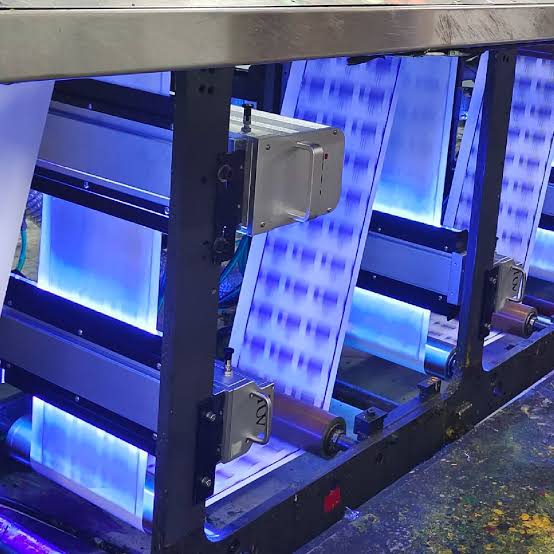
In printing applications, UV LED light instantly cures specially formulated inks and coatings as they are applied to the substrate.
This enables instant drying, immediate handling, and continuous production flow.
3. The Core Principle: Photopolymerization Without Heat Waste
UV curing works through a process called photopolymerization.
When UV light hits the ink:
-
Photoinitiators absorb UV energy
-
Chemical reactions begin instantly
-
Ink transforms from liquid to solid
-
The surface becomes durable and smudge-resistant
UV LED systems optimize this reaction by delivering energy precisely at the wavelength needed to trigger polymerization.
Unlike traditional systems, they do not rely on heat as a byproduct. This makes the process far more controlled and efficient.
4. Energy Efficiency: The Most Immediate Advantage
One of the most significant benefits of UV LED printing is energy reduction.
Compared to traditional UV systems, UV LED curing can reduce energy consumption by:
-
Up to 70%–80% in many applications
This efficiency comes from:
Instant activation
No warm-up or idle energy consumption.
Targeted wavelength output
Energy is not wasted on unnecessary spectral ranges.
Reduced heat loss
Minimal infrared emission means less wasted thermal energy.
Lower HVAC demand
Less heat in the production environment reduces cooling requirements.
The result is a system that converts electrical energy into usable curing energy with far higher efficiency.
5. Heat Reduction and Substrate Flexibility
Heat has always been a limiting factor in printing.
Traditional UV systems generate significant thermal output, which restricts:
-
Thin paper stocks
-
Heat-sensitive plastics
-
Flexible packaging films
-
Specialty coated materials
UV LED systems dramatically reduce surface heat, enabling:
-
Printing on temperature-sensitive substrates
-
Improved dimensional stability
-
Reduced material warping
-
More consistent print quality
This opens new possibilities for packaging, labels, signage, and specialty printing applications.
6. Environmental Benefits of UV LED Printing
Sustainability is now a core requirement across manufacturing industries, and printing is no exception.
UV LED technology supports environmental goals in several key ways:
6.1 Lower energy consumption
Reduced electricity usage directly lowers carbon emissions associated with production.
6.2 Mercury-free operation
Traditional UV lamps contain mercury, a hazardous material. UV LED systems eliminate this risk entirely.
6.3 Reduced waste
Longer-lasting LED modules reduce replacement frequency and industrial waste.
6.4 Lower VOC emissions
UV inks used with LED curing typically contain low or zero volatile organic compounds.
Together, these benefits make UV LED printing significantly cleaner and more environmentally responsible.
7. Operational Efficiency: Speed Without Compromise
In modern print production, speed is critical—but it must be balanced with quality and consistency.
UV LED systems enable:
-
Instant curing at high press speeds
-
Immediate post-processing (cutting, folding, finishing)
-
Reduced drying bottlenecks
-
Continuous workflow integration
Because ink is cured immediately, there is no need for drying racks or waiting periods.
This transforms production from a batch-based process into a continuous flow system.
8. Maintenance and Equipment Longevity
UV LED systems also improve operational reliability.
Compared to traditional UV lamps:
Longer lifespan
LED modules can last tens of thousands of operating hours.
Reduced downtime
No frequent lamp replacement cycles.
Stable output
Consistent intensity over time reduces calibration needs.
Lower mechanical stress
Less heat reduces wear on surrounding components.
This improves overall equipment uptime and reduces maintenance costs.
9. Ink Innovation: The Hidden Driver of UV LED Success
UV LED printing is not just about light—it also requires specialized ink formulations.
UV LED inks are designed to:
-
Cure at lower UV wavelengths
-
React quickly to LED light sources
-
Maintain adhesion across diverse substrates
-
Provide high durability and color vibrancy
Ink chemistry plays a critical role in ensuring that curing is fast, complete, and consistent.
Without compatible inks, even the most advanced LED system cannot perform effectively.
10. Print Quality Improvements
Beyond efficiency, UV LED printing often delivers superior print quality.
Benefits include:
-
Sharper image definition
-
Reduced dot gain
-
More consistent color reproduction
-
Improved surface gloss control
-
Better edge precision
Because curing happens instantly, ink spread is minimized, preserving detail integrity.
This is particularly valuable for:
-
Packaging design
-
High-end branding materials
-
Label printing
-
Decorative printing applications
11. Digital Transformation and Workflow Integration
UV LED systems integrate seamlessly with modern digital print workflows.
They support:
-
Variable data printing
-
On-demand production
-
Short-run customization
-
Real-time job switching
This aligns perfectly with the broader shift toward digital-first manufacturing, where flexibility is as important as speed.
Print shops can move from large inventory-based production to just-in-time printing models.
12. Cost Structure Transformation
While UV LED systems may require higher initial investment, their long-term cost structure is significantly more favorable.
Cost savings come from:
-
Lower energy consumption
-
Reduced maintenance frequency
-
Longer lamp lifespan
-
Decreased ink waste
-
Reduced HVAC costs
Over time, these savings compound, improving overall production economics.
13. Common Challenges and Adoption Considerations
Despite its advantages, UV LED adoption requires careful planning.
13.1 Ink compatibility
Not all existing inks are compatible with LED curing systems.
13.2 Equipment upgrades
Older presses may require retrofitting or replacement.
13.3 Process recalibration
Speed, exposure, and curing parameters must be adjusted.
13.4 Initial capital investment
Upfront costs can be higher than traditional systems.
However, most of these challenges are transitional and diminish over time as technology becomes standardized.
14. Industry Applications Driving UV LED Growth
UV LED printing is expanding across multiple sectors:
Packaging
High-speed curing for flexible packaging and cartons.
Label production
Precision printing for branding and logistics labels.
Commercial printing
Brochures, catalogs, and marketing materials.
Industrial printing
Product marking, signage, and specialty coatings.
Textile and specialty surfaces
Emerging applications in non-traditional substrates.
15. The Role of UV LED in Sustainable Manufacturing
Sustainability is no longer optional in industrial production.
UV LED printing supports sustainability goals by:
-
Reducing energy consumption per print job
-
Eliminating hazardous mercury-based systems
-
Lowering carbon footprint of production facilities
-
Enabling lean, waste-reducing workflows
In many ways, UV LED technology represents a bridge between high-performance production and environmental responsibility.
16. The Future of UV LED Printing Technology
The next phase of UV LED innovation is expected to include:
-
Higher efficiency diode systems
-
Broader wavelength optimization
-
AI-controlled curing adjustment
-
Fully integrated smart press systems
-
Expanded material compatibility
As technology evolves, UV LED curing will likely become the default standard across most modern print operations.
Final Thoughts: A Structural Shift, Not a Simple Upgrade
The transition to UV LED printing is not just a technical improvement—it is a fundamental shift in how printing systems are designed and operated.
It replaces:
-
Heat with precision light
-
Waste with efficiency
-
Delay with instant processing
-
High maintenance with long-life stability
In doing so, it enables a more sustainable, flexible, and cost-effective production model.
As the printing industry continues to evolve, UV LED technology is not simply an option for innovation-minded companies—it is rapidly becoming the foundation of modern, energy-conscious print production.
The efficiency revolution is already underway, and UV LED curing is at its center.