Every cat owner knows "the smell." It’s that sharp, ammonia-tinged ghost that haunts your hallway or lingers near the sofa. You’ve scrubbed the floors, you’ve lit the candles, and you’ve sniffed every inch of the carpet on your hands and knees—yet the scent remains.
In the world of feline ownership, what you can’t see can hurt your nose (and your home’s resale value). This is where the magic of ultraviolet (UV) technology comes in. Often called a "blacklight," a UV flashlight is the secret weapon that turns you into a forensic investigator, revealing the hidden history of your cat’s bathroom habits.
In this deep dive, we’ll explore the science of why cat urine glows, how to choose the right gear, and the professional-grade cleaning steps you need to take once the "invisible" becomes visible.
1. The Science of the Glow: Why Does Cat Urine Fluoresce?
Before you start hunting for spots, it’s helpful to understand why this works. Cat urine isn't just water; it’s a complex chemical cocktail.
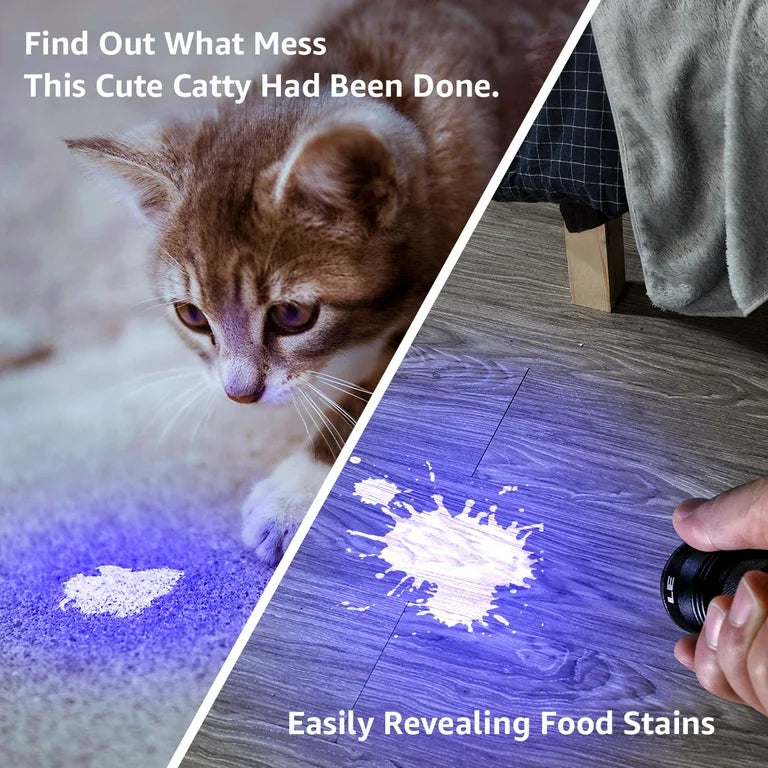
When cat urine dries, it breaks down into several components, including urea, uric acid, and proteins. The specific culprit behind the neon-yellow glow under UV light is phosphorus. As the organic matter in the urine decomposes, it creates crystalline salts. When hit with the specific wavelength of a UV light (usually between 365nm to 395nm), these elements absorb the energy and re-emit it as visible light.
The Problem with "Old" Stains
Unlike other biological fluids, cat urine becomes more detectable as it ages. Uric acid crystals are incredibly hardy. Even if you think you’ve cleaned a spot with standard soap, those crystals remain embedded in the carpet fibers, waiting for a humid day to release that pungent ammonia smell. The UV light doesn't just show you fresh accidents; it reveals the "fossilized" remains of accidents from years ago.
2. Choosing Your Gear: 365nm vs. 395nm
Not all UV flashlights are created equal. If you’ve ever bought a cheap "blacklight" at a party store and found it useless for pet stains, it’s because of the wavelength.
-
395nm Wavelength: Most affordable LED UV lights fall into this category. They emit a significant amount of visible purple light. While they can detect urine, the "glow" is often drowned out by the purple glare.
-
365nm Wavelength: This is the gold standard for pet owners. These lights emit less visible light and more "true" UV. This makes the urine stains pop with a high-contrast neon green or yellow against a dark background.
Pro-Tip: Look for a light with a black filter lens. This filters out the non-UV visible light, making your search much more effective even if the room isn't pitch black.
3. The Great House Hunt: How to Conduct a UV Audit
Ready to face the truth? Follow these steps for a successful "stain safari."
Step 1: Total Darkness
UV lights work best in high contrast. Close the blinds, turn off the hallway lights, and wait for nightfall. The darker the room, the more vivid the glow.
Step 2: The Vertical Search
A common mistake is only looking at the floor. Cats—especially unneutered males or stressed females—often "spray" to mark territory. This means you need to check:
-
Wall corners and baseboards.
-
The sides of the sofa.
-
Curtains and drapes at "cat height."
-
The area around the litter box (the "splash zone").
Step 3: Distinguishing Between Stains
Not everything that glows is urine. You might encounter "false positives," such as:
-
Cleaning products: Some detergents contain optical brighteners that glow bright blue/white.
-
Spilled drinks: Tonic water or certain sodas will glow.
-
Vomit: This will often have a different, chunkier texture and a duller glow compared to the crystalline shimmer of urine.
4. You Found a Spot: Now What? (The Cleaning Protocol)
Finding the stain is only half the battle. If you use a standard ammonia-based cleaner, you are actually inviting the cat back. Since urine contains ammonia, adding more ammonia-scented cleaner tells the cat, "This is a great place to pee!"
The Power of Enzymes
To truly remove the stain, you need an Enzymatic Cleaner. These cleaners contain specialized bacteria that "eat" the uric acid crystals.
-
Blot, Don't Rub: If the stain is fresh, soak up as much as possible with paper towels.
-
Saturate the Area: Urine travels downward in a "pyramid" shape. If the surface stain is 3 inches wide, the soak in the carpet pad might be 6 inches wide. Pour the enzymatic cleaner liberally.
-
The Plastic Wrap Trick: For old, stubborn stains, cover the wet area with plastic wrap. This prevents the cleaner from evaporating too quickly, giving the enzymes more time to break down the crystals.
-
Re-Check with UV: Once the area is dry, go back in with your UV light. If the glow is gone, the crystals are gone.
5. Beyond Cleaning: Understanding the "Why"
If your UV light revealed a house full of hidden spots, it’s time to look at the "why." Cats are clean animals by nature. If they are avoiding the litter box, it’s usually for one of three reasons:
-
Medical Issues: Urinary tract infections (UTIs) or bladder stones make urinating painful. The cat associates the litter box with pain and tries other spots.
-
Litter Box Hygiene: Is the box clean enough? Do you have enough boxes (The rule is: Number of cats + 1)?
-
Environmental Stress: Changes in the home (a new baby, a new pet, or even a stray cat outside the window) can trigger territorial marking.
6. The Long-Term Benefits of UV Monitoring
Regularly "sweeping" your home with a UV light isn't just about cleanliness; it's about preventative health.
By catching an accidental "miss" early, you can clean it before the smell sets in and before the cat develops a habit of returning to that spot. It’s an essential part of a modern pet-parenting toolkit, ensuring your home remains a sanctuary rather than a source of stress.
Summary Table: UV Detection vs. Traditional Cleaning
| Feature | Traditional Sniff Test | UV Light Detection |
| Accuracy | Low (Smell lingers, location unknown) | High (Visual confirmation of location) |
| Old Stains | Hard to find if dried | Easily glows due to crystals |
| Wall/Vertical | Often missed | Easily spotted |
| Post-Cleaning | "Smells clean" but crystals remain | Proves if the organic matter is gone |