Introduction: Why Industrial UV Systems Are Becoming Smarter
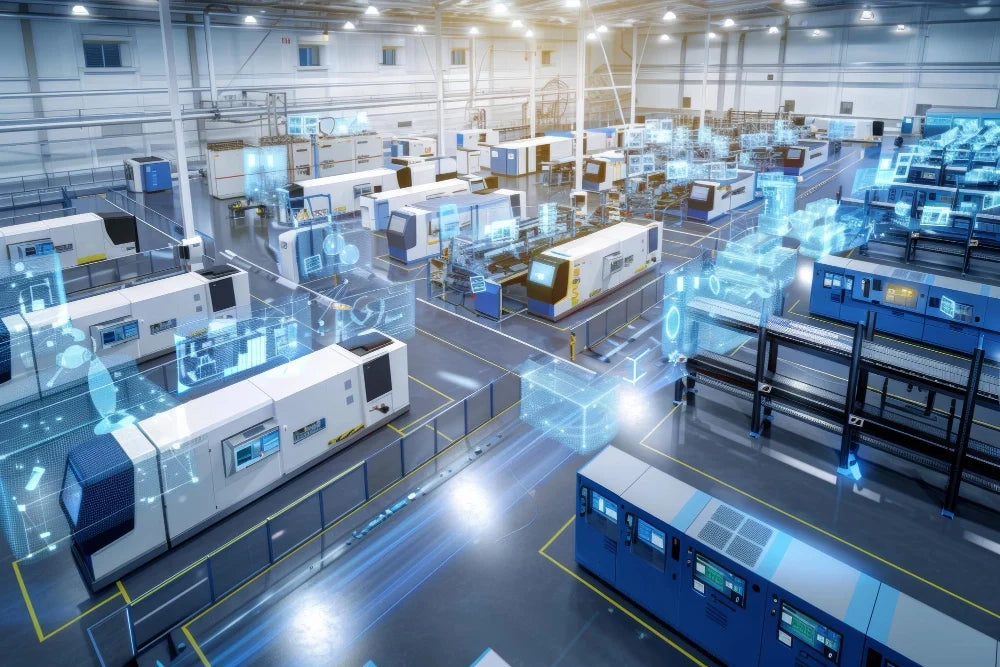
Modern manufacturing is moving toward a new generation of production environments where machines, sensors, controllers, software, and operators work together as one connected system. The traditional factory model, in which individual machines operate independently, is gradually being replaced by intelligent production lines capable of monitoring conditions, adjusting processes, and responding automatically to changing production requirements.
Industrial UV curing is an excellent example of this transformation.
UV curing technology is already widely used in applications such as coatings, adhesives, inks, electronics, printing, optical components, packaging, and advanced manufacturing. However, simply installing a UV lamp or UV LED curing unit is no longer enough for many modern production facilities. Manufacturers increasingly need a complete industrial UV control system capable of communicating with production equipment, responding to PLC commands, adjusting UV intensity, monitoring operating conditions, and maintaining consistent curing performance.
This is where PLC-integrated UV control systems with intelligent dimming become particularly valuable.
Instead of treating UV curing as an isolated process, an intelligent controller makes UV energy part of the overall automation architecture. The UV system can receive production signals, coordinate with conveyors and machines, adjust output according to production requirements, and provide operating feedback to the control system.
The result is a more coordinated, efficient, and controllable manufacturing process.
For factories pursuing automation, digital production, energy efficiency, and higher process consistency, an intelligent industrial UV control system is becoming less of an optional upgrade and more of a practical component of a modern production line.
What Is an Industrial UV Control System?
An industrial UV control system is the electronic and software-based control architecture used to manage UV curing equipment in a production environment.
Depending on the application, the system may control:
- UV LED curing power
- UV lamp output
- Intensity levels
- Exposure timing
- Cooling systems
- Conveyor synchronization
- Production start and stop signals
- Fault alarms
- Temperature monitoring
- Interlock functions
- Communication with PLCs
- Machine status feedback
A basic UV curing system may simply have an on/off switch.
A modern industrial UV control system goes much further.
It can become part of a larger automated production network.
For example, a production PLC may send a signal indicating that a workpiece has entered the curing area. The UV controller can then activate the curing source at a predefined intensity. Once the workpiece leaves the curing zone, the controller can reduce or stop UV output.
This type of coordination eliminates unnecessary manual operation and allows the UV process to respond directly to production conditions.
Why PLC Integration Matters in Modern Manufacturing
A Programmable Logic Controller, commonly known as a PLC, is one of the fundamental control components in industrial automation.
PLCs are widely used to coordinate machines, sensors, conveyors, motors, actuators, safety systems, and production processes.
When an industrial UV system can communicate with a PLC, UV curing becomes integrated into the production workflow instead of functioning as an independent device.
This provides several important advantages.
Coordinated Production
Imagine an automated production line manufacturing components that require UV adhesive curing.
Without PLC integration, operators may need to manually activate the UV curing equipment.
This creates several potential problems:
- Inconsistent timing
- Human error
- Unnecessary UV exposure
- Unstable production cycles
- Difficulty coordinating multiple machines
With PLC integration, the production controller can determine when the UV system should operate.
The curing process becomes synchronized with the rest of the line.
Typical PLC-to-UV Control Logic
A basic automated sequence might look like this:
Production start → Workpiece detected → PLC sends UV enable signal → UV system reaches target output → Curing process begins → Workpiece exits curing zone → PLC sends stop or standby command
This simple sequence can become significantly more sophisticated in an advanced factory.
For example, the PLC may monitor conveyor speed and production status while the UV controller independently manages output intensity and system protection.
This creates a division of responsibilities.
The PLC coordinates the overall production process.
The UV controller manages the technical operation of the UV source.
Together, they create a more reliable automation architecture.
Intelligent Dimming: More Than Simple Power Reduction
One of the most important features of a modern UV control system is intelligent dimming.
Traditional UV systems may operate primarily at fixed output levels. When the curing process requires less energy, the operator may simply turn the system off or reduce output manually.
Intelligent dimming introduces a much more flexible approach.
Instead of treating UV power as simply “on” or “off,” the system can operate across a defined range of output levels.
For UV LED systems, this can allow manufacturers to adjust curing intensity according to:
- Product type
- Coating thickness
- Adhesive characteristics
- Conveyor speed
- Material sensitivity
- Production requirements
- Process recipes
The UV output can therefore become a controllable production parameter.
Why Intelligent Dimming Improves Production Efficiency
Consider a production line that does not require maximum UV output continuously.
Running the UV source at full power throughout the entire production cycle may provide no additional benefit once the required curing energy has already been achieved.
An intelligent dimming system can reduce output when maximum intensity is unnecessary.
This can provide several benefits.
Reduced Energy Consumption
Lower output during suitable production stages can reduce energy demand.
Reduced Thermal Load
UV LED systems generate less heat than many traditional UV technologies, but thermal management remains important. Lower operating output can reduce heat generation in appropriate applications.
Longer Component Life
Operating equipment under optimized conditions can potentially reduce unnecessary stress on system components.
Better Process Control
Instead of using a single fixed UV output, manufacturers can create different operating profiles for different products.
UV Intensity and Production Speed
One of the most important relationships in industrial UV curing is the connection between UV intensity, exposure time, and the required curing dose.
In simplified terms, UV energy delivered to a surface depends on the intensity of the UV source and the amount of time the material is exposed.
A useful conceptual relationship is:
UV Dose = UV Intensity × Exposure Time
This means that changing conveyor speed can directly influence the available curing time.
If the conveyor becomes faster, exposure time may decrease.
The UV process may therefore require appropriate adjustment to maintain the desired curing result.
An intelligent UV control system can help manufacturers manage this relationship more effectively.
Instead of relying entirely on manual adjustment, the controller can be integrated with production signals or process recipes.
Connecting Conveyor Speed With UV Output
Consider two production modes.
Production Mode A
The conveyor operates at a relatively slow speed.
The product spends more time under the UV source.
In this case, the system may not require maximum output.
Production Mode B
The conveyor operates at a higher speed.
The exposure period becomes shorter.
The UV system may need to operate at a higher intensity to achieve the required process result.
A programmable control architecture can accommodate these different operating conditions.
This is especially useful in factories that manufacture multiple products on the same production line.
Recipe-Based UV Curing
One of the most useful features of an intelligent UV control system is the ability to create different process recipes.
For example, a manufacturer may produce three different products:
Product A
- Lower UV intensity
- Longer exposure
- Lower conveyor speed
Product B
- Medium UV intensity
- Medium exposure
- Standard conveyor speed
Product C
- Higher UV intensity
- Shorter exposure
- Higher conveyor speed
Instead of manually adjusting the equipment every time the product changes, the production system can select the appropriate recipe.
This reduces setup time and helps minimize operator errors.
The Importance of Stable UV Output
Consistency is one of the most important requirements in industrial curing.
A process may appear successful when a single product is tested manually. However, maintaining the same result across thousands or millions of production cycles is a much greater challenge.
Small variations in UV output can potentially affect curing quality.
Depending on the application, insufficient UV exposure may contribute to:
- Incomplete curing
- Reduced adhesion
- Surface defects
- Reduced durability
- Inconsistent coating performance
Excessive exposure may also be undesirable for certain materials.
Therefore, the objective is not simply to produce “more UV.”
The objective is to deliver the appropriate and repeatable UV energy required by the process.
Intelligent Control and UV Process Repeatability
An advanced UV control system can contribute to repeatability by maintaining programmed operating parameters.
Instead of relying on an operator to estimate the correct setting, the controller can apply predefined values.
This approach creates a more standardized process.
For manufacturers operating multiple shifts, this can be particularly valuable.
Different operators may otherwise have different habits when adjusting equipment.
Automation reduces dependence on individual judgment.
The production process becomes more predictable.
Industrial Communication and System Architecture
A modern UV controller should be designed with industrial integration in mind.
Depending on the specific equipment and automation architecture, communication may involve digital signals, analog signals, or industrial communication protocols.
Common control requirements may include:
- UV enable
- UV disable
- Power setting
- Fault output
- Ready status
- Alarm status
- Temperature status
- Emergency stop integration
- Remote control
- Production synchronization
The exact interface should always be selected according to the actual PLC and machine architecture.
Compatibility should be evaluated before installation rather than assumed based solely on connector type or marketing terminology.
Digital and Analog Control
Different factories have different automation architectures.
Some production systems rely heavily on digital I/O.
Others use analog signals for variable control.
For example, a digital signal may simply tell the UV system:
Run
or:
Stop
An analog control signal can instead represent a variable output level.
This allows the production controller to request different UV intensities.
The combination of digital commands and variable control can provide a more flexible system.
Feedback Is Just as Important as Control
A truly integrated system should not only receive commands.
It should also provide status information back to the production system.
This is known as feedback.
Useful feedback signals may include:
- System ready
- UV output active
- Fault detected
- Overtemperature condition
- Cooling fault
- Communication status
- Power abnormality
- Emergency shutdown
This creates a two-way relationship between the UV system and the factory automation system.
The PLC can then make decisions based on actual equipment status.
For example, if the UV controller reports a critical fault, the PLC may stop the production line to prevent defective products from continuing through the process.
Safety: Why Industrial UV Control Requires More Than Automation
Automation and safety must work together.
UV radiation can present hazards to skin and eyes depending on wavelength, intensity, exposure duration, and equipment configuration.
Therefore, industrial UV equipment should be designed and operated with appropriate engineering controls, guarding, interlocks, warning systems, and operating procedures.
A PLC connection should never be treated as a substitute for dedicated safety measures.
A robust system may include:
- Physical shielding
- Access-door interlocks
- Emergency stop integration
- UV status indicators
- Fault detection
- Cooling protection
- Appropriate personal protective equipment
- Controlled maintenance procedures
The exact safety architecture should be determined according to the equipment design, installation environment, applicable regulations, and risk assessment.
Smart Dimming and Standby Operation
One particularly useful function is automatic standby operation.
When the production line pauses, the UV system does not necessarily need to continue operating at full output.
An intelligent controller can place the UV source into an appropriate standby state.
When production resumes, the system can return to the required operating condition.
This can reduce unnecessary energy consumption and operating time.
For factories with frequent pauses, product changes, or variable production schedules, this feature can become especially valuable.
UV Control for Multiple Production Zones
Large production lines may require more than one UV curing zone.
For example, a manufacturing system could have:
- Pre-curing
- Intermediate curing
- Final curing
Each zone may require different UV characteristics.
An advanced control architecture can manage these zones independently while allowing the PLC to coordinate the overall process.
This provides greater flexibility than operating every UV source at the same setting.
Independent Zone Control
Independent control allows manufacturers to optimize each curing stage.
For example:
Zone 1: Lower intensity for initial stabilization
Zone 2: Higher intensity for deeper curing
Zone 3: Final exposure for completing the process
The exact configuration depends entirely on the material and application.
However, the concept demonstrates why programmable UV control can be more effective than a simple fixed-output system.
Intelligent UV Control and Product Changeovers
Product changeovers are an important issue in modern manufacturing.
Every minute spent changing production parameters can reduce overall productivity.
A programmable UV system can simplify changeovers by allowing different products to use predefined operating parameters.
Instead of manually adjusting:
- UV intensity
- Exposure timing
- Conveyor settings
- Cooling parameters
operators can select an appropriate production recipe.
This can make the transition between products faster and more repeatable.
Reducing Human Error
Human operators remain essential in modern factories, but automation can reduce repetitive adjustment tasks.
For example, manually entering a UV intensity value for every production batch introduces opportunities for error.
A recipe-based system can store predefined parameters.
Operators then select the correct product configuration rather than rebuilding the process every time.
This does not eliminate the need for human supervision.
Instead, it allows people to focus on higher-value production tasks.
Data and Traceability
Smart factories increasingly depend on production data.
A modern UV control system can potentially become part of a larger data architecture.
Depending on system design, useful information may include:
- Operating time
- UV output setting
- Alarm history
- Production cycles
- Temperature information
- Maintenance records
- Equipment status
This information can help manufacturers understand how the UV system is being used.
It can also support preventive maintenance and process troubleshooting.
Predictive Maintenance for UV Equipment
Maintenance is another area where intelligent control can provide value.
Instead of waiting for a component to fail, manufacturers can monitor operating conditions and maintenance intervals.
For example, abnormal temperature behavior or repeated cooling alarms could indicate that a UV system requires inspection.
Similarly, unusual changes in operating performance may justify checking:
- Cooling systems
- Optical components
- LED modules
- Electrical connections
- Ventilation
- Control interfaces
Early detection can help reduce unexpected production interruptions.
Industrial UV LED Systems and Intelligent Control
UV LED technology has become increasingly important in industrial curing because it offers characteristics that can be highly compatible with automated production.
Compared with many traditional UV lamp technologies, UV LEDs can provide:
- Instant or near-instant switching
- Digital controllability
- Adjustable output
- Long operating life
- Lower maintenance requirements in suitable applications
- Reduced heat transfer to the workpiece in many configurations
These characteristics make UV LED curing particularly suitable for programmable production environments.
The ability to switch and modulate output quickly is especially valuable when UV exposure needs to follow production events.
Why Instant Switching Matters
Traditional curing technologies may require warm-up or cool-down periods.
UV LED systems can generally respond much faster to control commands.
This means the UV source can be synchronized more closely with production movement.
For example:
No product → reduced output or standby
Product detected → curing output activated
Product leaves zone → output reduced
This approach can reduce unnecessary operation.
The Relationship Between UV Control and Energy Efficiency
Energy efficiency should not be viewed simply as reducing power.
A production process needs enough energy to achieve the required result.
The smarter approach is to deliver the necessary energy where and when it is needed.
Intelligent dimming supports this philosophy.
Rather than running every UV source continuously at maximum output, manufacturers can configure operation according to production requirements.
This can help reduce wasted energy while maintaining process performance.
Designing a Smart UV Control System for a Factory
When selecting an industrial UV control system, manufacturers should evaluate more than maximum UV power.
Important considerations include:
1. PLC Compatibility
Determine how the UV system will communicate with the existing PLC.
2. Control Resolution
Evaluate how precisely UV output can be adjusted.
3. Response Time
Consider how quickly the system responds to production commands.
4. Feedback Capability
Determine what operating information the controller can return.
5. Safety Integration
Review interlocks, emergency stop functions, alarms, and protective features.
6. Cooling Management
Ensure the controller can monitor and protect the UV source under expected operating conditions.
7. Recipe Management
For multi-product factories, programmable operating profiles can provide significant advantages.
8. Maintenance Accessibility
A smart system should still be practical to inspect, service, and troubleshoot.
Avoiding Over-Engineering
Smart does not necessarily mean complicated.
An industrial UV control system should provide the functions the factory actually needs.
For a simple production line, a straightforward PLC interface with adjustable power and status feedback may be sufficient.
For a highly automated facility, more advanced capabilities may be appropriate.
The best system is not necessarily the one with the most features.
It is the one that integrates effectively with the production process.
A Practical Example: Automated UV Adhesive Curing
Consider an electronics assembly line using UV-curable adhesive.
A component enters the curing station on an automated conveyor.
A sensor detects the component.
The PLC verifies that the production sequence is correct.
The PLC sends an enable command to the UV controller.
The UV system activates at the programmed intensity.
The conveyor continues moving at a defined speed.
The UV controller maintains the requested output throughout the curing zone.
Once the component exits, the system returns to standby.
If a cooling fault occurs, the UV controller sends a fault signal to the PLC.
The PLC then pauses production and alerts the operator.
This example demonstrates the value of integrating UV curing into the broader automation system.
The UV process becomes one controlled part of the manufacturing workflow rather than an independent machine.
The Future of Industrial UV Control
The next generation of manufacturing will continue to move toward connected, adaptive, and data-driven production systems.
UV curing technology will follow the same direction.
Future industrial UV systems are likely to place greater emphasis on:
- Intelligent power management
- Real-time monitoring
- Automated recipes
- Condition monitoring
- Advanced communication
- Production data integration
- Automated fault diagnosis
- Energy optimization
The long-term objective is not simply to make UV equipment more powerful.
It is to make UV curing more predictable, controllable, and integrated.
Why PLC Integration and Intelligent Dimming Are Becoming Standard Features
The modern factory is built around coordination.
Conveyors communicate with sensors.
Sensors communicate with controllers.
Controllers communicate with machines.
Production data flows between different systems.
In this environment, an isolated UV curing device creates an unnecessary gap in the automation chain.
PLC integration closes that gap.
Intelligent dimming adds another layer of flexibility by allowing UV output to respond to actual production requirements.
Together, these capabilities can help manufacturers achieve:
- More consistent curing
- Better production synchronization
- Reduced manual intervention
- More flexible product changeovers
- Potentially lower energy consumption
- Improved equipment monitoring
- Better process traceability
These benefits explain why intelligent UV control systems are increasingly relevant to modern industrial manufacturing.
Conclusion: Turning UV Curing Into an Intelligent Production Process
Industrial UV curing has evolved far beyond simply turning a lamp on and exposing a product to ultraviolet energy.
Today's manufacturers need curing equipment that can communicate, respond, adapt, and integrate.
A PLC-integrated industrial UV control system with intelligent dimming provides the foundation for this approach.
PLC connectivity allows the UV system to become part of the automated production line.
Intelligent dimming allows UV output to be adjusted according to process requirements.
Feedback functions provide greater visibility into equipment status.
Recipe-based operation simplifies product changes.
Monitoring and alarms can support safer and more reliable operation.
When these capabilities are combined with appropriate UV source selection, thermal management, process validation, and safety engineering, UV curing can become a highly controlled part of a smart manufacturing environment.
For factories looking to modernize their production lines, the key question is no longer simply, “How powerful is the UV system?”
A more useful question is:
“How intelligently can the UV system communicate with and respond to the production process?”
That shift in thinking is at the heart of smart industrial UV curing.
As manufacturing continues toward greater automation, flexibility, energy awareness, and process consistency, UV control systems designed for PLC integration and intelligent dimming will play an increasingly important role in building efficient, connected production lines.